# Model Context Protocol
Source: https://modelcontextprotocol.io/about/index
The open protocol that connects AI applications to the systems where context lives
Connect your AI applications to the world
AI-enabled tools are powerful, but they're often limited to the
information you manually provide or require bespoke integrations.
Whether it's reading files from your computer, searching through an
internal or external knowledge base, or updating tasks in an project
management tool, MCP provides a secure, standardized, *simple* way
to give AI systems the context they need.
How it works
1 Choose MCP servers
Pick from pre-built servers for popular tools like GitHub, Google
Drive, Slack and hundreds of others. Combine multiple servers for
complete workflows, or easily build your own for custom
integrations.
2 Connect your AI application
Configure your AI application (like Claude, VS Code, or ChatGPT)
to connect to your MCP servers. The application can now see
available tools, resources and prompts from all connected servers.
3 Work with context
Your AI-powered application can now access real data, execute
actions, and provide more helpful responses based on your actual
context.
# Example Clients
Source: https://modelcontextprotocol.io/clients
A list of applications that support MCP integrations
This page provides an overview of applications that support the Model Context Protocol (MCP). Each client may support different MCP features, allowing for varying levels of integration with MCP servers.
## Feature support matrix
## Client details
### 5ire
[5ire](https://github.com/nanbingxyz/5ire) is an open source cross-platform desktop AI assistant that supports tools through MCP servers.
**Key features:**
* Built-in MCP servers can be quickly enabled and disabled.
* Users can add more servers by modifying the configuration file.
* It is open-source and user-friendly, suitable for beginners.
* Future support for MCP will be continuously improved.
### AgentAI
[AgentAI](https://github.com/AdamStrojek/rust-agentai) is a Rust library designed to simplify the creation of AI agents. The library includes seamless integration with MCP Servers.
[Example of MCP Server integration](https://github.com/AdamStrojek/rust-agentai/blob/master/examples/tools_mcp.rs)
**Key features:**
* Multi-LLM – We support most LLM APIs (OpenAI, Anthropic, Gemini, Ollama, and all OpenAI API Compatible).
* Built-in support for MCP Servers.
* Create agentic flows in a type- and memory-safe language like Rust.
### AgenticFlow
[AgenticFlow](https://agenticflow.ai/) is a no-code AI platform that helps you build agents that handle sales, marketing, and creative tasks around the clock. Connect 2,500+ APIs and 10,000+ tools securely via MCP.
**Key features:**
* No-code AI agent creation and workflow building.
* Access a vast library of 10,000+ tools and 2,500+ APIs through MCP.
* Simple 3-step process to connect MCP servers.
* Securely manage connections and revoke access anytime.
**Learn more:**
* [AgenticFlow MCP Integration](https://agenticflow.ai/mcp)
### AIQL TUUI
[AIQL TUUI] is a native, cross-platform desktop AI chat application with MCP support. It supports multiple AI providers (e.g., Anthropic, Cloudflare, Deepseek, OpenAI, Qwen), local AI models (via vLLM, Ray, etc.), and aggregated API platforms (such as Deepinfra, Openrouter, and more).
**Key features:**
* **Dynamic LLM API & Agent Switching**: Seamlessly toggle between different LLM APIs and agents on the fly.
* **Comprehensive Capabilities Support**: Built-in support for tools, prompts, resources, and sampling methods.
* **Configurable Agents**: Enhanced flexibility with selectable and customizable tools via agent settings.
* **Advanced Sampling Control**: Modify sampling parameters and leverage multi-round sampling for optimal results.
* **Cross-Platform Compatibility**: Fully compatible with macOS, Windows, and Linux.
* **Free & Open-Source (FOSS)**: Permissive licensing allows modifications and custom app bundling.
**Learn more:**
* [TUUI document](https://www.tuui.com/)
* [AIQL GitHub repository](https://github.com/AI-QL)
### Amazon Q CLI
[Amazon Q CLI](https://github.com/aws/amazon-q-developer-cli) is an open-source, agentic coding assistant for terminals.
**Key features:**
* Full support for MCP servers.
* Edit prompts using your preferred text editor.
* Access saved prompts instantly with `@`.
* Control and organize AWS resources directly from your terminal.
* Tools, profiles, context management, auto-compact, and so much more!
**Get Started**
```bash
brew install amazon-q
```
### Amazon Q IDE
[Amazon Q IDE](https://aws.amazon.com/q/developer) is an open-source, agentic coding assistant for IDEs.
**Key features:**
* Support for the VSCode, JetBrains, Visual Studio, and Eclipse IDEs.
* Control and organize AWS resources directly from your IDE.
* Manage permissions for each MCP tool via the IDE user interface.
### Apify MCP Tester
[Apify MCP Tester](https://github.com/apify/tester-mcp-client) is an open-source client that connects to any MCP server using Server-Sent Events (SSE).
It is a standalone Apify Actor designed for testing MCP servers over SSE, with support for Authorization headers.
It uses plain JavaScript (old-school style) and is hosted on Apify, allowing you to run it without any setup.
**Key features:**
* Connects to any MCP server via SSE.
* Works with the [Apify MCP Server](https://apify.com/apify/actors-mcp-server) to interact with one or more Apify [Actors](https://apify.com/store).
* Dynamically utilizes tools based on context and user queries (if supported by the server).
### Amp
[Amp](https://ampcode.com) is an agentic coding tool built by Sourcegraph. It runs in VS Code (and compatible forks like Cursor, Windsurf, and VSCodium) and as a command-line tool. It’s also multiplayer — you can share threads and collaborate with your team.
**Key features:**
* Granular control over enabled tools and permissions
* Support for MCP servers defined in VS Code `mcp.json`
### Augment Code
[Augment Code](https://augmentcode.com) is an AI-powered coding platform for VS Code and JetBrains with autonomous agents, chat, and completions. Both local and remote agents are backed by full codebase awareness and native support for MCP, enabling enhanced context through external sources and tools.
**Key features:**
* Full MCP support in local and remote agents.
* Add additional context through MCP servers.
* Automate your development workflows with MCP tools.
* Works in VS Code and JetBrains IDEs.
### BeeAI Framework
[BeeAI Framework](https://i-am-bee.github.io/beeai-framework) is an open-source framework for building, deploying, and serving powerful agentic workflows at scale. The framework includes the **MCP Tool**, a native feature that simplifies the integration of MCP servers into agentic workflows.
**Key features:**
* Seamlessly incorporate MCP tools into agentic workflows.
* Quickly instantiate framework-native tools from connected MCP client(s).
* Planned future support for agentic MCP capabilities.
**Learn more:**
* [Example of using MCP tools in agentic workflow](https://i-am-bee.github.io/beeai-framework/#/typescript/tools?id=using-the-mcptool-class)
### BoltAI
[BoltAI](https://boltai.com) is a native, all-in-one AI chat client with MCP support. BoltAI supports multiple AI providers (OpenAI, Anthropic, Google AI...), including local AI models (via Ollama, LM Studio or LMX)
**Key features:**
* MCP Tool integrations: once configured, user can enable individual MCP server in each chat
* MCP quick setup: import configuration from Claude Desktop app or Cursor editor
* Invoke MCP tools inside any app with AI Command feature
* Integrate with remote MCP servers in the mobile app
**Learn more:**
* [BoltAI docs](https://boltai.com/docs/plugins/mcp-servers)
* [BoltAI website](https://boltai.com)
### Call Chirp
[Call Chirp] [https://www.call-chirp.com](https://www.call-chirp.com) uses AI to capture every critical detail from your business conversations, automatically syncing insights to your CRM and project tools so you never miss another deal-closing moment.
**Key features:**
* Save transcriptions from Zoom, Google Meet, and more
* MCP Tools for voice AI agents
* Remote MCP servers support
### ChatGPT
ChatGPT is OpenAI's AI assistant that provides MCP support for remote servers to conduct deep research.
**Key features:**
* Support for MCP via connections UI in settings
* Access to search tools from configured MCP servers for deep research
* Enterprise-grade security and compliance features
### ChatWise
ChatWise is a desktop-optimized, high-performance chat application that lets you bring your own API keys. It supports a wide range of LLMs and integrates with MCP to enable tool workflows.
**Key features:**
* Tools support for MCP servers
* Offer built-in tools like web search, artifacts and image generation.
### Claude Code
Claude Code is an interactive agentic coding tool from Anthropic that helps you code faster through natural language commands. It supports MCP integration for resources, prompts, tools, and roots, and also functions as an MCP server to integrate with other clients.
**Key features:**
* Full support for resources, prompts, tools, and roots from MCP servers
* Offers its own tools through an MCP server for integrating with other MCP clients
### Claude.ai
[Claude.ai](https://claude.ai) is Anthropic's web-based AI assistant that provides MCP support for remote servers.
**Key features:**
* Support for remote MCP servers via integrations UI in settings
* Access to tools, prompts, and resources from configured MCP servers
* Seamless integration with Claude's conversational interface
* Enterprise-grade security and compliance features
### Claude Desktop App
The Claude desktop application provides comprehensive support for MCP, enabling deep integration with local tools and data sources.
**Key features:**
* Full support for resources, allowing attachment of local files and data
* Support for prompt templates
* Tool integration for executing commands and scripts
* Local server connections for enhanced privacy and security
### Chorus
[Chorus](https://chorus.sh) is a native Mac app for chatting with AIs. Chat with multiple models at once, run tools and MCPs, create projects, quick chat, bring your own key, all in a blazing fast, keyboard shortcut friendly app.
**Key features:**
* MCP support with one-click install
* Built in tools, like web search, terminal, and image generation
* Chat with multiple models at once (cloud or local)
* Create projects with scoped memory
* Quick chat with an AI that can see your screen
### Cline
[Cline](https://github.com/cline/cline) is an autonomous coding agent in VS Code that edits files, runs commands, uses a browser, and more–with your permission at each step.
**Key features:**
* Create and add tools through natural language (e.g. "add a tool that searches the web")
* Share custom MCP servers Cline creates with others via the `~/Documents/Cline/MCP` directory
* Displays configured MCP servers along with their tools, resources, and any error logs
### CodeGPT
[CodeGPT](https://codegpt.co) is a popular VS Code and Jetbrains extension that brings AI-powered coding assistance to your editor. It supports integration with MCP servers for tools, allowing users to leverage external AI capabilities directly within their development workflow.
**Key features:**
* Use MCP tools from any configured MCP server
* Seamless integration with VS Code and Jetbrains UI
* Supports multiple LLM providers and custom endpoints
**Learn more:**
* [CodeGPT Documentation](https://docs.codegpt.co/)
### Continue
[Continue](https://github.com/continuedev/continue) is an open-source AI code assistant, with built-in support for all MCP features.
**Key features:**
* Type "@" to mention MCP resources
* Prompt templates surface as slash commands
* Use both built-in and MCP tools directly in chat
* Supports VS Code and JetBrains IDEs, with any LLM
### Copilot-MCP
[Copilot-MCP](https://github.com/VikashLoomba/copilot-mcp) enables AI coding assistance via MCP.
**Key features:**
* Support for MCP tools and resources
* Integration with development workflows
* Extensible AI capabilities
### Cursor
[Cursor](https://docs.cursor.com/advanced/model-context-protocol) is an AI code editor.
**Key features:**
* Support for MCP tools in Cursor Composer
* Support for both STDIO and SSE
### Daydreams
[Daydreams](https://github.com/daydreamsai/daydreams) is a generative agent framework for executing anything onchain
**Key features:**
* Supports MCP Servers in config
* Exposes MCP Client
### Emacs Mcp
[Emacs Mcp](https://github.com/lizqwerscott/mcp.el) is an Emacs client designed to interface with MCP servers, enabling seamless connections and interactions. It provides MCP tool invocation support for AI plugins like [gptel](https://github.com/karthink/gptel) and [llm](https://github.com/ahyatt/llm), adhering to Emacs' standard tool invocation format. This integration enhances the functionality of AI tools within the Emacs ecosystem.
**Key features:**
* Provides MCP tool support for Emacs.
### fast-agent
[fast-agent](https://github.com/evalstate/fast-agent) is a Python Agent framework, with simple declarative support for creating Agents and Workflows, with full multi-modal support for Anthropic and OpenAI models.
**Key features:**
* PDF and Image support, based on MCP Native types
* Interactive front-end to develop and diagnose Agent applications, including passthrough and playback simulators
* Built in support for "Building Effective Agents" workflows.
* Deploy Agents as MCP Servers
### FlowDown
[FlowDown](https://github.com/Lakr233/FlowDown) is a blazing fast and smooth client app for using AI/LLM, with a strong emphasis on privacy and user experience. It supports MCP servers to extend its capabilities with external tools, allowing users to build powerful, customized workflows.
**Key features:**
* **Seamless MCP Integration**: Easily connect to MCP servers to utilize a wide range of external tools.
* **Privacy-First Design**: Your data stays on your device. We don't collect any user data, ensuring complete privacy.
* **Lightweight & Efficient**: A compact and optimized design ensures a smooth and responsive experience with any AI model.
* **Broad Compatibility**: Works with all OpenAI-compatible service providers and supports local offline models through MLX.
* **Rich User Experience**: Features beautifully formatted Markdown, blazing-fast text rendering, and intelligent, automated chat titling.
**Learn more:**
* [FlowDown website](https://flowdown.ai/)
* [FlowDown documentation](https://apps.qaq.wiki/docs/flowdown/)
### FLUJO
Think n8n + ChatGPT. FLUJO is an desktop application that integrates with MCP to provide a workflow-builder interface for AI interactions. Built with Next.js and React, it supports both online and offline (ollama) models, it manages API Keys and environment variables centrally and can install MCP Servers from GitHub. FLUJO has an ChatCompletions endpoint and flows can be executed from other AI applications like Cline, Roo or Claude.
**Key features:**
* Environment & API Key Management
* Model Management
* MCP Server Integration
* Workflow Orchestration
* Chat Interface
### Genkit
[Genkit](https://github.com/firebase/genkit) is a cross-language SDK for building and integrating GenAI features into applications. The [genkitx-mcp](https://github.com/firebase/genkit/tree/main/js/plugins/mcp) plugin enables consuming MCP servers as a client or creating MCP servers from Genkit tools and prompts.
**Key features:**
* Client support for tools and prompts (resources partially supported)
* Rich discovery with support in Genkit's Dev UI playground
* Seamless interoperability with Genkit's existing tools and prompts
* Works across a wide variety of GenAI models from top providers
### Glama
[Glama](https://glama.ai/chat) is a comprehensive AI workspace and integration platform that offers a unified interface to leading LLM providers, including OpenAI, Anthropic, and others. It supports the Model Context Protocol (MCP) ecosystem, enabling developers and enterprises to easily discover, build, and manage MCP servers.
**Key features:**
* Integrated [MCP Server Directory](https://glama.ai/mcp/servers)
* Integrated [MCP Tool Directory](https://glama.ai/mcp/tools)
* Host MCP servers and access them via the Chat or SSE endpoints
– Ability to chat with multiple LLMs and MCP servers at once
* Upload and analyze local files and data
* Full-text search across all your chats and data
### GenAIScript
Programmatically assemble prompts for LLMs using [GenAIScript](https://microsoft.github.io/genaiscript/) (in JavaScript). Orchestrate LLMs, tools, and data in JavaScript.
**Key features:**
* JavaScript toolbox to work with prompts
* Abstraction to make it easy and productive
* Seamless Visual Studio Code integration
### Goose
[Goose](https://github.com/block/goose) is an open source AI agent that supercharges your software development by automating coding tasks.
**Key features:**
* Expose MCP functionality to Goose through tools.
* MCPs can be installed directly via the [extensions directory](https://block.github.io/goose/v1/extensions/), CLI, or UI.
* Goose allows you to extend its functionality by [building your own MCP servers](https://block.github.io/goose/docs/tutorials/custom-extensions).
* Includes built-in tools for development, web scraping, automation, memory, and integrations with JetBrains and Google Drive.
### GitHub Copilot coding agent
Delegate tasks to [GitHub Copilot coding agent](https://docs.github.com/en/copilot/concepts/about-copilot-coding-agent) and let it work in the background while you stay focused on the highest-impact and most interesting work
**Key features:**
* Delegate tasks to Copilot from GitHub Issues, Visual Studio Code, GitHub Copilot Chat or from your favorite MCP host using the GitHub MCP Server
* Tailor Copilot to your project by [customizing the agent's development environment](https://docs.github.com/en/enterprise-cloud@latest/copilot/how-tos/agents/copilot-coding-agent/customizing-the-development-environment-for-copilot-coding-agent#preinstalling-tools-or-dependencies-in-copilots-environment) or [writing custom instructions](https://docs.github.com/en/enterprise-cloud@latest/copilot/how-tos/agents/copilot-coding-agent/best-practices-for-using-copilot-to-work-on-tasks#adding-custom-instructions-to-your-repository)
* [Augment Copilot's context and capabilities with MCP tools](https://docs.github.com/en/enterprise-cloud@latest/copilot/how-tos/agents/copilot-coding-agent/extending-copilot-coding-agent-with-mcp), with support for both local and remote MCP servers
### gptme
[gptme](https://github.com/gptme/gptme) is a open-source terminal-based personal AI assistant/agent, designed to assist with programming tasks and general knowledge work.
**Key features:**
* CLI-first design with a focus on simplicity and ease of use
* Rich set of built-in tools for shell commands, Python execution, file operations, and web browsing
* Local-first approach with support for multiple LLM providers
* Open-source, built to be extensible and easy to modify
### HyperAgent
[HyperAgent](https://github.com/hyperbrowserai/HyperAgent) is Playwright supercharged with AI. With HyperAgent, you no longer need brittle scripts, just powerful natural language commands. Using MCP servers, you can extend the capability of HyperAgent, without having to write any code.
**Key features:**
* AI Commands: Simple APIs like page.ai(), page.extract() and executeTask() for any AI automation
* Fallback to Regular Playwright: Use regular Playwright when AI isn't needed
* Stealth Mode – Avoid detection with built-in anti-bot patches
* Cloud Ready – Instantly scale to hundreds of sessions via [Hyperbrowser](https://www.hyperbrowser.ai/)
* MCP Client – Connect to tools like Composio for full workflows (e.g. writing web data to Google Sheets)
### JetBrains AI Assistant
[JetBrains AI Assistant](https://plugins.jetbrains.com/plugin/22282-jetbrains-ai-assistant) plugin provides AI-powered features for software development available in all JetBrains IDEs.
**Key features:**
* Unlimited code completion powered by Mellum, JetBrains’ proprietary AI model.
* Context-aware AI chat that understands your code and helps you in real time.
* Access to top-tier models from OpenAI, Anthropic, and Google.
* Offline mode with connected local LLMs via Ollama or LM Studio.
* Deep integration into IDE workflows, including code suggestions in the editor, VCS assistance, runtime error explanation, and more.
### Kilo Code
[Kilo Code](https://github.com/Kilo-Org/kilocode) is an autonomous coding AI dev team in VS Code that edits files, runs commands, uses a browser, and more.
**Key features:**
* Create and add tools through natural language (e.g. "add a tool that searches the web")
* Discover MCP servers via the MCP Marketplace
* One click MCP server installs via MCP Marketplace
* Displays configured MCP servers along with their tools, resources, and any error logs
### Klavis AI Slack/Discord/Web
[Klavis AI](https://www.klavis.ai/) is an Open-Source Infra to Use, Build & Scale MCPs with ease.
**Key features:**
* Slack/Discord/Web MCP clients for using MCPs directly
* Simple web UI dashboard for easy MCP configuration
* Direct OAuth integration with Slack & Discord Clients and MCP Servers for secure user authentication
* SSE transport support
* Open-source infrastructure ([GitHub repository](https://github.com/Klavis-AI/klavis))
**Learn more:**
* [Demo video showing MCP usage in Slack/Discord](https://youtu.be/9-QQAhrQWw8)
### Langflow
Langflow is an open-source visual builder that lets developers rapidly prototype and build AI applications, it integrates with the Model Context Protocol (MCP) as both an MCP server and an MCP client.
**Key features:**
* Full support for using MCP server tools to build agents and flows.
* Export agents and flows as MCP server
* Local & remote server connections for enhanced privacy and security
**Learn more:**
* [Demo video showing how to use Langflow as both an MCP client & server](https://www.youtube.com/watch?v=pEjsaVVPjdI)
### LibreChat
[LibreChat](https://github.com/danny-avila/LibreChat) is an open-source, customizable AI chat UI that supports multiple AI providers, now including MCP integration.
**Key features:**
* Extend current tool ecosystem, including [Code Interpreter](https://www.librechat.ai/docs/features/code_interpreter) and Image generation tools, through MCP servers
* Add tools to customizable [Agents](https://www.librechat.ai/docs/features/agents), using a variety of LLMs from top providers
* Open-source and self-hostable, with secure multi-user support
* Future roadmap includes expanded MCP feature support
### LM Studio
[LM Studio](https://lmstudio.ai) is a cross-platform desktop app for discovering, downloading, and running open-source LLMs locally. You can now connect local models to tools via Model Context Protocol (MCP).
**Key features:**
* Use MCP servers with local models on your computer. Add entries to `mcp.json` and save to get started.
* Tool confirmation UI: when a model calls a tool, you can confirm the call in the LM Studio app.
* Cross-platform: runs on macOS, Windows, and Linux, one-click installer with no need to fiddle in the command line
* Supports GGUF (llama.cpp) or MLX models with GPU acceleration
* GUI & terminal mode: use the LM Studio app or CLI (lms) for scripting and automation
**Learn more:**
* [Docs: Using MCP in LM Studio](https://lmstudio.ai/docs/app/plugins/mcp)
* [Create a 'Add to LM Studio' button for your server](https://lmstudio.ai/docs/app/plugins/mcp/deeplink)
* [Announcement blog: LM Studio + MCP](https://lmstudio.ai/blog/mcp)
### Lutra
[Lutra](https://lutra.ai) is an AI agent that transforms conversations into actionable, automated workflows.
**Key features:**
* Easy MCP Integration: Connecting Lutra to MCP servers is as simple as providing the server URL; Lutra handles the rest behind the scenes.
* Chat to Take Action: Lutra understands your conversational context and goals, automatically integrating with your existing apps to perform tasks.
* Reusable Playbooks: After completing a task, save the steps as reusable, automated workflows—simplifying repeatable processes and reducing manual effort.
* Shareable Automations: Easily share your saved playbooks with teammates to standardize best practices and accelerate collaborative workflows.
**Learn more:**
* [Lutra AI agent explained](https://www.youtube.com/watch?v=W5ZpN0cMY70)
### mcp-agent
[mcp-agent] is a simple, composable framework to build agents using Model Context Protocol.
**Key features:**
* Automatic connection management of MCP servers.
* Expose tools from multiple servers to an LLM.
* Implements every pattern defined in [Building Effective Agents](https://www.anthropic.com/research/building-effective-agents).
* Supports workflow pause/resume signals, such as waiting for human feedback.
### mcp-client-chatbot
[mcp-client-chatbot](https://github.com/cgoinglove/mcp-client-chatbot) is a local-first chatbot built with Vercel's Next.js, AI SDK, and Shadcn UI.
**Key features:**
* It supports standard MCP tool calling and includes both a custom MCP server and a standalone UI for testing MCP tools outside the chat flow.
* All MCP tools are provided to the LLM by default, but the project also includes an optional `@toolname` mention feature to make tool invocation more explicit—particularly useful when connecting to multiple MCP servers with many tools.
* Visual workflow builder that lets you create custom tools by chaining LLM nodes and MCP tools together. Published workflows become callable as `@workflow_name` tools in chat, enabling complex multi-step automation sequences.
### mcp-use
[mcp-use] is an open source python library to very easily connect any LLM to any MCP server both locally and remotely.
**Key features:**
* Very simple interface to connect any LLM to any MCP.
* Support the creation of custom agents, workflows.
* Supports connection to multiple MCP servers simultaneously.
* Supports all langchain supported models, also locally.
* Offers efficient tool orchestration and search functionalities.
### modelcontextchat.com
[modelcontextchat.com](https://modelcontextchat.com) is a web-based MCP client designed for working with remote MCP servers, featuring comprehensive authentication support and integration with OpenRouter.
**Key features:**
* Web-based interface for remote MCP server connections
* Header-based Authorization support for secure server access
* OAuth authentication integration
* OpenRouter API Key support for accessing various LLM providers
* No installation required - accessible from any web browser
### MCPHub
[MCPHub] is a powerful Neovim plugin that integrates MCP (Model Context Protocol) servers into your workflow.
**Key features:**
* Install, configure and manage MCP servers with an intuitive UI.
* Built-in Neovim MCP server with support for file operations (read, write, search, replace), command execution, terminal integration, LSP integration, buffers, and diagnostics.
* Create Lua-based MCP servers directly in Neovim.
* Inegrates with popular Neovim chat plugins Avante.nvim and CodeCompanion.nvim
### MCPOmni-Connect
[MCPOmni-Connect](https://github.com/Abiorh001/mcp_omni_connect) is a versatile command-line interface (CLI) client designed to connect to various Model Context Protocol (MCP) servers using both stdio and SSE transport.
**Key features:**
* Support for resources, prompts, tools, and sampling
* Agentic mode with ReAct and orchestrator capabilities
* Seamless integration with OpenAI models and other LLMs
* Dynamic tool and resource management across multiple servers
* Support for both stdio and SSE transport protocols
* Comprehensive tool orchestration and resource analysis capabilities
### Memex
[Memex](https://memex.tech/) is the first MCP client and MCP server builder - all-in-one desktop app. Unlike traditional MCP clients that only consume existing servers, Memex can create custom MCP servers from natural language prompts, immediately integrate them into its toolkit, and use them to solve problems—all within a single conversation.
**Key features:**
* **Prompt-to-MCP Server**: Generate fully functional MCP servers from natural language descriptions
* **Self-Testing & Debugging**: Autonomously test, debug, and improve created MCP servers
* **Universal MCP Client**: Works with any MCP server through intuitive, natural language integration
* **Curated MCP Directory**: Access to tested, one-click installable MCP servers (Neon, Netlify, GitHub, Context7, and more)
* **Multi-Server Orchestration**: Leverage multiple MCP servers simultaneously for complex workflows
**Learn more:**
* [Memex Launch 2: MCP Teams and Agent API](https://memex.tech/blog/memex-launch-2-mcp-teams-and-agent-api-private-preview-125f)
### Microsoft Copilot Studio
[Microsoft Copilot Studio] is a robust SaaS platform designed for building custom AI-driven applications and intelligent agents, empowering developers to create, deploy, and manage sophisticated AI solutions.
**Key features:**
* Support for MCP tools
* Extend Copilot Studio agents with MCP servers
* Leveraging Microsoft unified, governed, and secure API management solutions
### MindPal
[MindPal](https://mindpal.io) is a no-code platform for building and running AI agents and multi-agent workflows for business processes.
**Key features:**
* Build custom AI agents with no-code
* Connect any SSE MCP server to extend agent tools
* Create multi-agent workflows for complex business processes
* User-friendly for both technical and non-technical professionals
* Ongoing development with continuous improvement of MCP support
**Learn more:**
* [MindPal MCP Documentation](https://docs.mindpal.io/agent/mcp)
### MooPoint
[MooPoint](https://moopoint.io)
MooPoint is a web-based AI chat platform built for developers and advanced users, letting you interact with multiple large language models (LLMs) through a single, unified interface. Connect your own API keys (OpenAI, Anthropic, and more) and securely manage custom MCP server integrations.
**Key features:**
* Accessible from any PC or smartphone—no installation required
* Choose your preferred LLM provider
* Supports `SSE`, `Streamable HTTP`, `npx`, and `uvx` MCP servers
* OAuth and sampling support
* New features added daily
### Msty Studio
[Msty Studio](https://msty.ai) is a privacy-first AI productivity platform that seamlessly integrates local and online language models (LLMs) into customizable workflows. Designed for both technical and non-technical users, Msty Studio offers a suite of tools to enhance AI interactions, automate tasks, and maintain full control over data and model behavior.
**Key features:**
* **Toolbox & Toolsets**: Connect AI models to local tools and scripts using MCP-compliant configurations. Group tools into Toolsets to enable dynamic, multi-step workflows within conversations.
* **Turnstiles**: Create automated, multi-step AI interactions, allowing for complex data processing and decision-making flows.
* **Real-Time Data Integration**: Enhance AI responses with up-to-date information by integrating real-time web search capabilities.
* **Split Chats & Branching**: Engage in parallel conversations with multiple models simultaneously, enabling comparative analysis and diverse perspectives.
**Learn more:**
* [Msty Studio Documentation](https://docs.msty.studio/features/toolbox/tools)
### NVIDIA Agent Intelligence (AIQ) toolkit
[NVIDIA Agent Intelligence (AIQ) toolkit](https://github.com/NVIDIA/AIQToolkit) is a flexible, lightweight, and unifying library that allows you to easily connect existing enterprise agents to data sources and tools across any framework.
**Key features:**
* Acts as an MCP **client** to consume remote tools
* Acts as an MCP **server** to expose tools
* Framework agnostic and compatible with LangChain, CrewAI, Semantic Kernel, and custom agents
* Includes built-in observability and evaluation tools
**Learn more:**
* [AIQ toolkit GitHub repository](https://github.com/NVIDIA/AIQToolkit)
* [AIQ toolkit MCP documentation](https://docs.nvidia.com/aiqtoolkit/latest/workflows/mcp/index.html)
### OpenSumi
[OpenSumi](https://github.com/opensumi/core) is a framework helps you quickly build AI Native IDE products.
**Key features:**
* Supports MCP tools in OpenSumi
* Supports built-in IDE MCP servers and custom MCP servers
### oterm
[oterm] is a terminal client for Ollama allowing users to create chats/agents.
**Key features:**
* Support for multiple fully customizable chat sessions with Ollama connected with tools.
* Support for MCP tools.
### Roo Code
[Roo Code](https://roocode.com) enables AI coding assistance via MCP.
**Key features:**
* Support for MCP tools and resources
* Integration with development workflows
* Extensible AI capabilities
### Postman
[Postman](https://postman.com/downloads) is the most popular API client and now supports MCP server testing and debugging.
**Key features:**
* Full support of all major MCP features (tools, prompts, resources, and subscriptions)
* Fast, seamless UI for debugging MCP capabilities
* MCP config integration (Claude, VSCode, etc.) for fast first-time experience in testing MCPs
* Integration with history, variables, and collections for reuse and collaboration
### RecurseChat
[RecurseChat](https://recurse.chat) is a powerful, fast, local-first chat client with MCP support. RecurseChat supports multiple AI providers including LLaMA.cpp, Ollama, and OpenAI, Anthropic.
**Key features:**
* Local AI: Support MCP with Ollama models.
* MCP Tools: Individual MCP server management. Easily visualize the connection states of MCP servers.
* MCP Import: Import configuration from Claude Desktop app or JSON
**Learn more:**
* [RecurseChat docs](https://recurse.chat/docs/features/mcp/)
### Shortwave
[Shortwave](https://www.shortwave.com) is an AI-powered email client that supports MCP tools to enhance email productivity and workflow automation.
**Key features:**
* MCP tool integration for enhanced email workflows
* Rich UI for adding, managing and interacting with a wide range of MCP servers
* Support for both remote (Streamable HTTP and SSE) and local (Stdio) MCP servers
* AI assistance for managing your emails, calendar, tasks and other third-party services
### Slack MCP Client
[Slack MCP Client](https://github.com/tuannvm/slack-mcp-client) acts as a bridge between Slack and Model Context Protocol (MCP) servers. Using Slack as the interface, it enables large language models (LLMs) to connect and interact with various MCP servers through standardized MCP tools.
**Key features:**
* **Supports Popular LLM Providers:** Integrates seamlessly with leading large language model providers such as OpenAI, Anthropic, and Ollama, allowing users to leverage advanced conversational AI and orchestration capabilities within Slack.
* **Dynamic and Secure Integration:** Supports dynamic registration of MCP tools, works in both channels and direct messages and manages credentials securely via environment variables or Kubernetes secrets.
* **Easy Deployment and Extensibility:** Offers official Docker images, a Helm chart for Kubernetes, and Docker Compose for local development, making it simple to deploy, configure, and extend with additional MCP servers or tools.
### Sourcegraph Cody
[Cody](https://openctx.org/docs/providers/modelcontextprotocol) is Sourcegraph's AI coding assistant, which implements MCP through OpenCTX.
**Key features:**
* Support for MCP resources
* Integration with Sourcegraph's code intelligence
* Uses OpenCTX as an abstraction layer
* Future support planned for additional MCP features
### SpinAI
[SpinAI](https://spinai.dev) is an open-source TypeScript framework for building observable AI agents. The framework provides native MCP compatibility, allowing agents to seamlessly integrate with MCP servers and tools.
**Key features:**
* Built-in MCP compatibility for AI agents
* Open-source TypeScript framework
* Observable agent architecture
* Native support for MCP tools integration
### Superinterface
[Superinterface](https://superinterface.ai) is AI infrastructure and a developer platform to build in-app AI assistants with support for MCP, interactive components, client-side function calling and more.
**Key features:**
* Use tools from MCP servers in assistants embedded via React components or script tags
* SSE transport support
* Use any AI model from any AI provider (OpenAI, Anthropic, Ollama, others)
### Superjoin
[Superjoin](https://superjoin.ai) brings the power of MCP directly into Google Sheets extension. With Superjoin, users can access and invoke MCP tools and agents without leaving their spreadsheets, enabling powerful AI workflows and automation right where their data lives.
**Key features:**
* Native Google Sheets add-on providing effortless access to MCP capabilities
* Supports OAuth 2.1 and header-based authentication for secure and flexible connections
* Compatible with both SSE and Streamable HTTP transport for efficient, real-time streaming communication
* Fully web-based, cross-platform client requiring no additional software installation
### systemprompt
[systemprompt](https://systemprompt.io) is a voice-controlled mobile app that manages your MCP servers. Securely leverage MCP agents from your pocket. Available on iOS and Android.
**Key features:**
* **Native Mobile Experience**: Access and manage your MCP servers anytime, anywhere on both Android and iOS devices
* **Advanced AI-Powered Voice Recognition**: Sophisticated voice recognition engine enhanced with cutting-edge AI and Natural Language Processing (NLP), specifically tuned to understand complex developer terminology and command structures
* **Unified Multi-MCP Server Management**: Effortlessly manage and interact with multiple Model Context Protocol (MCP) servers from a single, centralized mobile application
### Tambo
[Tambo](https://tambo.co) is a platform for building custom chat experiences in React, with integrated custom user interface components.
**Key features:**
* Hosted platform with React SDK for integrating chat or other LLM-based experiences into your own app.
* Support for selection of arbitrary React components in the chat experience, with state management and tool calling.
* Support for MCP servers, from Tambo's servers or directly from the browser.
* Supports OAuth 2.1 and custom header-based authentication.
* Support for MCP tools, with additional MCP features coming soon.
### Tencent CloudBase AI DevKit
[Tencent CloudBase AI DevKit](https://docs.cloudbase.net/ai/agent/mcp) is a tool for building AI agents in minutes, featuring zero-code tools, secure data integration, and extensible plugins via MCP.
**Key features:**
* Support for MCP tools
* Extend agents with MCP servers
* MCP servers hosting: serverless hosting and authentication support
### TheiaAI/TheiaIDE
[Theia AI](https://eclipsesource.com/blogs/2024/10/07/introducing-theia-ai/) is a framework for building AI-enhanced tools and IDEs. The [AI-powered Theia IDE](https://eclipsesource.com/blogs/2024/10/08/introducting-ai-theia-ide/) is an open and flexible development environment built on Theia AI.
**Key features:**
* **Tool Integration**: Theia AI enables AI agents, including those in the Theia IDE, to utilize MCP servers for seamless tool interaction.
* **Customizable Prompts**: The Theia IDE allows users to define and adapt prompts, dynamically integrating MCP servers for tailored workflows.
* **Custom agents**: The Theia IDE supports creating custom agents that leverage MCP capabilities, enabling users to design dedicated workflows on the fly.
Theia AI and Theia IDE's MCP integration provide users with flexibility, making them powerful platforms for exploring and adapting MCP.
**Learn more:**
* [Theia IDE and Theia AI MCP Announcement](https://eclipsesource.com/blogs/2024/12/19/theia-ide-and-theia-ai-support-mcp/)
* [Download the AI-powered Theia IDE](https://theia-ide.org/)
### Tome
[Tome](https://github.com/runebookai/tome) is an open source cross-platform desktop app designed for working with local LLMs and MCP servers. It is designed to be beginner friendly and abstract away the nitty gritty of configuration for people getting started with MCP.
**Key features:**
* MCP servers are managed by Tome so there is no need to install uv or npm or configure JSON
* Users can quickly add or remove MCP servers via UI
* Any tool-supported local model on Ollama is compatible
### TypingMind App
[TypingMind](https://www.typingmind.com) is an advanced frontend for LLMs with MCP support. TypingMind supports all popular LLM providers like OpenAI, Gemini, Claude, and users can use with their own API keys.
**Key features:**
* **MCP Tool Integration**: Once MCP is configured, MCP tools will show up as plugins that can be enabled/disabled easily via the main app interface.
* **Assign MCP Tools to Agents**: TypingMind allows users to create AI agents that have a set of MCP servers assigned.
* **Remote MCP servers**: Allows users to customize where to run the MCP servers via its MCP Connector configuration, allowing the use of MCP tools across multiple devices (laptop, mobile devices, etc.) or control MCP servers from a remote private server.
**Learn more:**
* [TypingMind MCP Document](https://www.typingmind.com/mcp)
* [Download TypingMind (PWA)](https://www.typingmind.com/)
### VS Code GitHub Copilot
[VS Code](https://code.visualstudio.com/) integrates MCP with GitHub Copilot through [agent mode](https://code.visualstudio.com/docs/copilot/chat/chat-agent-mode), allowing direct interaction with MCP-provided tools within your agentic coding workflow. Configure servers in Claude Desktop, workspace or user settings, with guided MCP installation and secure handling of keys in input variables to avoid leaking hard-coded keys.
**Key features:**
* Support for stdio and server-sent events (SSE) transport
* Per-session selection of tools per agent session for optimal performance
* Easy server debugging with restart commands and output logging
* Tool calls with editable inputs and always-allow toggle
* Integration with existing VS Code extension system to register MCP servers from extensions
### Warp
[Warp](https://www.warp.dev/) is the intelligent terminal with AI and your dev team's knowledge built-in. With natural language capabilities integrated directly into an agentic command line, Warp enables developers to code, automate, and collaborate more efficiently -- all within a terminal that features a modern UX.
**Key features:**
* **Agent Mode with MCP support**: invoke tools and access data from MCP servers using natural language prompts
* **Flexible server management**: add and manage CLI or SSE-based MCP servers via Warp's built-in UI
* **Live tool/resource discovery**: view tools and resources from each running MCP server
* **Configurable startup**: set MCP servers to start automatically with Warp or launch them manually as needed
### WhatsMCP
[WhatsMCP](https://wassist.app/mcp/) is an MCP client for WhatsApp. WhatsMCP lets you interact with your AI stack from the comfort of a WhatsApp chat.
**Key features:**
* Supports MCP tools
* SSE transport, full OAuth2 support
* Chat flow management for WhatsApp messages
* One click setup for connecting to your MCP servers
* In chat management of MCP servers
* Oauth flow natively supported in WhatsApp
### Windsurf Editor
[Windsurf Editor](https://codeium.com/windsurf) is an agentic IDE that combines AI assistance with developer workflows. It features an innovative AI Flow system that enables both collaborative and independent AI interactions while maintaining developer control.
**Key features:**
* Revolutionary AI Flow paradigm for human-AI collaboration
* Intelligent code generation and understanding
* Rich development tools with multi-model support
### Witsy
[Witsy](https://github.com/nbonamy/witsy) is an AI desktop assistant, supporting Anthropic models and MCP servers as LLM tools.
**Key features:**
* Multiple MCP servers support
* Tool integration for executing commands and scripts
* Local server connections for enhanced privacy and security
* Easy-install from Smithery.ai
* Open-source, available for macOS, Windows and Linux
### Zed
[Zed](https://zed.dev/docs/assistant/model-context-protocol) is a high-performance code editor with built-in MCP support, focusing on prompt templates and tool integration.
**Key features:**
* Prompt templates surface as slash commands in the editor
* Tool integration for enhanced coding workflows
* Tight integration with editor features and workspace context
* Does not support MCP resources
### Zencoder
[Zencoder](https://zecoder.ai) is a coding agent that's available as an extension for VS Code and JetBrains family of IDEs, meeting developers where they already work. It comes with RepoGrokking (deep contextual codebase understanding), agentic pipeline, and the ability to create and share custom agents.
**Key features:**
* RepoGrokking - deep contextual understanding of codebases
* Agentic pipeline - runs, tests, and executes code before outputting it
* Zen Agents platform - ability to build and create custom agents and share with the team
* Integrated MCP tool library with one-click installations
* Specialized agents for Unit and E2E Testing
**Learn more:**
* [Zencoder Documentation](https://docs.zencoder.ai)
## Adding MCP support to your application
If you've added MCP support to your application, we encourage you to submit a pull request to add it to this list. MCP integration can provide your users with powerful contextual AI capabilities and make your application part of the growing MCP ecosystem.
Benefits of adding MCP support:
* Enable users to bring their own context and tools
* Join a growing ecosystem of interoperable AI applications
* Provide users with flexible integration options
* Support local-first AI workflows
To get started with implementing MCP in your application, check out our [Python](https://github.com/modelcontextprotocol/python-sdk) or [TypeScript SDK Documentation](https://github.com/modelcontextprotocol/typescript-sdk)
## Updates and corrections
This list is maintained by the community. If you notice any inaccuracies or would like to update information about MCP support in your application, please submit a pull request or [open an issue in our documentation repository](https://github.com/modelcontextprotocol/modelcontextprotocol/issues).
# Contributor Communication
Source: https://modelcontextprotocol.io/community/communication
Communication strategy and framework for the Model Context Protocol community
This document explains how to communicate and collaborate within the Model Context Protocol (MCP) project.
## Communication Channels
In short:
* **[Discord][discord-join]**: For real-time or ad-hoc discussions.
* **[GitHub Discussions](https://github.com/modelcontextprotocol/modelcontextprotocol/discussions)**: For structured, longer-form discussions.
* **[GitHub Issues](https://github.com/modelcontextprotocol/modelcontextprotocol/issues)**: For actionable tasks, bug reports, and feature requests.
* **For security-sensitive issues**: Follow the process in [SECURITY.md](https://github.com/modelcontextprotocol/modelcontextprotocol/blob/main/SECURITY.md).
All communication is governed by our [Code of Conduct](https://github.com/modelcontextprotocol/modelcontextprotocol/blob/main/CODE_OF_CONDUCT.md). We expect all participants to maintain respectful, professional, and inclusive interactions across all channels.
### Discord
For real-time contributor discussion and collaboration. The server is designed around **MCP contributors** and is not intended
to be a place for general MCP support.
The Discord server will have both public and private channels.
[Join the Discord server here][discord-join].
#### Public Channels (Default)
* **Purpose**: Open community engagement, collaborative development, and transparent project coordination.
* Primary use cases:
* **Public SDK and tooling development**: All development, from ideation to release planning, happens in public channels (e.g., `#typescript-sdk-dev`, `#inspector-dev`).
* **Working and interest group discussions** (`#client-implementors`, `#agents-wg`, etc.)
* **Working Group**: Some specific goal or project in mind (such as an SDK, inspector, registry, server-identity, load-balancing, etc).
* **Interest Group**: An abstract gathering of folks that might raise a range of various topics. Some might get actioned on as one-offs, others might spin into Working Groups.
* **Community onboarding** and contribution guidance.
* **Community feedback** and collaborative brainstorming.
* Public **office hours** and **maintainer availability**.
* Avoid:
* MCP user support: participants are expected to read official documentation and start new GitHub Discussions for questions or support.
* Service or product marketing: interactions on this Discord are expected to be vendor-neutral and not used for brand-building or sales. Mentions of brands or products are discouraged outside of being used as examples or responses to conversations that start off focused on the specification.
#### Private channels (Exceptions)
* **Purpose**: Confidential coordination and sensitive matters that cannot be discussed publicly. Access will be restricted to designated maintainers.
* **Strict criteria for private use**:
* **Security incidents** (CVEs, protocol vulnerabilities).
* **People matters** (maintainer-related discussions, code of conduct policies).
* Select channels will be configured to be **read-only**. This can be good for example for maintainer decision making.
* Coordination requiring **immediate** or otherwise **focused response** with a limited audience.
* **Transparency**:
* **All technical and governance decisions** affecting the community **must be documented** in GitHub Discussions and/or Issues, and will be labeled with `notes`.
* **Some matters related to individual contributors** may remain private when appropriate (e.g., personal circumstances, disciplinary actions, or other sensitive individual matters).
* Private channels are to be used as **temporary "incident rooms,"** not for routine development.
Any significant discussion on Discord that leads to a potential decision or proposal must be moved to a GitHub Discussion or GitHub Issue to create a persistent, searchable record. Proposals will then be promoted to full-fledged PRs with associated work items (GitHub Issues) as needed.
### GitHub Discussions
For structured, long-form discussion and debate on project direction, features, improvements, and community topics.
When to use:
* Project roadmap planning and milestone discussions
* Announcements and release communications
* Community polls and consensus-building processes
* Feature requests with context and rationale
* If a particular repository does not have GitHub Discussions enabled, feel free to open a GitHub Issue instead.
### GitHub Issues
For bug reports, feature tracking, and actionable development tasks.
When to use:
* Submit SEP proposals (following the [SEP guidelines](./sep-guidelines))
* Bug reports with reproducible steps
* Documentation improvements with specific scope
* CI/CD problems and infrastructure issues
* Release tasks and milestone tracking
### Security Issues
**Do not post security issues publicly.** Instead:
1. Use the private security reporting process. For protocol-level security issues, follow the process in [SECURITY.md in the modelcontextprotocol GitHub repository](https://github.com/modelcontextprotocol/modelcontextprotocol/blob/main/SECURITY.md).
2. Contact lead and/or [core maintainers](./governance#current-core-maintainers) directly.
3. Follow responsible disclosure guidelines.
## Decision Records
All MCP decisions are documented and captured in public channels.
* **Technical decisions**: [GitHub Issues](https://github.com/modelcontextprotocol/modelcontextprotocol/issues) and SEPs.
* **Specification changes**: [On the Model Context Protocol website](https://modelcontextprotocol.io/specification/draft/changelog).
* **Process changes**: [Community documentation](https://modelcontextprotocol.io/community/governance).
* **Governance decisions and updates**: [GitHub Issues](https://github.com/modelcontextprotocol/modelcontextprotocol/issues) and SEPs.
When documenting decisions, we will retain as much context as possible:
* Decision makers
* Background context and motivation
* Options that were considered
* Rationale for the chosen approach
* Implementation steps
[discord-join]: https://discord.gg/6CSzBmMkjX
# Governance and Stewardship
Source: https://modelcontextprotocol.io/community/governance
Learn about the Model Context Protocol's governance structure and how to participate in the community
The Model Context Protocol (MCP) follows a formal governance model to ensure transparent decision-making and community participation. This document outlines how the project is organized and how decisions are made.
## Technical Governance
The MCP project adopts a hierarchical structure, similar to Python, PyTorch and other open source projects:
* A community of **contributors** who file issues, make pull requests, and contribute to the project.
* A small set of **maintainers** drive components within the MCP project, such as SDKs, documentation, and others.
* Contributors and maintainers are overseen by **core maintainers**, who drive the overall project direction.
* The core maintainers have two **lead core maintainers** who are the catch-all decision makers.
* Maintainers, core maintainers, and lead core maintainers form the **MCP steering group**.
All maintainers are expected to have a strong bias towards MCP's design philosophy. Membership in the technical governance process is for individuals, not companies. That is, there are no seats reserved for specific companies, and membership is associated with the person rather than the company employing that person. This ensures that maintainers act in the best interests of the protocol itself and the open source community.
### Channels
Technical Governance is facilitated through a shared [Discord server](/community/communication#discord) of all **maintainers, core maintainers** and **lead maintainers**. Each maintainer group can choose additional communication channels, but all decisions and their supporting discussions must be recorded and made transparently available on the Discord server.
### Maintainers
Maintainers are responsible for individual projects or technical working groups within the MCP project. These generally are independent repositories such as language-specific SDKs, but can also extend to subdirectories of a repository, such as the MCP documentation. Maintainers may adopt their own rules and procedures for making decisions. Maintainers are expected to make decisions for their respective projects independently, but can defer or escalate to the core maintainers when needed.
Maintainers are responsible for the:
* Thoughtful and productive engagement with community contributors,
* Maintaining and improving their respective area of the MCP project,
* Supporting documentation, roadmaps and other adjacent parts of the MCP project,
* Present ideas from community to core.
Maintainers are encouraged to propose additional maintainers when needed. Maintainers can only be appointed and removed by core maintainers or lead core maintainers at any time and without reason.
Maintainers have write and/or admin access to their respective repositories.
### Core Maintainers
The core maintainers are expected to have a deep understanding of the Model Context Protocol and its specification. Their responsibilities include:
* Designing, reviewing and steering the evolution of the MCP specification, as well as all other parts of the MCP project, such as documentation,
* Articulating a cohesive long-term vision for the project,
* Mediating and resolving contentious issues with fairness and transparency, seeking consensus where possible while making decisive choices when necessary,
* Appoint or remove maintainers,
* Stewardship of the MCP project in the best interest of MCP.
The core maintainers as a group have the power to veto any decisions made by maintainers by majority vote. The core maintainers have power to resolve disputes as they see fit. The core maintainers should publicly articulate their decision-making. The core group is responsible for adopting their own procedures for making decisions.
Core maintainers generally have write and admin access to all MCP repositories, but should use the same contribution (usually pull-requests) mechanism as outside contributors. Exceptions can be made based on security considerations.
### Lead Maintainers (BDFL)
MCP has two lead maintainers: Justin Spahr-Summers and David Soria Parra. Lead Maintainers can veto any decision by core maintainers or maintainers. This model is also commonly known as Benevolent Dictator for Life (BDFL) in the open source community. The Lead Maintainers should publicly articulate their decision-making and give clear reasoning for their decisions. Lead maintainers are part of the core maintainer group.
The Lead Maintainers are responsible for confirming or removing core maintainers.
Lead Maintainers are administrators on all infrastructure for the MCP project where possible. This includes but is not restricted to all communication channels, GitHub organizations and repositories.
### Decision Process
The core maintainer group meets every two weeks to discuss and vote on proposals, as well as discuss any topics needed. The shared Discord server can be used to discuss and vote on smaller proposals if needed.
The lead maintainer, core maintainer, and maintainer group should attempt to meet in person every three to six months.
## Processes
Core and lead maintainers are responsible for all aspects of Model Context Protocol, including documentation, issues, suggestions for content, and all other parts under the [MCP project](https://github.com/modelcontextprotocol). Maintainers are responsible for documentation, issues, and suggestions of content for their area of the MCP project, but are encouraged to partake in general maintenance of the MCP projects. Maintainers, core maintainers, and lead maintainers should use the same contribution process as external contributors, rather than making direct changes to repos. This provides insight into intent and opportunity for discussion.
### Projects and Working Groups
The MCP project is organized into two main structures: projects and working groups.
Projects are concrete components maintained in dedicated repositories. These include the Specification, TypeScript SDK, Go SDK, Inspector, and other implementation artifacts.
Working groups are forums for collaboration where interested parties discuss specific aspects of MCP without maintaining code repositories. These include groups focused on transport protocols, client implementation, and other cross-cutting concerns.
#### Governance Principles
All projects and working groups are self-governed while adhering to these core principles:
1. Clear contribution and decision-making processes
2. Open communication and transparent decisions
Both must:
* Document their contribution process
* Maintain transparent communication
* Make decisions publicly (working groups must publish meeting notes and proposals)
Projects and working groups without specified processes default to:
* GitHub pull requests and issues for contributions
* A public channel in the official [MCP Contributor Discord](/community/communication#discord)
#### Maintenance Responsibilities
Components without dedicated maintainers (such as documentation) fall under core maintainer responsibility. These follow standard contribution guidelines through pull requests, with maintainers handling reviews and escalating to core maintainer review for any significant changes.
Core maintainers and maintainers are encouraged to improve any part of the MCP project, regardless of formal maintenance assignments.
### Specification Project
#### Specification Enhancement Proposal (SEP)
Proposed changes to the specification must come in the form of a written version, starting with a summary of the proposal, outlining the **problem** it tries to solve, propose **solution**, **alternatives**, **considerations, outcomes** and **risks**. The [SEP Guidelines](/community/sep-guidelines) outline information on the expected structure of SEPs. SEP's should be created as issues in the [specification repository](https://github.com/modelcontextprotocol/specification) and tagged with the labels `proposal, sep`.
All proposals must have a **sponsor** from the MCP steering group (maintainer, core maintainer or lead core maintainer). The sponsor is responsible for ensuring that the proposal is actively developed, meets the quality standard for proposals and is responsible for presenting and discussing it in meetings of core maintainers. Maintainer and Core Maintainer groups should review open proposals without sponsors in regular intervals. Proposals that do not find a sponsor within six months are automatically rejected.
Once proposals have a sponsor, they are assigned to the sponsor and are tagged `draft`.
## Communication
### Core Maintainer Meetings
The core maintainer group meets on a bi-weekly basis to discuss proposals and the project. Notes on proposals should be made public. The core maintainer group will strive to meet in person every 3-6 months.
### Public Chat
The MCP project maintains a [public Discord server](/community/communication#discord) with open chats for interest groups. The MCP project may have private channels for certain communications.
## Nominating, Confirming and Removing Maintainers
### The Principles
* Membership in module maintainer groups is given to **individuals** on merit basis after they demonstrated strong expertise of their area of work through contributions, reviews, and discussions and are aligned with the overall MCP direction.
* For membership in the **maintainer** group the individual has to demonstrate strong and continued alignment with the overall MCP principles.
* No term limits for module maintainers or core maintainers
* Light criteria of moving working-group or sub-project maintenance to 'emeritus' status if they don't actively participate over long periods of time. Each maintainer group may define the inactive period that's appropriate for their area.
* The membership is for an individual, not a company.
### Nomination and Removal
* Core Maintainers are responsible for adding and removing maintainers. They will take the consideration of existing maintainers into account.
* The lead maintainers are responsible for adding and removing core maintainers.
#### Nomination Process
If a Maintainer (or Core / Lead Maintainer) wishes to propose a nomination for the Core / Lead Maintainers’ consideration, they should follow the following process:
1. Collect evidence for the nomination. This will generally come in the form of a history of merged PRs on the repositories for which maintainership is being considered.
2. Discuss among maintainers of the relevant group(s) as to whether they would be supportive of approving the nomination.
3. DM a Community Moderator or Core Maintainer to create a private channel in Discord, in the format `nomination-{name}-{group}`. Add all core maintainers, lead maintainers, and co-maintainers on the relevant group.
4. Provide context for the individual under nomination. See below for suggestions on what to include here.
5. Create a Discord Poll and ask Core / Lead Maintainers to vote Yes / No on the nomination. Reaching conesensus is encouraged though not required.
6. After Core / Lead Maintainers discuss and/or vote, if the nomination is favorable, relevant members with permissions to update GitHub an Discord roles will add the nominee to the appropriate groups. The nominator should announce the new maintainership in the relevant Discord channel.
7. The temporary Discord channel will be deleted a week later.
Suggestions for the kind of information to share with core maintainers when nominating someone:
* GitHub profile link, LinkedIn profile link, Discord username
* For what group(s) are you nominating the individual for maintainership
* Whether the group(s) agree that this person should be elevated to maintainership
* Description of their contributions to date (including links to most substantial contributions)
* Description of expected contributions moving forward (e.g. Are they eager to be a maintainer? Will they have capacity to do so?)
* Other context about the individual (e.g. current employer, motivations behind MCP involvement)
* Anything else you think may be relevant to consider for the nomination
## Current Core Maintainers
* Inna Harper
* Basil Hosmer
* Paul Carleton
* Nick Cooper
* Nick Aldridge
* Che Liu
* Den Delimarsky
## Current Maintainers and Working Groups
Refer to [the maintainer list](https://github.com/modelcontextprotocol/modelcontextprotocol/blob/main/MAINTAINERS.md).
# SEP Guidelines
Source: https://modelcontextprotocol.io/community/sep-guidelines
Specification Enhancement Proposal (SEP) guidelines for proposing changes to the Model Context Protocol
## What is a SEP?
SEP stands for Specification Enhancement Proposal. A SEP is a design document providing information to the MCP community, or describing a new feature for the Model Context Protocol or its processes or environment. The SEP should provide a concise technical specification of the feature and a rationale for the feature.
We intend SEPs to be the primary mechanisms for proposing major new features, for collecting community input on an issue, and for documenting the design decisions that have gone into MCP. The SEP author is responsible for building consensus within the community and documenting dissenting opinions.
Because the SEPs are maintained as text files in a versioned repository (GitHub Issues), their revision history is the historical record of the feature proposal.
## What qualifies a SEP?
The goal is to reserve the SEP process for changes that are substantial enough to require broad community discussion, a formal design document, and a historical record of the decision-making process. A regular GitHub issue or pull request is often more appropriate for smaller, more direct changes.
Consider proposing a SEP if your change involves any of the following:
* **A New Feature or Protocol Change**: Any change that adds, modifies, or removes features in the Model Context Protocol. This includes:
* Adding new API endpoints or methods.
* Changing the syntax or semantics of existing data structures or messages.
* Introducing a new standard for interoperability between different MCP-compatible tools.
* Significant changes to how the specification itself is defined, presented, or validated.
* **A Breaking Change**: Any change that is not backwards-compatible.
* **A Change to Governance or Process**: Any proposal that alters the project's decision-making, contribution guidelines (like this document itself).
* **A Complex or Controversial Topic**: If a change is likely to have multiple valid solutions or generate significant debate, the SEP process provides the necessary framework to explore alternatives, document the rationale, and build community consensus before implementation begins.
## SEP Types
There are three kinds of SEP:
1. **Standards Track** SEP describes a new feature or implementation for the Model Context Protocol. It may also describe an interoperability standard that will be supported outside the core protocol specification.
2. **Informational** SEP describes a Model Context Protocol design issue, or provides general guidelines or information to the MCP community, but does not propose a new feature. Informational SEPs do not necessarily represent an MCP community consensus or recommendation.
3. **Process** SEP describes a process surrounding MCP, or proposes a change to (or an event in) a process. Process SEPs are like Standards Track SEPs but apply to areas other than the MCP protocol itself.
## Submitting a SEP
The SEP process begins with a new idea for the Model Context Protocol. It is highly recommended that a single SEP contain a single key proposal or new idea. Small enhancements or patches often don't need a SEP and can be injected into the MCP development workflow with a pull request to the MCP repo. The more focused the SEP, the more successful it tends to be.
Each SEP must have an **SEP author** -- someone who writes the SEP using the style and format described below, shepherds the discussions in the appropriate forums, and attempts to build community consensus around the idea. The SEP author should first attempt to ascertain whether the idea is SEP-able. Posting to the MCP community forums (Discord, GitHub Discussions) is the best way to go about this.
### SEP Workflow
SEPs should be submitted as a GitHub Issue in the [specification repository](https://github.com/modelcontextprotocol/modelcontextprotocol). The standard SEP workflow is:
1. You, the SEP author, create a [well-formatted](#sep-format) GitHub Issue with the `SEP` and `proposal` tags. The SEP number is the same as the GitHub Issue number, the two can be used interchangably.
2. Find a Core Maintainer or Maintainer to sponsor your proposal. Core Maintainers and Maintainers will regularly go over the list of open proposals to determine which proposals to sponsor. You can tag relevant maintainers from [the maintainer list](https://github.com/modelcontextprotocol/modelcontextprotocol/blob/main/MAINTAINERS.md) in your proposal.
3. Once a sponsor is found, the GitHub Issue is assigned to the sponsor. The sponsor will add the `draft` tag, ensure the SEP number is in the title, and assign a milestone.
4. The sponsor will informally review the proposal and may request changes based on community feedback. When ready for formal review, the sponsor will add the `in-review` tag.
5. After the `in-review` tag is added, the SEP enters formal review by the Core Maintainers team. The SEP may be accepted, rejected, or returned for revision.
6. If the SEP has not found a sponsor within three months, Core Maintainers may close the SEP as `dormant`.
### SEP Format
Each SEP should have the following parts:
1. **Preamble** -- A short descriptive title, the names and contact info for each author, the current status.
2. **Abstract** -- A short (\~200 word) description of the technical issue being addressed.
3. **Motivation** -- The motivation should clearly explain why the existing protocol specification is inadequate to address the problem that the SEP solves. The motivation is critical for SEPs that want to change the Model Context Protocol. SEP submissions without sufficient motivation may be rejected outright.
4. **Specification** -- The technical specification should describe the syntax and semantics of any new protocol feature. The specification should be detailed enough to allow competing, interoperable implementations. A PR with the changes to the specification should be provided.
5. **Rationale** -- The rationale explains why particular design decisions were made. It should describe alternate designs that were considered and related work. The rationale should provide evidence of consensus within the community and discuss important objections or concerns raised during discussion.
6. **Backward Compatibility** -- All SEPs that introduce backward incompatibilities must include a section describing these incompatibilities and their severity. The SEP must explain how the author proposes to deal with these incompatibilities.
7. **Reference Implementation** -- The reference implementation must be completed before any SEP is given status "Final", but it need not be completed before the SEP is accepted. While there is merit to the approach of reaching consensus on the specification and rationale before writing code, the principle of "rough consensus and running code" is still useful when it comes to resolving many discussions of protocol details.
8. **Security Implications** -- If there are security concerns in relation to the SEP, those concerns should be explicitly written out to make sure reviewers of the SEP are aware of them.
### SEP States
SEPs can be one one of the following states
* `proposal`: SEP proposal without a sponsor.
* `draft`: SEP proposal with a sponsor.
* `in-review`: SEP proposal ready for review.
* `accepted`: SEP accepted by Core Maintainers, but still requires final wording and reference implementation.
* `rejected`: SEP rejected by Core Maintainers.
* `withdrawn`: SEP withdrawn.
* `final`: SEP finalized.
* `superseded`: SEP has been replaced by a newer SEP.
* `dormant`: SEP that has not found sponsors and was subsequently closed.
### SEP Review & Resolution
SEPs are reviewed by the MCP Core Maintainers team on a bi-weekly basis.
For a SEP to be accepted it must meet certain minimum criteria:
* A prototype implementation demonstrating the proposal
* Clear benefit to the MCP ecosystem
* Community support and consensus
Once a SEP has been accepted, the reference implementation must be completed. When the reference implementation is complete and incorporated into the main source code repository, the status will be changed to "Final".
A SEP can also be "Rejected" or "Withdrawn". A SEP that is "Withdrawn" may be re-submitted at a later date.
## Reporting SEP Bugs, or Submitting SEP Updates
How you report a bug, or submit a SEP update depends on several factors, such as the maturity of the SEP, the preferences of the SEP author, and the nature of your comments. For SEPs not yet reaching `final` state, it's probably best to send your comments and changes directly to the SEP author. Once SEP is finalized, you may want to submit corrections as a GitHub comment on the issue or pull request to the reference implementation.
## Transferring SEP Ownership
It occasionally becomes necessary to transfer ownership of SEPs to a new SEP author. In general, we'd like to retain the original author as a co-author of the transferred SEP, but that's really up to the original author. A good reason to transfer ownership is because the original author no longer has the time or interest in updating it or following through with the SEP process, or has fallen off the face of the 'net (i.e. is unreachable or not responding to email). A bad reason to transfer ownership is because you don't agree with the direction of the SEP. We try to build consensus around a SEP, but if that's not possible, you can always submit a competing SEP.
## Copyright
This document is placed in the public domain or under the CC0-1.0-Universal license, whichever is more permissive.
# Roadmap
Source: https://modelcontextprotocol.io/development/roadmap
Our plans for evolving Model Context Protocol
Last updated: **2025-07-22**
The Model Context Protocol is rapidly evolving. This page outlines our current thinking on key priorities and direction for approximately **the next six months**, though these may change significantly as the project develops. To see what's changed recently, check out the **[specification changelog](/specification/2025-06-18/changelog/)**.
The ideas presented here are not commitments—we may solve these challenges differently than described, or some may not materialize at all. This is also not an *exhaustive* list; we may incorporate work that isn't mentioned here.
We value community participation! Each section links to relevant discussions where you can learn more and contribute your thoughts.
For a technical view of our standardization process, visit the [Standards Track](https://github.com/orgs/modelcontextprotocol/projects/2/views/2) on GitHub, which tracks how proposals progress toward inclusion in the official [MCP specification](https://spec.modelcontextprotocol.io).
## Agents
As MCP increasingly becomes part of agentic workflows, we're focusing on key improvements:
* **Asynchronous Operations**: supporting long-running operations that may take extended periods, with resilient handling of disconnections and reconnections
## Authentication and Security
We're evolving our authorization and security resources to improve user safety and provide a better developer experience:
* **Guides and Best Practices**: documenting specifics about deploying MCP securely in the form of guides and best practices to help developers avoid common pitfalls.
* **Alternatives to Dynamic Client Registration (DCR)**: exploring alternatives to DCR, attempting to address operational challenges while preserving a smooth user experience.
* **Fine-grained Authorization**: developing mechanisms and guidelines for primitive authorization for sensitive actions
* **Enterprise Managed Authorization**: adding the capability for enterprises to simplify MCP server authorization with the help of Single Sign-On (SSO)
* **Secure Authorization Elicitation**: enable developers to integrate secure authorization flows for downstream APIs outside the main MCP server authorization
## Validation
To foster a robust developer ecosystem, we plan to invest in:
* **Reference Client Implementations**: demonstrating protocol features with high-quality AI applications
* **Reference Server Implementation**: showcasing authentication patterns and remote deployment best practices
* **Compliance Test Suites**: automated verification that clients, servers, and SDKs properly implement the specification
These tools will help developers confidently implement MCP while ensuring consistent behavior across the ecosystem.
## Registry
For MCP to reach its full potential, we need streamlined ways to distribute and discover MCP servers.
We plan to develop an [**MCP Registry**](https://github.com/orgs/modelcontextprotocol/discussions/159) that will enable centralized server discovery and metadata. This registry will primarily function as an API layer that third-party marketplaces and discovery services can build upon.
## Multimodality
Supporting the full spectrum of AI capabilities in MCP, including:
* **Additional Modalities**: video and other media types
* **[Streaming](https://github.com/modelcontextprotocol/specification/issues/117)**: multipart, chunked messages, and bidirectional communication for interactive experiences
## Get Involved
We welcome your contributions to MCP's future! Join our [GitHub Discussions](https://github.com/orgs/modelcontextprotocol/discussions) to share ideas, provide feedback, or participate in the development process.
# Build an MCP client
Source: https://modelcontextprotocol.io/docs/develop/build-client
Get started building your own client that can integrate with all MCP servers.
In this tutorial, you'll learn how to build an LLM-powered chatbot client that connects to MCP servers.
Before you begin, it helps to have gone through our [Build an MCP Server](/docs/develop/build-server) tutorial so you can understand how clients and servers communicate.
[You can find the complete code for this tutorial here.](https://github.com/modelcontextprotocol/quickstart-resources/tree/main/mcp-client-python)
## System Requirements
Before starting, ensure your system meets these requirements:
* Mac or Windows computer
* Latest Python version installed
* Latest version of `uv` installed
## Setting Up Your Environment
First, create a new Python project with `uv`:
```bash
# Create project directory
uv init mcp-client
cd mcp-client
# Create virtual environment
uv venv
# Activate virtual environment
# On Windows:
.venv\Scripts\activate
# On Unix or macOS:
source .venv/bin/activate
# Install required packages
uv add mcp anthropic python-dotenv
# Remove boilerplate files
# On Windows:
del main.py
# On Unix or macOS:
rm main.py
# Create our main file
touch client.py
```
## Setting Up Your API Key
You'll need an Anthropic API key from the [Anthropic Console](https://console.anthropic.com/settings/keys).
Create a `.env` file to store it:
```bash
# Create .env file
touch .env
```
Add your key to the `.env` file:
```bash
ANTHROPIC_API_KEY=
```
Add `.env` to your `.gitignore`:
```bash
echo ".env" >> .gitignore
```
Make sure you keep your `ANTHROPIC_API_KEY` secure!
## Creating the Client
### Basic Client Structure
First, let's set up our imports and create the basic client class:
```python
import asyncio
from typing import Optional
from contextlib import AsyncExitStack
from mcp import ClientSession, StdioServerParameters
from mcp.client.stdio import stdio_client
from anthropic import Anthropic
from dotenv import load_dotenv
load_dotenv() # load environment variables from .env
class MCPClient:
def __init__(self):
# Initialize session and client objects
self.session: Optional[ClientSession] = None
self.exit_stack = AsyncExitStack()
self.anthropic = Anthropic()
# methods will go here
```
### Server Connection Management
Next, we'll implement the method to connect to an MCP server:
```python
async def connect_to_server(self, server_script_path: str):
"""Connect to an MCP server
Args:
server_script_path: Path to the server script (.py or .js)
"""
is_python = server_script_path.endswith('.py')
is_js = server_script_path.endswith('.js')
if not (is_python or is_js):
raise ValueError("Server script must be a .py or .js file")
command = "python" if is_python else "node"
server_params = StdioServerParameters(
command=command,
args=[server_script_path],
env=None
)
stdio_transport = await self.exit_stack.enter_async_context(stdio_client(server_params))
self.stdio, self.write = stdio_transport
self.session = await self.exit_stack.enter_async_context(ClientSession(self.stdio, self.write))
await self.session.initialize()
# List available tools
response = await self.session.list_tools()
tools = response.tools
print("\nConnected to server with tools:", [tool.name for tool in tools])
```
### Query Processing Logic
Now let's add the core functionality for processing queries and handling tool calls:
```python
async def process_query(self, query: str) -> str:
"""Process a query using Claude and available tools"""
messages = [
{
"role": "user",
"content": query
}
]
response = await self.session.list_tools()
available_tools = [{
"name": tool.name,
"description": tool.description,
"input_schema": tool.inputSchema
} for tool in response.tools]
# Initial Claude API call
response = self.anthropic.messages.create(
model="claude-3-5-sonnet-20241022",
max_tokens=1000,
messages=messages,
tools=available_tools
)
# Process response and handle tool calls
final_text = []
assistant_message_content = []
for content in response.content:
if content.type == 'text':
final_text.append(content.text)
assistant_message_content.append(content)
elif content.type == 'tool_use':
tool_name = content.name
tool_args = content.input
# Execute tool call
result = await self.session.call_tool(tool_name, tool_args)
final_text.append(f"[Calling tool {tool_name} with args {tool_args}]")
assistant_message_content.append(content)
messages.append({
"role": "assistant",
"content": assistant_message_content
})
messages.append({
"role": "user",
"content": [
{
"type": "tool_result",
"tool_use_id": content.id,
"content": result.content
}
]
})
# Get next response from Claude
response = self.anthropic.messages.create(
model="claude-3-5-sonnet-20241022",
max_tokens=1000,
messages=messages,
tools=available_tools
)
final_text.append(response.content[0].text)
return "\n".join(final_text)
```
### Interactive Chat Interface
Now we'll add the chat loop and cleanup functionality:
```python
async def chat_loop(self):
"""Run an interactive chat loop"""
print("\nMCP Client Started!")
print("Type your queries or 'quit' to exit.")
while True:
try:
query = input("\nQuery: ").strip()
if query.lower() == 'quit':
break
response = await self.process_query(query)
print("\n" + response)
except Exception as e:
print(f"\nError: {str(e)}")
async def cleanup(self):
"""Clean up resources"""
await self.exit_stack.aclose()
```
### Main Entry Point
Finally, we'll add the main execution logic:
```python
async def main():
if len(sys.argv) < 2:
print("Usage: python client.py ")
sys.exit(1)
client = MCPClient()
try:
await client.connect_to_server(sys.argv[1])
await client.chat_loop()
finally:
await client.cleanup()
if __name__ == "__main__":
import sys
asyncio.run(main())
```
You can find the complete `client.py` file [here.](https://gist.github.com/zckly/f3f28ea731e096e53b39b47bf0a2d4b1)
## Key Components Explained
### 1. Client Initialization
* The `MCPClient` class initializes with session management and API clients
* Uses `AsyncExitStack` for proper resource management
* Configures the Anthropic client for Claude interactions
### 2. Server Connection
* Supports both Python and Node.js servers
* Validates server script type
* Sets up proper communication channels
* Initializes the session and lists available tools
### 3. Query Processing
* Maintains conversation context
* Handles Claude's responses and tool calls
* Manages the message flow between Claude and tools
* Combines results into a coherent response
### 4. Interactive Interface
* Provides a simple command-line interface
* Handles user input and displays responses
* Includes basic error handling
* Allows graceful exit
### 5. Resource Management
* Proper cleanup of resources
* Error handling for connection issues
* Graceful shutdown procedures
## Common Customization Points
1. **Tool Handling**
* Modify `process_query()` to handle specific tool types
* Add custom error handling for tool calls
* Implement tool-specific response formatting
2. **Response Processing**
* Customize how tool results are formatted
* Add response filtering or transformation
* Implement custom logging
3. **User Interface**
* Add a GUI or web interface
* Implement rich console output
* Add command history or auto-completion
## Running the Client
To run your client with any MCP server:
```bash
uv run client.py path/to/server.py # python server
uv run client.py path/to/build/index.js # node server
```
If you're continuing the weather tutorial from the server quickstart, your command might look something like this: `python client.py .../quickstart-resources/weather-server-python/weather.py`
The client will:
1. Connect to the specified server
2. List available tools
3. Start an interactive chat session where you can:
* Enter queries
* See tool executions
* Get responses from Claude
Here's an example of what it should look like if connected to the weather server from the server quickstart:
## How It Works
When you submit a query:
1. The client gets the list of available tools from the server
2. Your query is sent to Claude along with tool descriptions
3. Claude decides which tools (if any) to use
4. The client executes any requested tool calls through the server
5. Results are sent back to Claude
6. Claude provides a natural language response
7. The response is displayed to you
## Best practices
1. **Error Handling**
* Always wrap tool calls in try-catch blocks
* Provide meaningful error messages
* Gracefully handle connection issues
2. **Resource Management**
* Use `AsyncExitStack` for proper cleanup
* Close connections when done
* Handle server disconnections
3. **Security**
* Store API keys securely in `.env`
* Validate server responses
* Be cautious with tool permissions
## Troubleshooting
### Server Path Issues
* Double-check the path to your server script is correct
* Use the absolute path if the relative path isn't working
* For Windows users, make sure to use forward slashes (/) or escaped backslashes (\\) in the path
* Verify the server file has the correct extension (.py for Python or .js for Node.js)
Example of correct path usage:
```bash
# Relative path
uv run client.py ./server/weather.py
# Absolute path
uv run client.py /Users/username/projects/mcp-server/weather.py
# Windows path (either format works)
uv run client.py C:/projects/mcp-server/weather.py
uv run client.py C:\\projects\\mcp-server\\weather.py
```
### Response Timing
* The first response might take up to 30 seconds to return
* This is normal and happens while:
* The server initializes
* Claude processes the query
* Tools are being executed
* Subsequent responses are typically faster
* Don't interrupt the process during this initial waiting period
### Common Error Messages
If you see:
* `FileNotFoundError`: Check your server path
* `Connection refused`: Ensure the server is running and the path is correct
* `Tool execution failed`: Verify the tool's required environment variables are set
* `Timeout error`: Consider increasing the timeout in your client configuration
[You can find the complete code for this tutorial here.](https://github.com/modelcontextprotocol/quickstart-resources/tree/main/mcp-client-typescript)
## System Requirements
Before starting, ensure your system meets these requirements:
* Mac or Windows computer
* Node.js 17 or higher installed
* Latest version of `npm` installed
* Anthropic API key (Claude)
## Setting Up Your Environment
First, let's create and set up our project:
```bash macOS/Linux
# Create project directory
mkdir mcp-client-typescript
cd mcp-client-typescript
# Initialize npm project
npm init -y
# Install dependencies
npm install @anthropic-ai/sdk @modelcontextprotocol/sdk dotenv
# Install dev dependencies
npm install -D @types/node typescript
# Create source file
touch index.ts
```
```powershell Windows
# Create project directory
md mcp-client-typescript
cd mcp-client-typescript
# Initialize npm project
npm init -y
# Install dependencies
npm install @anthropic-ai/sdk @modelcontextprotocol/sdk dotenv
# Install dev dependencies
npm install -D @types/node typescript
# Create source file
new-item index.ts
```
Update your `package.json` to set `type: "module"` and a build script:
```json package.json
{
"type": "module",
"scripts": {
"build": "tsc && chmod 755 build/index.js"
}
}
```
Create a `tsconfig.json` in the root of your project:
```json tsconfig.json
{
"compilerOptions": {
"target": "ES2022",
"module": "Node16",
"moduleResolution": "Node16",
"outDir": "./build",
"rootDir": "./",
"strict": true,
"esModuleInterop": true,
"skipLibCheck": true,
"forceConsistentCasingInFileNames": true
},
"include": ["index.ts"],
"exclude": ["node_modules"]
}
```
## Setting Up Your API Key
You'll need an Anthropic API key from the [Anthropic Console](https://console.anthropic.com/settings/keys).
Create a `.env` file to store it:
```bash
echo "ANTHROPIC_API_KEY=" > .env
```
Add `.env` to your `.gitignore`:
```bash
echo ".env" >> .gitignore
```
Make sure you keep your `ANTHROPIC_API_KEY` secure!
## Creating the Client
### Basic Client Structure
First, let's set up our imports and create the basic client class in `index.ts`:
```typescript
import { Anthropic } from "@anthropic-ai/sdk";
import {
MessageParam,
Tool,
} from "@anthropic-ai/sdk/resources/messages/messages.mjs";
import { Client } from "@modelcontextprotocol/sdk/client/index.js";
import { StdioClientTransport } from "@modelcontextprotocol/sdk/client/stdio.js";
import readline from "readline/promises";
import dotenv from "dotenv";
dotenv.config();
const ANTHROPIC_API_KEY = process.env.ANTHROPIC_API_KEY;
if (!ANTHROPIC_API_KEY) {
throw new Error("ANTHROPIC_API_KEY is not set");
}
class MCPClient {
private mcp: Client;
private anthropic: Anthropic;
private transport: StdioClientTransport | null = null;
private tools: Tool[] = [];
constructor() {
this.anthropic = new Anthropic({
apiKey: ANTHROPIC_API_KEY,
});
this.mcp = new Client({ name: "mcp-client-cli", version: "1.0.0" });
}
// methods will go here
}
```
### Server Connection Management
Next, we'll implement the method to connect to an MCP server:
```typescript
async connectToServer(serverScriptPath: string) {
try {
const isJs = serverScriptPath.endsWith(".js");
const isPy = serverScriptPath.endsWith(".py");
if (!isJs && !isPy) {
throw new Error("Server script must be a .js or .py file");
}
const command = isPy
? process.platform === "win32"
? "python"
: "python3"
: process.execPath;
this.transport = new StdioClientTransport({
command,
args: [serverScriptPath],
});
await this.mcp.connect(this.transport);
const toolsResult = await this.mcp.listTools();
this.tools = toolsResult.tools.map((tool) => {
return {
name: tool.name,
description: tool.description,
input_schema: tool.inputSchema,
};
});
console.log(
"Connected to server with tools:",
this.tools.map(({ name }) => name)
);
} catch (e) {
console.log("Failed to connect to MCP server: ", e);
throw e;
}
}
```
### Query Processing Logic
Now let's add the core functionality for processing queries and handling tool calls:
```typescript
async processQuery(query: string) {
const messages: MessageParam[] = [
{
role: "user",
content: query,
},
];
const response = await this.anthropic.messages.create({
model: "claude-3-5-sonnet-20241022",
max_tokens: 1000,
messages,
tools: this.tools,
});
const finalText = [];
for (const content of response.content) {
if (content.type === "text") {
finalText.push(content.text);
} else if (content.type === "tool_use") {
const toolName = content.name;
const toolArgs = content.input as { [x: string]: unknown } | undefined;
const result = await this.mcp.callTool({
name: toolName,
arguments: toolArgs,
});
finalText.push(
`[Calling tool ${toolName} with args ${JSON.stringify(toolArgs)}]`
);
messages.push({
role: "user",
content: result.content as string,
});
const response = await this.anthropic.messages.create({
model: "claude-3-5-sonnet-20241022",
max_tokens: 1000,
messages,
});
finalText.push(
response.content[0].type === "text" ? response.content[0].text : ""
);
}
}
return finalText.join("\n");
}
```
### Interactive Chat Interface
Now we'll add the chat loop and cleanup functionality:
```typescript
async chatLoop() {
const rl = readline.createInterface({
input: process.stdin,
output: process.stdout,
});
try {
console.log("\nMCP Client Started!");
console.log("Type your queries or 'quit' to exit.");
while (true) {
const message = await rl.question("\nQuery: ");
if (message.toLowerCase() === "quit") {
break;
}
const response = await this.processQuery(message);
console.log("\n" + response);
}
} finally {
rl.close();
}
}
async cleanup() {
await this.mcp.close();
}
```
### Main Entry Point
Finally, we'll add the main execution logic:
```typescript
async function main() {
if (process.argv.length < 3) {
console.log("Usage: node index.ts ");
return;
}
const mcpClient = new MCPClient();
try {
await mcpClient.connectToServer(process.argv[2]);
await mcpClient.chatLoop();
} finally {
await mcpClient.cleanup();
process.exit(0);
}
}
main();
```
## Running the Client
To run your client with any MCP server:
```bash
# Build TypeScript
npm run build
# Run the client
node build/index.js path/to/server.py # python server
node build/index.js path/to/build/index.js # node server
```
If you're continuing the weather tutorial from the server quickstart, your command might look something like this: `node build/index.js .../quickstart-resources/weather-server-typescript/build/index.js`
**The client will:**
1. Connect to the specified server
2. List available tools
3. Start an interactive chat session where you can:
* Enter queries
* See tool executions
* Get responses from Claude
## How It Works
When you submit a query:
1. The client gets the list of available tools from the server
2. Your query is sent to Claude along with tool descriptions
3. Claude decides which tools (if any) to use
4. The client executes any requested tool calls through the server
5. Results are sent back to Claude
6. Claude provides a natural language response
7. The response is displayed to you
## Best practices
1. **Error Handling**
* Use TypeScript's type system for better error detection
* Wrap tool calls in try-catch blocks
* Provide meaningful error messages
* Gracefully handle connection issues
2. **Security**
* Store API keys securely in `.env`
* Validate server responses
* Be cautious with tool permissions
## Troubleshooting
### Server Path Issues
* Double-check the path to your server script is correct
* Use the absolute path if the relative path isn't working
* For Windows users, make sure to use forward slashes (/) or escaped backslashes (\\) in the path
* Verify the server file has the correct extension (.js for Node.js or .py for Python)
Example of correct path usage:
```bash
# Relative path
node build/index.js ./server/build/index.js
# Absolute path
node build/index.js /Users/username/projects/mcp-server/build/index.js
# Windows path (either format works)
node build/index.js C:/projects/mcp-server/build/index.js
node build/index.js C:\\projects\\mcp-server\\build\\index.js
```
### Response Timing
* The first response might take up to 30 seconds to return
* This is normal and happens while:
* The server initializes
* Claude processes the query
* Tools are being executed
* Subsequent responses are typically faster
* Don't interrupt the process during this initial waiting period
### Common Error Messages
If you see:
* `Error: Cannot find module`: Check your build folder and ensure TypeScript compilation succeeded
* `Connection refused`: Ensure the server is running and the path is correct
* `Tool execution failed`: Verify the tool's required environment variables are set
* `ANTHROPIC_API_KEY is not set`: Check your .env file and environment variables
* `TypeError`: Ensure you're using the correct types for tool arguments
This is a quickstart demo based on Spring AI MCP auto-configuration and boot starters.
To learn how to create sync and async MCP Clients manually, consult the [Java SDK Client](/sdk/java/mcp-client) documentation
This example demonstrates how to build an interactive chatbot that combines Spring AI's Model Context Protocol (MCP) with the [Brave Search MCP Server](https://github.com/modelcontextprotocol/servers-archived/tree/main/src/brave-search). The application creates a conversational interface powered by Anthropic's Claude AI model that can perform internet searches through Brave Search, enabling natural language interactions with real-time web data.
[You can find the complete code for this tutorial here.](https://github.com/spring-projects/spring-ai-examples/tree/main/model-context-protocol/web-search/brave-chatbot)
## System Requirements
Before starting, ensure your system meets these requirements:
* Java 17 or higher
* Maven 3.6+
* npx package manager
* Anthropic API key (Claude)
* Brave Search API key
## Setting Up Your Environment
1. Install npx (Node Package eXecute):
First, make sure to install [npm](https://docs.npmjs.com/downloading-and-installing-node-js-and-npm)
and then run:
```bash
npm install -g npx
```
2. Clone the repository:
```bash
git clone https://github.com/spring-projects/spring-ai-examples.git
cd model-context-protocol/brave-chatbot
```
3. Set up your API keys:
```bash
export ANTHROPIC_API_KEY='your-anthropic-api-key-here'
export BRAVE_API_KEY='your-brave-api-key-here'
```
4. Build the application:
```bash
./mvnw clean install
```
5. Run the application using Maven:
```bash
./mvnw spring-boot:run
```
Make sure you keep your `ANTHROPIC_API_KEY` and `BRAVE_API_KEY` keys secure!
## How it Works
The application integrates Spring AI with the Brave Search MCP server through several components:
### MCP Client Configuration
1. Required dependencies in pom.xml:
```xml
org.springframework.aispring-ai-starter-mcp-clientorg.springframework.aispring-ai-starter-model-anthropic
```
2. Application properties (application.yml):
```yml
spring:
ai:
mcp:
client:
enabled: true
name: brave-search-client
version: 1.0.0
type: SYNC
request-timeout: 20s
stdio:
root-change-notification: true
servers-configuration: classpath:/mcp-servers-config.json
toolcallback:
enabled: true
anthropic:
api-key: ${ANTHROPIC_API_KEY}
```
This activates the `spring-ai-starter-mcp-client` to create one or more `McpClient`s based on the provided server configuration.
The `spring.ai.mcp.client.toolcallback.enabled=true` property enables the tool callback mechanism, that automatically registers all MCP tool as spring ai tools.
It is disabled by default.
3. MCP Server Configuration (`mcp-servers-config.json`):
```json
{
"mcpServers": {
"brave-search": {
"command": "npx",
"args": ["-y", "@modelcontextprotocol/server-brave-search"],
"env": {
"BRAVE_API_KEY": ""
}
}
}
}
```
### Chat Implementation
The chatbot is implemented using Spring AI's ChatClient with MCP tool integration:
```java
var chatClient = chatClientBuilder
.defaultSystem("You are useful assistant, expert in AI and Java.")
.defaultToolCallbacks((Object[]) mcpToolAdapter.toolCallbacks())
.defaultAdvisors(new MessageChatMemoryAdvisor(new InMemoryChatMemory()))
.build();
```
Key features:
* Uses Claude AI model for natural language understanding
* Integrates Brave Search through MCP for real-time web search capabilities
* Maintains conversation memory using InMemoryChatMemory
* Runs as an interactive command-line application
### Build and run
```bash
./mvnw clean install
java -jar ./target/ai-mcp-brave-chatbot-0.0.1-SNAPSHOT.jar
```
or
```bash
./mvnw spring-boot:run
```
The application will start an interactive chat session where you can ask questions. The chatbot will use Brave Search when it needs to find information from the internet to answer your queries.
The chatbot can:
* Answer questions using its built-in knowledge
* Perform web searches when needed using Brave Search
* Remember context from previous messages in the conversation
* Combine information from multiple sources to provide comprehensive answers
### Advanced Configuration
The MCP client supports additional configuration options:
* Client customization through `McpSyncClientCustomizer` or `McpAsyncClientCustomizer`
* Multiple clients with multiple transport types: `STDIO` and `SSE` (Server-Sent Events)
* Integration with Spring AI's tool execution framework
* Automatic client initialization and lifecycle management
For WebFlux-based applications, you can use the WebFlux starter instead:
```xml
org.springframework.aispring-ai-mcp-client-webflux-spring-boot-starter
```
This provides similar functionality but uses a WebFlux-based SSE transport implementation, recommended for production deployments.
[You can find the complete code for this tutorial here.](https://github.com/modelcontextprotocol/kotlin-sdk/tree/main/samples/kotlin-mcp-client)
## System Requirements
Before starting, ensure your system meets these requirements:
* Java 17 or higher
* Anthropic API key (Claude)
## Setting up your environment
First, let's install `java` and `gradle` if you haven't already.
You can download `java` from [official Oracle JDK website](https://www.oracle.com/java/technologies/downloads/).
Verify your `java` installation:
```bash
java --version
```
Now, let's create and set up your project:
```bash macOS/Linux
# Create a new directory for our project
mkdir kotlin-mcp-client
cd kotlin-mcp-client
# Initialize a new kotlin project
gradle init
```
```powershell Windows
# Create a new directory for our project
md kotlin-mcp-client
cd kotlin-mcp-client
# Initialize a new kotlin project
gradle init
```
After running `gradle init`, you will be presented with options for creating your project.
Select **Application** as the project type, **Kotlin** as the programming language, and **Java 17** as the Java version.
Alternatively, you can create a Kotlin application using the [IntelliJ IDEA project wizard](https://kotlinlang.org/docs/jvm-get-started.html).
After creating the project, add the following dependencies:
```kotlin build.gradle.kts
val mcpVersion = "0.4.0"
val slf4jVersion = "2.0.9"
val anthropicVersion = "0.8.0"
dependencies {
implementation("io.modelcontextprotocol:kotlin-sdk:$mcpVersion")
implementation("org.slf4j:slf4j-nop:$slf4jVersion")
implementation("com.anthropic:anthropic-java:$anthropicVersion")
}
```
```groovy build.gradle
def mcpVersion = '0.3.0'
def slf4jVersion = '2.0.9'
def anthropicVersion = '0.8.0'
dependencies {
implementation "io.modelcontextprotocol:kotlin-sdk:$mcpVersion"
implementation "org.slf4j:slf4j-nop:$slf4jVersion"
implementation "com.anthropic:anthropic-java:$anthropicVersion"
}
```
Also, add the following plugins to your build script:
```kotlin build.gradle.kts
plugins {
id("com.github.johnrengelman.shadow") version "8.1.1"
}
```
```groovy build.gradle
plugins {
id 'com.github.johnrengelman.shadow' version '8.1.1'
}
```
## Setting up your API key
You'll need an Anthropic API key from the [Anthropic Console](https://console.anthropic.com/settings/keys).
Set up your API key:
```bash
export ANTHROPIC_API_KEY='your-anthropic-api-key-here'
```
Make sure your keep your `ANTHROPIC_API_KEY` secure!
## Creating the Client
### Basic Client Structure
First, let's create the basic client class:
```kotlin
class MCPClient : AutoCloseable {
private val anthropic = AnthropicOkHttpClient.fromEnv()
private val mcp: Client = Client(clientInfo = Implementation(name = "mcp-client-cli", version = "1.0.0"))
private lateinit var tools: List
// methods will go here
override fun close() {
runBlocking {
mcp.close()
anthropic.close()
}
}
```
### Server connection management
Next, we'll implement the method to connect to an MCP server:
```kotlin
suspend fun connectToServer(serverScriptPath: String) {
try {
val command = buildList {
when (serverScriptPath.substringAfterLast(".")) {
"js" -> add("node")
"py" -> add(if (System.getProperty("os.name").lowercase().contains("win")) "python" else "python3")
"jar" -> addAll(listOf("java", "-jar"))
else -> throw IllegalArgumentException("Server script must be a .js, .py or .jar file")
}
add(serverScriptPath)
}
val process = ProcessBuilder(command).start()
val transport = StdioClientTransport(
input = process.inputStream.asSource().buffered(),
output = process.outputStream.asSink().buffered()
)
mcp.connect(transport)
val toolsResult = mcp.listTools()
tools = toolsResult?.tools?.map { tool ->
ToolUnion.ofTool(
Tool.builder()
.name(tool.name)
.description(tool.description ?: "")
.inputSchema(
Tool.InputSchema.builder()
.type(JsonValue.from(tool.inputSchema.type))
.properties(tool.inputSchema.properties.toJsonValue())
.putAdditionalProperty("required", JsonValue.from(tool.inputSchema.required))
.build()
)
.build()
)
} ?: emptyList()
println("Connected to server with tools: ${tools.joinToString(", ") { it.tool().get().name() }}")
} catch (e: Exception) {
println("Failed to connect to MCP server: $e")
throw e
}
}
```
Also create a helper function to convert from `JsonObject` to `JsonValue` for Anthropic:
```kotlin
private fun JsonObject.toJsonValue(): JsonValue {
val mapper = ObjectMapper()
val node = mapper.readTree(this.toString())
return JsonValue.fromJsonNode(node)
}
```
### Query processing logic
Now let's add the core functionality for processing queries and handling tool calls:
```kotlin
private val messageParamsBuilder: MessageCreateParams.Builder = MessageCreateParams.builder()
.model(Model.CLAUDE_3_5_SONNET_20241022)
.maxTokens(1024)
suspend fun processQuery(query: String): String {
val messages = mutableListOf(
MessageParam.builder()
.role(MessageParam.Role.USER)
.content(query)
.build()
)
val response = anthropic.messages().create(
messageParamsBuilder
.messages(messages)
.tools(tools)
.build()
)
val finalText = mutableListOf()
response.content().forEach { content ->
when {
content.isText() -> finalText.add(content.text().getOrNull()?.text() ?: "")
content.isToolUse() -> {
val toolName = content.toolUse().get().name()
val toolArgs =
content.toolUse().get()._input().convert(object : TypeReference>() {})
val result = mcp.callTool(
name = toolName,
arguments = toolArgs ?: emptyMap()
)
finalText.add("[Calling tool $toolName with args $toolArgs]")
messages.add(
MessageParam.builder()
.role(MessageParam.Role.USER)
.content(
"""
"type": "tool_result",
"tool_name": $toolName,
"result": ${result?.content?.joinToString("\n") { (it as TextContent).text ?: "" }}
""".trimIndent()
)
.build()
)
val aiResponse = anthropic.messages().create(
messageParamsBuilder
.messages(messages)
.build()
)
finalText.add(aiResponse.content().first().text().getOrNull()?.text() ?: "")
}
}
}
return finalText.joinToString("\n", prefix = "", postfix = "")
}
```
### Interactive chat
We'll add the chat loop:
```kotlin
suspend fun chatLoop() {
println("\nMCP Client Started!")
println("Type your queries or 'quit' to exit.")
while (true) {
print("\nQuery: ")
val message = readLine() ?: break
if (message.lowercase() == "quit") break
val response = processQuery(message)
println("\n$response")
}
}
```
### Main entry point
Finally, we'll add the main execution function:
```kotlin
fun main(args: Array) = runBlocking {
if (args.isEmpty()) throw IllegalArgumentException("Usage: java -jar /build/libs/kotlin-mcp-client-0.1.0-all.jar ")
val serverPath = args.first()
val client = MCPClient()
client.use {
client.connectToServer(serverPath)
client.chatLoop()
}
}
```
## Running the client
To run your client with any MCP server:
```bash
./gradlew build
# Run the client
java -jar build/libs/.jar path/to/server.jar # jvm server
java -jar build/libs/.jar path/to/server.py # python server
java -jar build/libs/.jar path/to/build/index.js # node server
```
If you're continuing the weather tutorial from the server quickstart, your command might look something like this: `java -jar build/libs/kotlin-mcp-client-0.1.0-all.jar .../samples/weather-stdio-server/build/libs/weather-stdio-server-0.1.0-all.jar`
**The client will:**
1. Connect to the specified server
2. List available tools
3. Start an interactive chat session where you can:
* Enter queries
* See tool executions
* Get responses from Claude
## How it works
Here's a high-level workflow schema:
```mermaid
---
config:
theme: neutral
---
sequenceDiagram
actor User
participant Client
participant Claude
participant MCP_Server as MCP Server
participant Tools
User->>Client: Send query
Client<<->>MCP_Server: Get available tools
Client->>Claude: Send query with tool descriptions
Claude-->>Client: Decide tool execution
Client->>MCP_Server: Request tool execution
MCP_Server->>Tools: Execute chosen tools
Tools-->>MCP_Server: Return results
MCP_Server-->>Client: Send results
Client->>Claude: Send tool results
Claude-->>Client: Provide final response
Client-->>User: Display response
```
When you submit a query:
1. The client gets the list of available tools from the server
2. Your query is sent to Claude along with tool descriptions
3. Claude decides which tools (if any) to use
4. The client executes any requested tool calls through the server
5. Results are sent back to Claude
6. Claude provides a natural language response
7. The response is displayed to you
## Best practices
1. **Error Handling**
* Leverage Kotlin's type system to model errors explicitly
* Wrap external tool and API calls in `try-catch` blocks when exceptions are possible
* Provide clear and meaningful error messages
* Handle network timeouts and connection issues gracefully
2. **Security**
* Store API keys and secrets securely in `local.properties`, environment variables, or secret managers
* Validate all external responses to avoid unexpected or unsafe data usage
* Be cautious with permissions and trust boundaries when using tools
## Troubleshooting
### Server Path Issues
* Double-check the path to your server script is correct
* Use the absolute path if the relative path isn't working
* For Windows users, make sure to use forward slashes (/) or escaped backslashes (\\) in the path
* Make sure that the required runtime is installed (java for Java, npm for Node.js, or uv for Python)
* Verify the server file has the correct extension (.jar for Java, .js for Node.js or .py for Python)
Example of correct path usage:
```bash
# Relative path
java -jar build/libs/client.jar ./server/build/libs/server.jar
# Absolute path
java -jar build/libs/client.jar /Users/username/projects/mcp-server/build/libs/server.jar
# Windows path (either format works)
java -jar build/libs/client.jar C:/projects/mcp-server/build/libs/server.jar
java -jar build/libs/client.jar C:\\projects\\mcp-server\\build\\libs\\server.jar
```
### Response Timing
* The first response might take up to 30 seconds to return
* This is normal and happens while:
* The server initializes
* Claude processes the query
* Tools are being executed
* Subsequent responses are typically faster
* Don't interrupt the process during this initial waiting period
### Common Error Messages
If you see:
* `Connection refused`: Ensure the server is running and the path is correct
* `Tool execution failed`: Verify the tool's required environment variables are set
* `ANTHROPIC_API_KEY is not set`: Check your environment variables
[You can find the complete code for this tutorial here.](https://github.com/modelcontextprotocol/csharp-sdk/tree/main/samples/QuickstartClient)
## System Requirements
Before starting, ensure your system meets these requirements:
* .NET 8.0 or higher
* Anthropic API key (Claude)
* Windows, Linux, or macOS
## Setting up your environment
First, create a new .NET project:
```bash
dotnet new console -n QuickstartClient
cd QuickstartClient
```
Then, add the required dependencies to your project:
```bash
dotnet add package ModelContextProtocol --prerelease
dotnet add package Anthropic.SDK
dotnet add package Microsoft.Extensions.Hosting
dotnet add package Microsoft.Extensions.AI
```
## Setting up your API key
You'll need an Anthropic API key from the [Anthropic Console](https://console.anthropic.com/settings/keys).
```bash
dotnet user-secrets init
dotnet user-secrets set "ANTHROPIC_API_KEY" ""
```
## Creating the Client
### Basic Client Structure
First, let's setup the basic client class in the file `Program.cs`:
```csharp
using Anthropic.SDK;
using Microsoft.Extensions.AI;
using Microsoft.Extensions.Configuration;
using Microsoft.Extensions.Hosting;
using ModelContextProtocol.Client;
using ModelContextProtocol.Protocol.Transport;
var builder = Host.CreateApplicationBuilder(args);
builder.Configuration
.AddEnvironmentVariables()
.AddUserSecrets();
```
This creates the beginnings of a .NET console application that can read the API key from user secrets.
Next, we'll setup the MCP Client:
```csharp
var (command, arguments) = GetCommandAndArguments(args);
var clientTransport = new StdioClientTransport(new()
{
Name = "Demo Server",
Command = command,
Arguments = arguments,
});
await using var mcpClient = await McpClientFactory.CreateAsync(clientTransport);
var tools = await mcpClient.ListToolsAsync();
foreach (var tool in tools)
{
Console.WriteLine($"Connected to server with tools: {tool.Name}");
}
```
Add this function at the end of the `Program.cs` file:
```csharp
static (string command, string[] arguments) GetCommandAndArguments(string[] args)
{
return args switch
{
[var script] when script.EndsWith(".py") => ("python", args),
[var script] when script.EndsWith(".js") => ("node", args),
[var script] when Directory.Exists(script) || (File.Exists(script) && script.EndsWith(".csproj")) => ("dotnet", ["run", "--project", script, "--no-build"]),
_ => throw new NotSupportedException("An unsupported server script was provided. Supported scripts are .py, .js, or .csproj")
};
}
```
This creates an MCP client that will connect to a server that is provided as a command line argument. It then lists the available tools from the connected server.
### Query processing logic
Now let's add the core functionality for processing queries and handling tool calls:
```csharp
using var anthropicClient = new AnthropicClient(new APIAuthentication(builder.Configuration["ANTHROPIC_API_KEY"]))
.Messages
.AsBuilder()
.UseFunctionInvocation()
.Build();
var options = new ChatOptions
{
MaxOutputTokens = 1000,
ModelId = "claude-3-5-sonnet-20241022",
Tools = [.. tools]
};
Console.ForegroundColor = ConsoleColor.Green;
Console.WriteLine("MCP Client Started!");
Console.ResetColor();
PromptForInput();
while(Console.ReadLine() is string query && !"exit".Equals(query, StringComparison.OrdinalIgnoreCase))
{
if (string.IsNullOrWhiteSpace(query))
{
PromptForInput();
continue;
}
await foreach (var message in anthropicClient.GetStreamingResponseAsync(query, options))
{
Console.Write(message);
}
Console.WriteLine();
PromptForInput();
}
static void PromptForInput()
{
Console.WriteLine("Enter a command (or 'exit' to quit):");
Console.ForegroundColor = ConsoleColor.Cyan;
Console.Write("> ");
Console.ResetColor();
}
```
## Key Components Explained
### 1. Client Initialization
* The client is initialized using `McpClientFactory.CreateAsync()`, which sets up the transport type and command to run the server.
### 2. Server Connection
* Supports Python, Node.js, and .NET servers.
* The server is started using the command specified in the arguments.
* Configures to use stdio for communication with the server.
* Initializes the session and available tools.
### 3. Query Processing
* Leverages [Microsoft.Extensions.AI](https://learn.microsoft.com/dotnet/ai/ai-extensions) for the chat client.
* Configures the `IChatClient` to use automatic tool (function) invocation.
* The client reads user input and sends it to the server.
* The server processes the query and returns a response.
* The response is displayed to the user.
## Running the Client
To run your client with any MCP server:
```bash
dotnet run -- path/to/server.csproj # dotnet server
dotnet run -- path/to/server.py # python server
dotnet run -- path/to/server.js # node server
```
If you're continuing the weather tutorial from the server quickstart, your command might look something like this: `dotnet run -- path/to/QuickstartWeatherServer`.
The client will:
1. Connect to the specified server
2. List available tools
3. Start an interactive chat session where you can:
* Enter queries
* See tool executions
* Get responses from Claude
4. Exit the session when done
Here's an example of what it should look like it connected to a weather server quickstart:
## Next steps
Check out our gallery of official MCP servers and implementations
View the list of clients that support MCP integrations
# Build an MCP server
Source: https://modelcontextprotocol.io/docs/develop/build-server
Get started building your own server to use in Claude for Desktop and other clients.
In this tutorial, we'll build a simple MCP weather server and connect it to a host, Claude for Desktop.
### What we'll be building
We'll build a server that exposes two tools: `get_alerts` and `get_forecast`. Then we'll connect the server to an MCP host (in this case, Claude for Desktop):
Servers can connect to any client. We've chosen Claude for Desktop here for simplicity, but we also have guides on [building your own client](/docs/develop/build-client) as well as a [list of other clients here](/clients).
### Core MCP Concepts
MCP servers can provide three main types of capabilities:
1. **[Resources](/docs/learn/server-concepts#resources)**: File-like data that can be read by clients (like API responses or file contents)
2. **[Tools](/docs/learn/server-concepts#tools)**: Functions that can be called by the LLM (with user approval)
3. **[Prompts](/docs/learn/server-concepts#prompts)**: Pre-written templates that help users accomplish specific tasks
This tutorial will primarily focus on tools.
Let's get started with building our weather server! [You can find the complete code for what we'll be building here.](https://github.com/modelcontextprotocol/quickstart-resources/tree/main/weather-server-python)
### Prerequisite knowledge
This quickstart assumes you have familiarity with:
* Python
* LLMs like Claude
### Logging in MCP Servers
When implementing MCP servers, be careful about how you handle logging:
**For STDIO-based servers:** Never write to standard output (stdout). This includes:
* `print()` statements in Python
* `console.log()` in JavaScript
* `fmt.Println()` in Go
* Similar stdout functions in other languages
Writing to stdout will corrupt the JSON-RPC messages and break your server.
**For HTTP-based servers:** Standard output logging is fine since it doesn't interfere with HTTP responses.
### Best Practices
1. Use a logging library that writes to stderr or files.
### Quick Examples
```python
# ❌ Bad (STDIO)
print("Processing request")
# ✅ Good (STDIO)
import logging
logging.info("Processing request")
```
### System requirements
* Python 3.10 or higher installed.
* You must use the Python MCP SDK 1.2.0 or higher.
### Set up your environment
First, let's install `uv` and set up our Python project and environment:
```bash macOS/Linux
curl -LsSf https://astral.sh/uv/install.sh | sh
```
```powershell Windows
powershell -ExecutionPolicy ByPass -c "irm https://astral.sh/uv/install.ps1 | iex"
```
Make sure to restart your terminal afterwards to ensure that the `uv` command gets picked up.
Now, let's create and set up our project:
```bash macOS/Linux
# Create a new directory for our project
uv init weather
cd weather
# Create virtual environment and activate it
uv venv
source .venv/bin/activate
# Install dependencies
uv add "mcp[cli]" httpx
# Create our server file
touch weather.py
```
```powershell Windows
# Create a new directory for our project
uv init weather
cd weather
# Create virtual environment and activate it
uv venv
.venv\Scripts\activate
# Install dependencies
uv add mcp[cli] httpx
# Create our server file
new-item weather.py
```
Now let's dive into building your server.
## Building your server
### Importing packages and setting up the instance
Add these to the top of your `weather.py`:
```python
from typing import Any
import httpx
from mcp.server.fastmcp import FastMCP
# Initialize FastMCP server
mcp = FastMCP("weather")
# Constants
NWS_API_BASE = "https://api.weather.gov"
USER_AGENT = "weather-app/1.0"
```
The FastMCP class uses Python type hints and docstrings to automatically generate tool definitions, making it easy to create and maintain MCP tools.
### Helper functions
Next, let's add our helper functions for querying and formatting the data from the National Weather Service API:
```python
async def make_nws_request(url: str) -> dict[str, Any] | None:
"""Make a request to the NWS API with proper error handling."""
headers = {
"User-Agent": USER_AGENT,
"Accept": "application/geo+json"
}
async with httpx.AsyncClient() as client:
try:
response = await client.get(url, headers=headers, timeout=30.0)
response.raise_for_status()
return response.json()
except Exception:
return None
def format_alert(feature: dict) -> str:
"""Format an alert feature into a readable string."""
props = feature["properties"]
return f"""
Event: {props.get('event', 'Unknown')}
Area: {props.get('areaDesc', 'Unknown')}
Severity: {props.get('severity', 'Unknown')}
Description: {props.get('description', 'No description available')}
Instructions: {props.get('instruction', 'No specific instructions provided')}
"""
```
### Implementing tool execution
The tool execution handler is responsible for actually executing the logic of each tool. Let's add it:
```python
@mcp.tool()
async def get_alerts(state: str) -> str:
"""Get weather alerts for a US state.
Args:
state: Two-letter US state code (e.g. CA, NY)
"""
url = f"{NWS_API_BASE}/alerts/active/area/{state}"
data = await make_nws_request(url)
if not data or "features" not in data:
return "Unable to fetch alerts or no alerts found."
if not data["features"]:
return "No active alerts for this state."
alerts = [format_alert(feature) for feature in data["features"]]
return "\n---\n".join(alerts)
@mcp.tool()
async def get_forecast(latitude: float, longitude: float) -> str:
"""Get weather forecast for a location.
Args:
latitude: Latitude of the location
longitude: Longitude of the location
"""
# First get the forecast grid endpoint
points_url = f"{NWS_API_BASE}/points/{latitude},{longitude}"
points_data = await make_nws_request(points_url)
if not points_data:
return "Unable to fetch forecast data for this location."
# Get the forecast URL from the points response
forecast_url = points_data["properties"]["forecast"]
forecast_data = await make_nws_request(forecast_url)
if not forecast_data:
return "Unable to fetch detailed forecast."
# Format the periods into a readable forecast
periods = forecast_data["properties"]["periods"]
forecasts = []
for period in periods[:5]: # Only show next 5 periods
forecast = f"""
{period['name']}:
Temperature: {period['temperature']}°{period['temperatureUnit']}
Wind: {period['windSpeed']} {period['windDirection']}
Forecast: {period['detailedForecast']}
"""
forecasts.append(forecast)
return "\n---\n".join(forecasts)
```
### Running the server
Finally, let's initialize and run the server:
```python
if __name__ == "__main__":
# Initialize and run the server
mcp.run(transport='stdio')
```
Your server is complete! Run `uv run weather.py` to start the MCP server, which will listen for messages from MCP hosts.
Let's now test your server from an existing MCP host, Claude for Desktop.
## Testing your server with Claude for Desktop
Claude for Desktop is not yet available on Linux. Linux users can proceed to the [Building a client](/docs/develop/build-client) tutorial to build an MCP client that connects to the server we just built.
First, make sure you have Claude for Desktop installed. [You can install the latest version
here.](https://claude.ai/download) If you already have Claude for Desktop, **make sure it's updated to the latest version.**
We'll need to configure Claude for Desktop for whichever MCP servers you want to use. To do this, open your Claude for Desktop App configuration at `~/Library/Application Support/Claude/claude_desktop_config.json` in a text editor. Make sure to create the file if it doesn't exist.
For example, if you have [VS Code](https://code.visualstudio.com/) installed:
```bash macOS/Linux
code ~/Library/Application\ Support/Claude/claude_desktop_config.json
```
```powershell Windows
code $env:AppData\Claude\claude_desktop_config.json
```
You'll then add your servers in the `mcpServers` key. The MCP UI elements will only show up in Claude for Desktop if at least one server is properly configured.
In this case, we'll add our single weather server like so:
```json macOS/Linux
{
"mcpServers": {
"weather": {
"command": "uv",
"args": [
"--directory",
"/ABSOLUTE/PATH/TO/PARENT/FOLDER/weather",
"run",
"weather.py"
]
}
}
}
```
```json Windows
{
"mcpServers": {
"weather": {
"command": "uv",
"args": [
"--directory",
"C:\\ABSOLUTE\\PATH\\TO\\PARENT\\FOLDER\\weather",
"run",
"weather.py"
]
}
}
}
```
You may need to put the full path to the `uv` executable in the `command` field. You can get this by running `which uv` on macOS/Linux or `where uv` on Windows.
Make sure you pass in the absolute path to your server. You can get this by running `pwd` on macOS/Linux or `cd` on Windows Command Prompt. On Windows, remember to use double backslashes (`\\`) or forward slashes (`/`) in the JSON path.
This tells Claude for Desktop:
1. There's an MCP server named "weather"
2. To launch it by running `uv --directory /ABSOLUTE/PATH/TO/PARENT/FOLDER/weather run weather.py`
Save the file, and restart **Claude for Desktop**.
Let's get started with building our weather server! [You can find the complete code for what we'll be building here.](https://github.com/modelcontextprotocol/quickstart-resources/tree/main/weather-server-typescript)
### Prerequisite knowledge
This quickstart assumes you have familiarity with:
* TypeScript
* LLMs like Claude
### Logging in MCP Servers
When implementing MCP servers, be careful about how you handle logging:
**For STDIO-based servers:** Never write to standard output (stdout). This includes:
* `print()` statements in Python
* `console.log()` in JavaScript
* `fmt.Println()` in Go
* Similar stdout functions in other languages
Writing to stdout will corrupt the JSON-RPC messages and break your server.
**For HTTP-based servers:** Standard output logging is fine since it doesn't interfere with HTTP responses.
### Best Practices
1. Use a logging library that writes to stderr or files, such as `logging` in Python.
2. For JavaScript, be especially careful - `console.log()` writes to stdout by default
### Quick Examples
```javascript
// ❌ Bad (STDIO)
console.log("Server started");
// ✅ Good (STDIO)
console.error("Server started"); // stderr is safe
```
### System requirements
For TypeScript, make sure you have the latest version of Node installed.
### Set up your environment
First, let's install Node.js and npm if you haven't already. You can download them from [nodejs.org](https://nodejs.org/).
Verify your Node.js installation:
```bash
node --version
npm --version
```
For this tutorial, you'll need Node.js version 16 or higher.
Now, let's create and set up our project:
```bash macOS/Linux
# Create a new directory for our project
mkdir weather
cd weather
# Initialize a new npm project
npm init -y
# Install dependencies
npm install @modelcontextprotocol/sdk zod@3
npm install -D @types/node typescript
# Create our files
mkdir src
touch src/index.ts
```
```powershell Windows
# Create a new directory for our project
md weather
cd weather
# Initialize a new npm project
npm init -y
# Install dependencies
npm install @modelcontextprotocol/sdk zod@3
npm install -D @types/node typescript
# Create our files
md src
new-item src\index.ts
```
Update your package.json to add type: "module" and a build script:
```json package.json
{
"type": "module",
"bin": {
"weather": "./build/index.js"
},
"scripts": {
"build": "tsc && chmod 755 build/index.js"
},
"files": ["build"]
}
```
Create a `tsconfig.json` in the root of your project:
```json tsconfig.json
{
"compilerOptions": {
"target": "ES2022",
"module": "Node16",
"moduleResolution": "Node16",
"outDir": "./build",
"rootDir": "./src",
"strict": true,
"esModuleInterop": true,
"skipLibCheck": true,
"forceConsistentCasingInFileNames": true
},
"include": ["src/**/*"],
"exclude": ["node_modules"]
}
```
Now let's dive into building your server.
## Building your server
### Importing packages and setting up the instance
Add these to the top of your `src/index.ts`:
```typescript
import { McpServer } from "@modelcontextprotocol/sdk/server/mcp.js";
import { StdioServerTransport } from "@modelcontextprotocol/sdk/server/stdio.js";
import { z } from "zod";
const NWS_API_BASE = "https://api.weather.gov";
const USER_AGENT = "weather-app/1.0";
// Create server instance
const server = new McpServer({
name: "weather",
version: "1.0.0",
capabilities: {
resources: {},
tools: {},
},
});
```
### Helper functions
Next, let's add our helper functions for querying and formatting the data from the National Weather Service API:
```typescript
// Helper function for making NWS API requests
async function makeNWSRequest(url: string): Promise {
const headers = {
"User-Agent": USER_AGENT,
Accept: "application/geo+json",
};
try {
const response = await fetch(url, { headers });
if (!response.ok) {
throw new Error(`HTTP error! status: ${response.status}`);
}
return (await response.json()) as T;
} catch (error) {
console.error("Error making NWS request:", error);
return null;
}
}
interface AlertFeature {
properties: {
event?: string;
areaDesc?: string;
severity?: string;
status?: string;
headline?: string;
};
}
// Format alert data
function formatAlert(feature: AlertFeature): string {
const props = feature.properties;
return [
`Event: ${props.event || "Unknown"}`,
`Area: ${props.areaDesc || "Unknown"}`,
`Severity: ${props.severity || "Unknown"}`,
`Status: ${props.status || "Unknown"}`,
`Headline: ${props.headline || "No headline"}`,
"---",
].join("\n");
}
interface ForecastPeriod {
name?: string;
temperature?: number;
temperatureUnit?: string;
windSpeed?: string;
windDirection?: string;
shortForecast?: string;
}
interface AlertsResponse {
features: AlertFeature[];
}
interface PointsResponse {
properties: {
forecast?: string;
};
}
interface ForecastResponse {
properties: {
periods: ForecastPeriod[];
};
}
```
### Implementing tool execution
The tool execution handler is responsible for actually executing the logic of each tool. Let's add it:
```typescript
// Register weather tools
server.tool(
"get_alerts",
"Get weather alerts for a state",
{
state: z.string().length(2).describe("Two-letter state code (e.g. CA, NY)"),
},
async ({ state }) => {
const stateCode = state.toUpperCase();
const alertsUrl = `${NWS_API_BASE}/alerts?area=${stateCode}`;
const alertsData = await makeNWSRequest(alertsUrl);
if (!alertsData) {
return {
content: [
{
type: "text",
text: "Failed to retrieve alerts data",
},
],
};
}
const features = alertsData.features || [];
if (features.length === 0) {
return {
content: [
{
type: "text",
text: `No active alerts for ${stateCode}`,
},
],
};
}
const formattedAlerts = features.map(formatAlert);
const alertsText = `Active alerts for ${stateCode}:\n\n${formattedAlerts.join("\n")}`;
return {
content: [
{
type: "text",
text: alertsText,
},
],
};
},
);
server.tool(
"get_forecast",
"Get weather forecast for a location",
{
latitude: z.number().min(-90).max(90).describe("Latitude of the location"),
longitude: z
.number()
.min(-180)
.max(180)
.describe("Longitude of the location"),
},
async ({ latitude, longitude }) => {
// Get grid point data
const pointsUrl = `${NWS_API_BASE}/points/${latitude.toFixed(4)},${longitude.toFixed(4)}`;
const pointsData = await makeNWSRequest(pointsUrl);
if (!pointsData) {
return {
content: [
{
type: "text",
text: `Failed to retrieve grid point data for coordinates: ${latitude}, ${longitude}. This location may not be supported by the NWS API (only US locations are supported).`,
},
],
};
}
const forecastUrl = pointsData.properties?.forecast;
if (!forecastUrl) {
return {
content: [
{
type: "text",
text: "Failed to get forecast URL from grid point data",
},
],
};
}
// Get forecast data
const forecastData = await makeNWSRequest(forecastUrl);
if (!forecastData) {
return {
content: [
{
type: "text",
text: "Failed to retrieve forecast data",
},
],
};
}
const periods = forecastData.properties?.periods || [];
if (periods.length === 0) {
return {
content: [
{
type: "text",
text: "No forecast periods available",
},
],
};
}
// Format forecast periods
const formattedForecast = periods.map((period: ForecastPeriod) =>
[
`${period.name || "Unknown"}:`,
`Temperature: ${period.temperature || "Unknown"}°${period.temperatureUnit || "F"}`,
`Wind: ${period.windSpeed || "Unknown"} ${period.windDirection || ""}`,
`${period.shortForecast || "No forecast available"}`,
"---",
].join("\n"),
);
const forecastText = `Forecast for ${latitude}, ${longitude}:\n\n${formattedForecast.join("\n")}`;
return {
content: [
{
type: "text",
text: forecastText,
},
],
};
},
);
```
### Running the server
Finally, implement the main function to run the server:
```typescript
async function main() {
const transport = new StdioServerTransport();
await server.connect(transport);
console.error("Weather MCP Server running on stdio");
}
main().catch((error) => {
console.error("Fatal error in main():", error);
process.exit(1);
});
```
Make sure to run `npm run build` to build your server! This is a very important step in getting your server to connect.
Let's now test your server from an existing MCP host, Claude for Desktop.
## Testing your server with Claude for Desktop
Claude for Desktop is not yet available on Linux. Linux users can proceed to the [Building a client](/docs/develop/build-client) tutorial to build an MCP client that connects to the server we just built.
First, make sure you have Claude for Desktop installed. [You can install the latest version
here.](https://claude.ai/download) If you already have Claude for Desktop, **make sure it's updated to the latest version.**
We'll need to configure Claude for Desktop for whichever MCP servers you want to use. To do this, open your Claude for Desktop App configuration at `~/Library/Application Support/Claude/claude_desktop_config.json` in a text editor. Make sure to create the file if it doesn't exist.
For example, if you have [VS Code](https://code.visualstudio.com/) installed:
```bash macOS/Linux
code ~/Library/Application\ Support/Claude/claude_desktop_config.json
```
```powershell Windows
code $env:AppData\Claude\claude_desktop_config.json
```
You'll then add your servers in the `mcpServers` key. The MCP UI elements will only show up in Claude for Desktop if at least one server is properly configured.
In this case, we'll add our single weather server like so:
```json macOS/Linux
{
"mcpServers": {
"weather": {
"command": "node",
"args": ["/ABSOLUTE/PATH/TO/PARENT/FOLDER/weather/build/index.js"]
}
}
}
```
```json Windows
{
"mcpServers": {
"weather": {
"command": "node",
"args": ["C:\\PATH\\TO\\PARENT\\FOLDER\\weather\\build\\index.js"]
}
}
}
```
This tells Claude for Desktop:
1. There's an MCP server named "weather"
2. Launch it by running `node /ABSOLUTE/PATH/TO/PARENT/FOLDER/weather/build/index.js`
Save the file, and restart **Claude for Desktop**.
This is a quickstart demo based on Spring AI MCP auto-configuration and boot starters.
To learn how to create sync and async MCP Servers, manually, consult the [Java SDK Server](/sdk/java/mcp-server) documentation.
Let's get started with building our weather server!
[You can find the complete code for what we'll be building here.](https://github.com/spring-projects/spring-ai-examples/tree/main/model-context-protocol/weather/starter-stdio-server)
For more information, see the [MCP Server Boot Starter](https://docs.spring.io/spring-ai/reference/api/mcp/mcp-server-boot-starter-docs.html) reference documentation.
For manual MCP Server implementation, refer to the [MCP Server Java SDK documentation](/sdk/java/mcp-server).
### Logging in MCP Servers
When implementing MCP servers, be careful about how you handle logging:
**For STDIO-based servers:** Never write to standard output (stdout). This includes:
* `print()` statements in Python
* `console.log()` in JavaScript
* `fmt.Println()` in Go
* Similar stdout functions in other languages
Writing to stdout will corrupt the JSON-RPC messages and break your server.
**For HTTP-based servers:** Standard output logging is fine since it doesn't interfere with HTTP responses.
### Best Practices
1. Use a logging library that writes to stderr or files.
2. Ensure any configured logging library will not write to STDOUT
### System requirements
* Java 17 or higher installed.
* [Spring Boot 3.3.x](https://docs.spring.io/spring-boot/installing.html) or higher
### Set up your environment
Use the [Spring Initializer](https://start.spring.io/) to bootstrap the project.
You will need to add the following dependencies:
```xml Maven
org.springframework.aispring-ai-starter-mcp-serverorg.springframeworkspring-web
```
```groovy Gradle
dependencies {
implementation platform("org.springframework.ai:spring-ai-starter-mcp-server")
implementation platform("org.springframework:spring-web")
}
```
Then configure your application by setting the application properties:
```bash application.properties
spring.main.bannerMode=off
logging.pattern.console=
```
```yaml application.yml
logging:
pattern:
console:
spring:
main:
banner-mode: off
```
The [Server Configuration Properties](https://docs.spring.io/spring-ai/reference/api/mcp/mcp-server-boot-starter-docs.html#_configuration_properties) documents all available properties.
Now let's dive into building your server.
## Building your server
### Weather Service
Let's implement a [WeatherService.java](https://github.com/spring-projects/spring-ai-examples/blob/main/model-context-protocol/weather/starter-stdio-server/src/main/java/org/springframework/ai/mcp/sample/server/WeatherService.java) that uses a REST client to query the data from the National Weather Service API:
```java
@Service
public class WeatherService {
private final RestClient restClient;
public WeatherService() {
this.restClient = RestClient.builder()
.baseUrl("https://api.weather.gov")
.defaultHeader("Accept", "application/geo+json")
.defaultHeader("User-Agent", "WeatherApiClient/1.0 (your@email.com)")
.build();
}
@Tool(description = "Get weather forecast for a specific latitude/longitude")
public String getWeatherForecastByLocation(
double latitude, // Latitude coordinate
double longitude // Longitude coordinate
) {
// Returns detailed forecast including:
// - Temperature and unit
// - Wind speed and direction
// - Detailed forecast description
}
@Tool(description = "Get weather alerts for a US state")
public String getAlerts(
@ToolParam(description = "Two-letter US state code (e.g. CA, NY)") String state
) {
// Returns active alerts including:
// - Event type
// - Affected area
// - Severity
// - Description
// - Safety instructions
}
// ......
}
```
The `@Service` annotation with auto-register the service in your application context.
The Spring AI `@Tool` annotation, making it easy to create and maintain MCP tools.
The auto-configuration will automatically register these tools with the MCP server.
### Create your Boot Application
```java
@SpringBootApplication
public class McpServerApplication {
public static void main(String[] args) {
SpringApplication.run(McpServerApplication.class, args);
}
@Bean
public ToolCallbackProvider weatherTools(WeatherService weatherService) {
return MethodToolCallbackProvider.builder().toolObjects(weatherService).build();
}
}
```
Uses the `MethodToolCallbackProvider` utils to convert the `@Tools` into actionable callbacks used by the MCP server.
### Running the server
Finally, let's build the server:
```bash
./mvnw clean install
```
This will generate a `mcp-weather-stdio-server-0.0.1-SNAPSHOT.jar` file within the `target` folder.
Let's now test your server from an existing MCP host, Claude for Desktop.
## Testing your server with Claude for Desktop
Claude for Desktop is not yet available on Linux.
First, make sure you have Claude for Desktop installed.
[You can install the latest version here.](https://claude.ai/download) If you already have Claude for Desktop, **make sure it's updated to the latest version.**
We'll need to configure Claude for Desktop for whichever MCP servers you want to use.
To do this, open your Claude for Desktop App configuration at `~/Library/Application Support/Claude/claude_desktop_config.json` in a text editor.
Make sure to create the file if it doesn't exist.
For example, if you have [VS Code](https://code.visualstudio.com/) installed:
```bash macOS/Linux
code ~/Library/Application\ Support/Claude/claude_desktop_config.json
```
```powershell Windows
code $env:AppData\Claude\claude_desktop_config.json
```
You'll then add your servers in the `mcpServers` key.
The MCP UI elements will only show up in Claude for Desktop if at least one server is properly configured.
In this case, we'll add our single weather server like so:
```json macOS/Linux
{
"mcpServers": {
"spring-ai-mcp-weather": {
"command": "java",
"args": [
"-Dspring.ai.mcp.server.stdio=true",
"-jar",
"/ABSOLUTE/PATH/TO/PARENT/FOLDER/mcp-weather-stdio-server-0.0.1-SNAPSHOT.jar"
]
}
}
}
```
```json Windows
{
"mcpServers": {
"spring-ai-mcp-weather": {
"command": "java",
"args": [
"-Dspring.ai.mcp.server.transport=STDIO",
"-jar",
"C:\\ABSOLUTE\\PATH\\TO\\PARENT\\FOLDER\\weather\\mcp-weather-stdio-server-0.0.1-SNAPSHOT.jar"
]
}
}
}
```
Make sure you pass in the absolute path to your server.
This tells Claude for Desktop:
1. There's an MCP server named "my-weather-server"
2. To launch it by running `java -jar /ABSOLUTE/PATH/TO/PARENT/FOLDER/mcp-weather-stdio-server-0.0.1-SNAPSHOT.jar`
Save the file, and restart **Claude for Desktop**.
## Testing your server with Java client
### Create an MCP Client manually
Use the `McpClient` to connect to the server:
```java
var stdioParams = ServerParameters.builder("java")
.args("-jar", "/ABSOLUTE/PATH/TO/PARENT/FOLDER/mcp-weather-stdio-server-0.0.1-SNAPSHOT.jar")
.build();
var stdioTransport = new StdioClientTransport(stdioParams);
var mcpClient = McpClient.sync(stdioTransport).build();
mcpClient.initialize();
ListToolsResult toolsList = mcpClient.listTools();
CallToolResult weather = mcpClient.callTool(
new CallToolRequest("getWeatherForecastByLocation",
Map.of("latitude", "47.6062", "longitude", "-122.3321")));
CallToolResult alert = mcpClient.callTool(
new CallToolRequest("getAlerts", Map.of("state", "NY")));
mcpClient.closeGracefully();
```
### Use MCP Client Boot Starter
Create a new boot starter application using the `spring-ai-starter-mcp-client` dependency:
```xml
org.springframework.aispring-ai-starter-mcp-client
```
and set the `spring.ai.mcp.client.stdio.servers-configuration` property to point to your `claude_desktop_config.json`.
You can reuse the existing Anthropic Desktop configuration:
```properties
spring.ai.mcp.client.stdio.servers-configuration=file:PATH/TO/claude_desktop_config.json
```
When you start your client application, the auto-configuration will create, automatically MCP clients from the claude\_desktop\_config.json.
For more information, see the [MCP Client Boot Starters](https://docs.spring.io/spring-ai/reference/api/mcp/mcp-server-boot-client-docs.html) reference documentation.
## More Java MCP Server examples
The [starter-webflux-server](https://github.com/spring-projects/spring-ai-examples/tree/main/model-context-protocol/weather/starter-webflux-server) demonstrates how to create an MCP server using SSE transport.
It showcases how to define and register MCP Tools, Resources, and Prompts, using the Spring Boot's auto-configuration capabilities.
Let's get started with building our weather server! [You can find the complete code for what we'll be building here.](https://github.com/modelcontextprotocol/kotlin-sdk/tree/main/samples/weather-stdio-server)
### Prerequisite knowledge
This quickstart assumes you have familiarity with:
* Kotlin
* LLMs like Claude
### System requirements
* Java 17 or higher installed.
### Set up your environment
First, let's install `java` and `gradle` if you haven't already.
You can download `java` from [official Oracle JDK website](https://www.oracle.com/java/technologies/downloads/).
Verify your `java` installation:
```bash
java --version
```
Now, let's create and set up your project:
```bash macOS/Linux
# Create a new directory for our project
mkdir weather
cd weather
# Initialize a new kotlin project
gradle init
```
```powershell Windows
# Create a new directory for our project
md weather
cd weather
# Initialize a new kotlin project
gradle init
```
After running `gradle init`, you will be presented with options for creating your project.
Select **Application** as the project type, **Kotlin** as the programming language, and **Java 17** as the Java version.
Alternatively, you can create a Kotlin application using the [IntelliJ IDEA project wizard](https://kotlinlang.org/docs/jvm-get-started.html).
After creating the project, add the following dependencies:
```kotlin build.gradle.kts
val mcpVersion = "0.4.0"
val slf4jVersion = "2.0.9"
val ktorVersion = "3.1.1"
dependencies {
implementation("io.modelcontextprotocol:kotlin-sdk:$mcpVersion")
implementation("org.slf4j:slf4j-nop:$slf4jVersion")
implementation("io.ktor:ktor-client-content-negotiation:$ktorVersion")
implementation("io.ktor:ktor-serialization-kotlinx-json:$ktorVersion")
}
```
```groovy build.gradle
def mcpVersion = '0.3.0'
def slf4jVersion = '2.0.9'
def ktorVersion = '3.1.1'
dependencies {
implementation "io.modelcontextprotocol:kotlin-sdk:$mcpVersion"
implementation "org.slf4j:slf4j-nop:$slf4jVersion"
implementation "io.ktor:ktor-client-content-negotiation:$ktorVersion"
implementation "io.ktor:ktor-serialization-kotlinx-json:$ktorVersion"
}
```
Also, add the following plugins to your build script:
```kotlin build.gradle.kts
plugins {
kotlin("plugin.serialization") version "your_version_of_kotlin"
id("com.github.johnrengelman.shadow") version "8.1.1"
}
```
```groovy build.gradle
plugins {
id 'org.jetbrains.kotlin.plugin.serialization' version 'your_version_of_kotlin'
id 'com.github.johnrengelman.shadow' version '8.1.1'
}
```
Now let’s dive into building your server.
## Building your server
### Setting up the instance
Add a server initialization function:
```kotlin
// Main function to run the MCP server
fun `run mcp server`() {
// Create the MCP Server instance with a basic implementation
val server = Server(
Implementation(
name = "weather", // Tool name is "weather"
version = "1.0.0" // Version of the implementation
),
ServerOptions(
capabilities = ServerCapabilities(tools = ServerCapabilities.Tools(listChanged = true))
)
)
// Create a transport using standard IO for server communication
val transport = StdioServerTransport(
System.`in`.asInput(),
System.out.asSink().buffered()
)
runBlocking {
server.connect(transport)
val done = Job()
server.onClose {
done.complete()
}
done.join()
}
}
```
### Weather API helper functions
Next, let's add functions and data classes for querying and converting responses from the National Weather Service API:
```kotlin
// Extension function to fetch forecast information for given latitude and longitude
suspend fun HttpClient.getForecast(latitude: Double, longitude: Double): List {
val points = this.get("/points/$latitude,$longitude").body()
val forecast = this.get(points.properties.forecast).body()
return forecast.properties.periods.map { period ->
"""
${period.name}:
Temperature: ${period.temperature} ${period.temperatureUnit}
Wind: ${period.windSpeed} ${period.windDirection}
Forecast: ${period.detailedForecast}
""".trimIndent()
}
}
// Extension function to fetch weather alerts for a given state
suspend fun HttpClient.getAlerts(state: String): List {
val alerts = this.get("/alerts/active/area/$state").body()
return alerts.features.map { feature ->
"""
Event: ${feature.properties.event}
Area: ${feature.properties.areaDesc}
Severity: ${feature.properties.severity}
Description: ${feature.properties.description}
Instruction: ${feature.properties.instruction}
""".trimIndent()
}
}
@Serializable
data class Points(
val properties: Properties
) {
@Serializable
data class Properties(val forecast: String)
}
@Serializable
data class Forecast(
val properties: Properties
) {
@Serializable
data class Properties(val periods: List)
@Serializable
data class Period(
val number: Int, val name: String, val startTime: String, val endTime: String,
val isDaytime: Boolean, val temperature: Int, val temperatureUnit: String,
val temperatureTrend: String, val probabilityOfPrecipitation: JsonObject,
val windSpeed: String, val windDirection: String,
val shortForecast: String, val detailedForecast: String,
)
}
@Serializable
data class Alert(
val features: List
) {
@Serializable
data class Feature(
val properties: Properties
)
@Serializable
data class Properties(
val event: String, val areaDesc: String, val severity: String,
val description: String, val instruction: String?,
)
}
```
### Implementing tool execution
The tool execution handler is responsible for actually executing the logic of each tool. Let's add it:
```kotlin
// Create an HTTP client with a default request configuration and JSON content negotiation
val httpClient = HttpClient {
defaultRequest {
url("https://api.weather.gov")
headers {
append("Accept", "application/geo+json")
append("User-Agent", "WeatherApiClient/1.0")
}
contentType(ContentType.Application.Json)
}
// Install content negotiation plugin for JSON serialization/deserialization
install(ContentNegotiation) { json(Json { ignoreUnknownKeys = true }) }
}
// Register a tool to fetch weather alerts by state
server.addTool(
name = "get_alerts",
description = """
Get weather alerts for a US state. Input is Two-letter US state code (e.g. CA, NY)
""".trimIndent(),
inputSchema = Tool.Input(
properties = buildJsonObject {
putJsonObject("state") {
put("type", "string")
put("description", "Two-letter US state code (e.g. CA, NY)")
}
},
required = listOf("state")
)
) { request ->
val state = request.arguments["state"]?.jsonPrimitive?.content
if (state == null) {
return@addTool CallToolResult(
content = listOf(TextContent("The 'state' parameter is required."))
)
}
val alerts = httpClient.getAlerts(state)
CallToolResult(content = alerts.map { TextContent(it) })
}
// Register a tool to fetch weather forecast by latitude and longitude
server.addTool(
name = "get_forecast",
description = """
Get weather forecast for a specific latitude/longitude
""".trimIndent(),
inputSchema = Tool.Input(
properties = buildJsonObject {
putJsonObject("latitude") { put("type", "number") }
putJsonObject("longitude") { put("type", "number") }
},
required = listOf("latitude", "longitude")
)
) { request ->
val latitude = request.arguments["latitude"]?.jsonPrimitive?.doubleOrNull
val longitude = request.arguments["longitude"]?.jsonPrimitive?.doubleOrNull
if (latitude == null || longitude == null) {
return@addTool CallToolResult(
content = listOf(TextContent("The 'latitude' and 'longitude' parameters are required."))
)
}
val forecast = httpClient.getForecast(latitude, longitude)
CallToolResult(content = forecast.map { TextContent(it) })
}
```
### Running the server
Finally, implement the main function to run the server:
```kotlin
fun main() = `run mcp server`()
```
Make sure to run `./gradlew build` to build your server. This is a very important step in getting your server to connect.
Let's now test your server from an existing MCP host, Claude for Desktop.
## Testing your server with Claude for Desktop
Claude for Desktop is not yet available on Linux. Linux users can proceed to the [Building a client](/docs/develop/build-client) tutorial to build an MCP client that connects to the server we just built.
First, make sure you have Claude for Desktop installed. [You can install the latest version
here.](https://claude.ai/download) If you already have Claude for Desktop, **make sure it's updated to the latest version.**
We'll need to configure Claude for Desktop for whichever MCP servers you want to use.
To do this, open your Claude for Desktop App configuration at `~/Library/Application Support/Claude/claude_desktop_config.json` in a text editor.
Make sure to create the file if it doesn't exist.
For example, if you have [VS Code](https://code.visualstudio.com/) installed:
```bash macOS/Linux
code ~/Library/Application\ Support/Claude/claude_desktop_config.json
```
```powershell Windows
code $env:AppData\Claude\claude_desktop_config.json
```
You'll then add your servers in the `mcpServers` key.
The MCP UI elements will only show up in Claude for Desktop if at least one server is properly configured.
In this case, we'll add our single weather server like so:
```json macOS/Linux
{
"mcpServers": {
"weather": {
"command": "java",
"args": [
"-jar",
"/ABSOLUTE/PATH/TO/PARENT/FOLDER/weather/build/libs/weather-0.1.0-all.jar"
]
}
}
}
```
```json Windows
{
"mcpServers": {
"weather": {
"command": "java",
"args": [
"-jar",
"C:\\PATH\\TO\\PARENT\\FOLDER\\weather\\build\\libs\\weather-0.1.0-all.jar"
]
}
}
}
```
This tells Claude for Desktop:
1. There's an MCP server named "weather"
2. Launch it by running `java -jar /ABSOLUTE/PATH/TO/PARENT/FOLDER/weather/build/libs/weather-0.1.0-all.jar`
Save the file, and restart **Claude for Desktop**.
Let's get started with building our weather server! [You can find the complete code for what we'll be building here.](https://github.com/modelcontextprotocol/csharp-sdk/tree/main/samples/QuickstartWeatherServer)
### Prerequisite knowledge
This quickstart assumes you have familiarity with:
* C#
* LLMs like Claude
* .NET 8 or higher
### Logging in MCP Servers
When implementing MCP servers, be careful about how you handle logging:
**For STDIO-based servers:** Never write to standard output (stdout). This includes:
* `print()` statements in Python
* `console.log()` in JavaScript
* `fmt.Println()` in Go
* Similar stdout functions in other languages
Writing to stdout will corrupt the JSON-RPC messages and break your server.
**For HTTP-based servers:** Standard output logging is fine since it doesn't interfere with HTTP responses.
### Best Practices
1. Use a logging library that writes to stderr or files
### System requirements
* [.NET 8 SDK](https://dotnet.microsoft.com/download/dotnet/8.0) or higher installed.
### Set up your environment
First, let's install `dotnet` if you haven't already. You can download `dotnet` from [official Microsoft .NET website](https://dotnet.microsoft.com/download/). Verify your `dotnet` installation:
```bash
dotnet --version
```
Now, let's create and set up your project:
```bash macOS/Linux
# Create a new directory for our project
mkdir weather
cd weather
# Initialize a new C# project
dotnet new console
```
```powershell Windows
# Create a new directory for our project
mkdir weather
cd weather
# Initialize a new C# project
dotnet new console
```
After running `dotnet new console`, you will be presented with a new C# project.
You can open the project in your favorite IDE, such as [Visual Studio](https://visualstudio.microsoft.com/) or [Rider](https://www.jetbrains.com/rider/).
Alternatively, you can create a C# application using the [Visual Studio project wizard](https://learn.microsoft.com/en-us/visualstudio/get-started/csharp/tutorial-console?view=vs-2022).
After creating the project, add NuGet package for the Model Context Protocol SDK and hosting:
```bash
# Add the Model Context Protocol SDK NuGet package
dotnet add package ModelContextProtocol --prerelease
# Add the .NET Hosting NuGet package
dotnet add package Microsoft.Extensions.Hosting
```
Now let’s dive into building your server.
## Building your server
Open the `Program.cs` file in your project and replace its contents with the following code:
```csharp
using Microsoft.Extensions.DependencyInjection;
using Microsoft.Extensions.Hosting;
using ModelContextProtocol;
using System.Net.Http.Headers;
var builder = Host.CreateEmptyApplicationBuilder(settings: null);
builder.Services.AddMcpServer()
.WithStdioServerTransport()
.WithToolsFromAssembly();
builder.Services.AddSingleton(_ =>
{
var client = new HttpClient() { BaseAddress = new Uri("https://api.weather.gov") };
client.DefaultRequestHeaders.UserAgent.Add(new ProductInfoHeaderValue("weather-tool", "1.0"));
return client;
});
var app = builder.Build();
await app.RunAsync();
```
When creating the `ApplicationHostBuilder`, ensure you use `CreateEmptyApplicationBuilder` instead of `CreateDefaultBuilder`. This ensures that the server does not write any additional messages to the console. This is only necessary for servers using STDIO transport.
This code sets up a basic console application that uses the Model Context Protocol SDK to create an MCP server with standard I/O transport.
### Weather API helper functions
Create an extension class for `HttpClient` which helps simplify JSON request handling:
```csharp
using System.Text.Json;
internal static class HttpClientExt
{
public static async Task ReadJsonDocumentAsync(this HttpClient client, string requestUri)
{
using var response = await client.GetAsync(requestUri);
response.EnsureSuccessStatusCode();
return await JsonDocument.ParseAsync(await response.Content.ReadAsStreamAsync());
}
}
```
Next, define a class with the tool execution handlers for querying and converting responses from the National Weather Service API:
```csharp
using ModelContextProtocol.Server;
using System.ComponentModel;
using System.Globalization;
using System.Text.Json;
namespace QuickstartWeatherServer.Tools;
[McpServerToolType]
public static class WeatherTools
{
[McpServerTool, Description("Get weather alerts for a US state.")]
public static async Task GetAlerts(
HttpClient client,
[Description("The US state to get alerts for.")] string state)
{
using var jsonDocument = await client.ReadJsonDocumentAsync($"/alerts/active/area/{state}");
var jsonElement = jsonDocument.RootElement;
var alerts = jsonElement.GetProperty("features").EnumerateArray();
if (!alerts.Any())
{
return "No active alerts for this state.";
}
return string.Join("\n--\n", alerts.Select(alert =>
{
JsonElement properties = alert.GetProperty("properties");
return $"""
Event: {properties.GetProperty("event").GetString()}
Area: {properties.GetProperty("areaDesc").GetString()}
Severity: {properties.GetProperty("severity").GetString()}
Description: {properties.GetProperty("description").GetString()}
Instruction: {properties.GetProperty("instruction").GetString()}
""";
}));
}
[McpServerTool, Description("Get weather forecast for a location.")]
public static async Task GetForecast(
HttpClient client,
[Description("Latitude of the location.")] double latitude,
[Description("Longitude of the location.")] double longitude)
{
var pointUrl = string.Create(CultureInfo.InvariantCulture, $"/points/{latitude},{longitude}");
using var jsonDocument = await client.ReadJsonDocumentAsync(pointUrl);
var forecastUrl = jsonDocument.RootElement.GetProperty("properties").GetProperty("forecast").GetString()
?? throw new Exception($"No forecast URL provided by {client.BaseAddress}points/{latitude},{longitude}");
using var forecastDocument = await client.ReadJsonDocumentAsync(forecastUrl);
var periods = forecastDocument.RootElement.GetProperty("properties").GetProperty("periods").EnumerateArray();
return string.Join("\n---\n", periods.Select(period => $"""
{period.GetProperty("name").GetString()}
Temperature: {period.GetProperty("temperature").GetInt32()}°F
Wind: {period.GetProperty("windSpeed").GetString()} {period.GetProperty("windDirection").GetString()}
Forecast: {period.GetProperty("detailedForecast").GetString()}
"""));
}
}
```
### Running the server
Finally, run the server using the following command:
```bash
dotnet run
```
This will start the server and listen for incoming requests on standard input/output.
## Testing your server with Claude for Desktop
Claude for Desktop is not yet available on Linux. Linux users can proceed to the [Building a client](/docs/develop/build-client) tutorial to build an MCP client that connects to the server we just built.
First, make sure you have Claude for Desktop installed. [You can install the latest version
here.](https://claude.ai/download) If you already have Claude for Desktop, **make sure it's updated to the latest version.**
We'll need to configure Claude for Desktop for whichever MCP servers you want to use. To do this, open your Claude for Desktop App configuration at `~/Library/Application Support/Claude/claude_desktop_config.json` in a text editor. Make sure to create the file if it doesn't exist.
For example, if you have [VS Code](https://code.visualstudio.com/) installed:
```bash macOS/Linux
code ~/Library/Application\ Support/Claude/claude_desktop_config.json
```
```powershell Windows
code $env:AppData\Claude\claude_desktop_config.json
```
You'll then add your servers in the `mcpServers` key. The MCP UI elements will only show up in Claude for Desktop if at least one server is properly configured.
In this case, we'll add our single weather server like so:
```json macOS/Linux
{
"mcpServers": {
"weather": {
"command": "dotnet",
"args": ["run", "--project", "/ABSOLUTE/PATH/TO/PROJECT", "--no-build"]
}
}
}
```
```json Windows
{
"mcpServers": {
"weather": {
"command": "dotnet",
"args": [
"run",
"--project",
"C:\\ABSOLUTE\\PATH\\TO\\PROJECT",
"--no-build"
]
}
}
}
```
This tells Claude for Desktop:
1. There's an MCP server named "weather"
2. Launch it by running `dotnet run /ABSOLUTE/PATH/TO/PROJECT`
Save the file, and restart **Claude for Desktop**.
### Test with commands
Let's make sure Claude for Desktop is picking up the two tools we've exposed in our `weather` server. You can do this by looking for the "Search and tools" icon:
After clicking on the slider icon, you should see two tools listed:
If your server isn't being picked up by Claude for Desktop, proceed to the [Troubleshooting](#troubleshooting) section for debugging tips.
If the tool settings icon has shown up, you can now test your server by running the following commands in Claude for Desktop:
* What's the weather in Sacramento?
* What are the active weather alerts in Texas?
Since this is the US National Weather service, the queries will only work for US locations.
## What's happening under the hood
When you ask a question:
1. The client sends your question to Claude
2. Claude analyzes the available tools and decides which one(s) to use
3. The client executes the chosen tool(s) through the MCP server
4. The results are sent back to Claude
5. Claude formulates a natural language response
6. The response is displayed to you!
## Troubleshooting
**Getting logs from Claude for Desktop**
Claude.app logging related to MCP is written to log files in `~/Library/Logs/Claude`:
* `mcp.log` will contain general logging about MCP connections and connection failures.
* Files named `mcp-server-SERVERNAME.log` will contain error (stderr) logging from the named server.
You can run the following command to list recent logs and follow along with any new ones:
```bash
# Check Claude's logs for errors
tail -n 20 -f ~/Library/Logs/Claude/mcp*.log
```
**Server not showing up in Claude**
1. Check your `claude_desktop_config.json` file syntax
2. Make sure the path to your project is absolute and not relative
3. Restart Claude for Desktop completely
**Tool calls failing silently**
If Claude attempts to use the tools but they fail:
1. Check Claude's logs for errors
2. Verify your server builds and runs without errors
3. Try restarting Claude for Desktop
**None of this is working. What do I do?**
Please refer to our [debugging guide](/legacy/tools/debugging) for better debugging tools and more detailed guidance.
**Error: Failed to retrieve grid point data**
This usually means either:
1. The coordinates are outside the US
2. The NWS API is having issues
3. You're being rate limited
Fix:
* Verify you're using US coordinates
* Add a small delay between requests
* Check the NWS API status page
**Error: No active alerts for \[STATE]**
This isn't an error - it just means there are no current weather alerts for that state. Try a different state or check during severe weather.
For more advanced troubleshooting, check out our guide on [Debugging MCP](/legacy/tools/debugging)
## Next steps
Learn how to build your own MCP client that can connect to your server
Check out our gallery of official MCP servers and implementations
Learn how to effectively debug MCP servers and integrations
Learn how to use LLMs like Claude to speed up your MCP development
# Connect to local MCP servers
Source: https://modelcontextprotocol.io/docs/develop/connect-local-servers
Learn how to extend Claude Desktop with local MCP servers to enable file system access and other powerful integrations
Model Context Protocol (MCP) servers extend AI applications' capabilities by providing secure, controlled access to local resources and tools. Many clients support MCP, enabling diverse integration possibilities across different platforms and applications.
This guide demonstrates how to connect to local MCP servers using Claude Desktop as an example, one of the [many clients that support MCP](/clients). While we focus on Claude Desktop's implementation, the concepts apply broadly to other MCP-compatible clients. By the end of this tutorial, Claude will be able to interact with files on your computer, create new documents, organize folders, and search through your file system—all with your explicit permission for each action.
## Prerequisites
Before starting this tutorial, ensure you have the following installed on your system:
### Claude Desktop
Download and install [Claude Desktop](https://claude.ai/download) for your operating system. Claude Desktop is currently available for macOS and Windows. Linux support is coming soon.
If you already have Claude Desktop installed, verify you're running the latest version by clicking the Claude menu and selecting "Check for Updates..."
### Node.js
The Filesystem Server and many other MCP servers require Node.js to run. Verify your Node.js installation by opening a terminal or command prompt and running:
```bash
node --version
```
If Node.js is not installed, download it from [nodejs.org](https://nodejs.org/). We recommend the LTS (Long Term Support) version for stability.
## Understanding MCP Servers
MCP servers are programs that run on your computer and provide specific capabilities to Claude Desktop through a standardized protocol. Each server exposes tools that Claude can use to perform actions, with your approval. The Filesystem Server we'll install provides tools for:
* Reading file contents and directory structures
* Creating new files and directories
* Moving and renaming files
* Searching for files by name or content
All actions require your explicit approval before execution, ensuring you maintain full control over what Claude can access and modify.
## Installing the Filesystem Server
The process involves configuring Claude Desktop to automatically start the Filesystem Server whenever you launch the application. This configuration is done through a JSON file that tells Claude Desktop which servers to run and how to connect to them.
Start by accessing the Claude Desktop settings. Click on the Claude menu in your system's menu bar (not the settings within the Claude window itself) and select "Settings..."
On macOS, this appears in the top menu bar:
This opens the Claude Desktop configuration window, which is separate from your Claude account settings.
In the Settings window, navigate to the "Developer" tab in the left sidebar. This section contains options for configuring MCP servers and other developer features.
Click the "Edit Config" button to open the configuration file:
This action creates a new configuration file if one doesn't exist, or opens your existing configuration. The file is located at:
* **macOS**: `~/Library/Application Support/Claude/claude_desktop_config.json`
* **Windows**: `%APPDATA%\Claude\claude_desktop_config.json`
Replace the contents of the configuration file with the following JSON structure. This configuration tells Claude Desktop to start the Filesystem Server with access to specific directories:
```json macOS
{
"mcpServers": {
"filesystem": {
"command": "npx",
"args": [
"-y",
"@modelcontextprotocol/server-filesystem",
"/Users/username/Desktop",
"/Users/username/Downloads"
]
}
}
}
```
```json Windows
{
"mcpServers": {
"filesystem": {
"command": "npx",
"args": [
"-y",
"@modelcontextprotocol/server-filesystem",
"C:\\Users\\username\\Desktop",
"C:\\Users\\username\\Downloads"
]
}
}
}
```
Replace `username` with your actual computer username. The paths listed in the `args` array specify which directories the Filesystem Server can access. You can modify these paths or add additional directories as needed.
**Understanding the Configuration**
* `"filesystem"`: A friendly name for the server that appears in Claude Desktop
* `"command": "npx"`: Uses Node.js's npx tool to run the server
* `"-y"`: Automatically confirms the installation of the server package
* `"@modelcontextprotocol/server-filesystem"`: The package name of the Filesystem Server
* The remaining arguments: Directories the server is allowed to access
**Security Consideration**
Only grant access to directories you're comfortable with Claude reading and modifying. The server runs with your user account permissions, so it can perform any file operations you can perform manually.
After saving the configuration file, completely quit Claude Desktop and restart it. The application needs to restart to load the new configuration and start the MCP server.
Upon successful restart, you'll see an MCP server indicator in the bottom-right corner of the conversation input box:
Click on this indicator to view the available tools provided by the Filesystem Server:
If the server indicator doesn't appear, refer to the [Troubleshooting](#troubleshooting) section for debugging steps.
## Using the Filesystem Server
With the Filesystem Server connected, Claude can now interact with your file system. Try these example requests to explore the capabilities:
### File Management Examples
* **"Can you write a poem and save it to my desktop?"** - Claude will compose a poem and create a new text file on your desktop
* **"What work-related files are in my downloads folder?"** - Claude will scan your downloads and identify work-related documents
* **"Please organize all images on my desktop into a new folder called 'Images'"** - Claude will create a folder and move image files into it
### How Approval Works
Before executing any file system operation, Claude will request your approval. This ensures you maintain control over all actions:
Review each request carefully before approving. You can always deny a request if you're not comfortable with the proposed action.
## Troubleshooting
If you encounter issues setting up or using the Filesystem Server, these solutions address common problems:
1. Restart Claude Desktop completely
2. Check your `claude_desktop_config.json` file syntax
3. Make sure the file paths included in `claude_desktop_config.json` are valid and that they are absolute and not relative
4. Look at [logs](#getting-logs-from-claude-for-desktop) to see why the server is not connecting
5. In your command line, try manually running the server (replacing `username` as you did in `claude_desktop_config.json`) to see if you get any errors:
```bash macOS/Linux
npx -y @modelcontextprotocol/server-filesystem /Users/username/Desktop /Users/username/Downloads
```
```powershell Windows
npx -y @modelcontextprotocol/server-filesystem C:\Users\username\Desktop C:\Users\username\Downloads
```
Claude.app logging related to MCP is written to log files in:
* macOS: `~/Library/Logs/Claude`
* Windows: `%APPDATA%\Claude\logs`
* `mcp.log` will contain general logging about MCP connections and connection failures.
* Files named `mcp-server-SERVERNAME.log` will contain error (stderr) logging from the named server.
You can run the following command to list recent logs and follow along with any new ones (on Windows, it will only show recent logs):
```bash macOS/Linux
tail -n 20 -f ~/Library/Logs/Claude/mcp*.log
```
```powershell Windows
type "%APPDATA%\Claude\logs\mcp*.log"
```
If Claude attempts to use the tools but they fail:
1. Check Claude's logs for errors
2. Verify your server builds and runs without errors
3. Try restarting Claude Desktop
Please refer to our [debugging guide](/legacy/tools/debugging) for better debugging tools and more detailed guidance.
If your configured server fails to load, and you see within its logs an error referring to `${APPDATA}` within a path, you may need to add the expanded value of `%APPDATA%` to your `env` key in `claude_desktop_config.json`:
```json
{
"brave-search": {
"command": "npx",
"args": ["-y", "@modelcontextprotocol/server-brave-search"],
"env": {
"APPDATA": "C:\\Users\\user\\AppData\\Roaming\\",
"BRAVE_API_KEY": "..."
}
}
}
```
With this change in place, launch Claude Desktop once again.
**NPM should be installed globally**
The `npx` command may continue to fail if you have not installed NPM globally. If NPM is already installed globally, you will find `%APPDATA%\npm` exists on your system. If not, you can install NPM globally by running the following command:
```bash
npm install -g npm
```
## Next Steps
Now that you've successfully connected Claude Desktop to a local MCP server, explore these options to expand your setup:
Browse our collection of official and community-created MCP servers for
additional capabilities
Create custom MCP servers tailored to your specific workflows and
integrations
Learn how to connect Claude to remote MCP servers for cloud-based tools and
services
Dive deeper into how MCP works and its architecture
# Connect to remote MCP Servers
Source: https://modelcontextprotocol.io/docs/develop/connect-remote-servers
Learn how to connect Claude to remote MCP servers and extend its capabilities with internet-hosted tools and data sources
Remote MCP servers extend AI applications' capabilities beyond your local environment, providing access to internet-hosted tools, services, and data sources. By connecting to remote MCP servers, you transform AI assistants from helpful tools into informed teammates capable of handling complex, multi-step projects with real-time access to external resources.
Many clients now support remote MCP servers, enabling a wide range of integration possibilities. This guide demonstrates how to connect to remote MCP servers using [Claude](https://claude.ai/) as an example, one of the [many clients that support MCP](/clients). While we focus on Claude's implementation through Custom Connectors, the concepts apply broadly to other MCP-compatible clients.
## Understanding Remote MCP Servers
Remote MCP servers function similarly to local MCP servers but are hosted on the internet rather than your local machine. They expose tools, prompts, and resources that Claude can use to perform tasks on your behalf. These servers can integrate with various services such as project management tools, documentation systems, code repositories, and any other API-enabled service.
The key advantage of remote MCP servers is their accessibility. Unlike local servers that require installation and configuration on each device, remote servers are available from any MCP client with an internet connection. This makes them ideal for web-based AI applications, integrations that emphasize ease-of-use and services that require server-side processing or authentication.
## What are Custom Connectors?
Custom Connectors serve as the bridge between Claude and remote MCP servers. They allow you to connect Claude directly to the tools and data sources that matter most to your workflows, enabling Claude to operate within your favorite software and draw insights from the complete context of your external tools.
With Custom Connectors, you can:
* [Connect Claude to existing remote MCP servers](https://support.anthropic.com/en/articles/11175166-getting-started-with-custom-connectors-using-remote-mcp) provided by third-party developers
* [Build your own remote MCP servers to connect with any tool](https://support.anthropic.com/en/articles/11503834-building-custom-connectors-via-remote-mcp-servers)
## Connecting to a Remote MCP Server
The process of connecting Claude to a remote MCP server involves adding a Custom Connector through the [Claude interface](https://claude.ai/). This establishes a secure connection between Claude and your chosen remote server.
Open Claude in your browser and navigate to the settings page. You can access this by clicking on your profile icon and selecting "Settings" from the dropdown menu. Once in settings, locate and click on the "Connectors" section in the sidebar.
This will display your currently configured connectors and provide options to add new ones.
In the Connectors section, scroll to the bottom where you'll find the "Add custom connector" button. Click this button to begin the connection process.
A dialog will appear prompting you to enter the remote MCP server URL. This URL should be provided by the server developer or administrator. Enter the complete URL, ensuring it includes the proper protocol (https\://) and any necessary path components.
After entering the URL, click "Add" to proceed with the connection.
Most remote MCP servers require authentication to ensure secure access to their resources. The authentication process varies depending on the server implementation but commonly involves OAuth, API keys, or username/password combinations.
Follow the authentication prompts provided by the server. This may redirect you to a third-party authentication provider or display a form within Claude. Once authentication is complete, Claude will establish a secure connection to the remote server.
After successful connection, the remote server's resources and prompts become available in your Claude conversations. You can access these by clicking the paperclip icon in the message input area, which opens the attachment menu.
The menu displays all available resources and prompts from your connected servers. Select the items you want to include in your conversation. These resources provide Claude with context and information from your external tools.
Remote MCP servers often expose multiple tools with varying capabilities. You can control which tools Claude is allowed to use by configuring permissions in the connector settings. This ensures Claude only performs actions you've explicitly authorized.
Navigate back to the Connectors settings and click on your connected server. Here you can enable or disable specific tools, set usage limits, and configure other security parameters according to your needs.
## Best Practices for Using Remote MCP Servers
When working with remote MCP servers, consider these recommendations to ensure a secure and efficient experience:
**Security considerations**: Always verify the authenticity of remote MCP servers before connecting. Only connect to servers from trusted sources, and review the permissions requested during authentication. Be cautious about granting access to sensitive data or systems.
**Managing multiple connectors**: You can connect to multiple remote MCP servers simultaneously. Organize your connectors by purpose or project to maintain clarity. Regularly review and remove connectors you no longer use to keep your workspace organized and secure.
## Next Steps
Now that you've connected Claude to a remote MCP server, you can explore its capabilities in your conversations. Try using the connected tools to automate tasks, access external data, or integrate with your existing workflows.
Create custom remote MCP servers to integrate with proprietary tools and
services
Browse our collection of official and community-created MCP servers
Learn how to connect Claude Desktop to local MCP servers for direct system
access
Dive deeper into how MCP works and its architecture
Remote MCP servers unlock powerful possibilities for extending Claude's capabilities. As you become familiar with these integrations, you'll discover new ways to streamline your workflows and accomplish complex tasks more efficiently.
# What is the Model Context Protocol (MCP)?
Source: https://modelcontextprotocol.io/docs/getting-started/intro
MCP (Model Context Protocol) is an open-source standard for connecting AI applications to external systems.
Using MCP, AI applications like Claude or ChatGPT can connect to data sources (e.g. local files, databases), tools (e.g. search engines, calculators) and workflows (e.g. specialized prompts)—enabling them to access key information and perform tasks.
Think of MCP like a USB-C port for AI applications. Just as USB-C provides a standardized way to connect electronic devices, MCP provides a standardized way to connect AI applications to external systems.
## What can MCP enable?
* Agents can access your Google Calendar and Notion, acting as a more personalized AI assistant.
* Claude Code can generate an entire web app using a Figma design.
* Enterprise chatbots can connect to multiple databases across an organization, empowering users to analyze data using chat.
* AI models can create 3D designs on Blender and print them out using a 3D printer.
## Why does MCP matter?
Depending on where you sit in the ecosystem, MCP can have a range of benefits.
* **Developers**: MCP reduces development time and complexity when building, or integrating with, an AI application or agent.
* **AI applications or agents**: MCP provides access to an ecosystem of data sources, tools and apps which will enhance capabilities and improve the end-user experience.
* **End-users**: MCP results in more capable AI applications or agents which can access your data and take actions on your behalf when necessary.
## Start Building
Create MCP servers to expose your data and tools
Develop applications that connect to MCP servers
## Learn more
Learn the core concepts and architecture of MCP
# Architecture overview
Source: https://modelcontextprotocol.io/docs/learn/architecture
This overview of the Model Context Protocol (MCP) discusses its [scope](#scope) and [core concepts](#concepts-of-mcp), and provides an [example](#example) demonstrating each core concept.
Because MCP SDKs abstract away many concerns, most developers will likely find the [data layer protocol](#data-layer-protocol) section to be the most useful. It discusses how MCP servers can provide context to an AI application.
For specific implementation details, please refer to the documentation for your [language-specific SDK](/docs/sdk).
## Scope
The Model Context Protocol includes the following projects:
* [MCP Specification](https://modelcontextprotocol.io/specification/latest): A specification of MCP that outlines the implementation requirements for clients and servers.
* [MCP SDKs](/docs/sdk): SDKs for different programming languages that implement MCP.
* **MCP Development Tools**: Tools for developing MCP servers and clients, including the [MCP Inspector](https://github.com/modelcontextprotocol/inspector)
* [MCP Reference Server Implementations](https://github.com/modelcontextprotocol/servers): Reference implementations of MCP servers.
MCP focuses solely on the protocol for context exchange—it does not dictate
how AI applications use LLMs or manage the provided context.
## Concepts of MCP
### Participants
MCP follows a client-server architecture where an MCP host — an AI application like [Claude Code](https://www.anthropic.com/claude-code) or [Claude Desktop](https://www.claude.ai/download) — establishes connections to one or more MCP servers. The MCP host accomplishes this by creating one MCP client for each MCP server. Each MCP client maintains a dedicated one-to-one connection with its corresponding MCP server.
The key participants in the MCP architecture are:
* **MCP Host**: The AI application that coordinates and manages one or multiple MCP clients
* **MCP Client**: A component that maintains a connection to an MCP server and obtains context from an MCP server for the MCP host to use
* **MCP Server**: A program that provides context to MCP clients
**For example**: Visual Studio Code acts as an MCP host. When Visual Studio Code establishes a connection to an MCP server, such as the [Sentry MCP server](https://docs.sentry.io/product/sentry-mcp/), the Visual Studio Code runtime instantiates an MCP client object that maintains the connection to the Sentry MCP server.
When Visual Studio Code subsequently connects to another MCP server, such as the [local filesystem server](https://github.com/modelcontextprotocol/servers/tree/main/src/filesystem), the Visual Studio Code runtime instantiates an additional MCP client object to maintain this connection, hence maintaining a one-to-one
relationship of MCP clients to MCP servers.
```mermaid
graph TB
subgraph "MCP Host (AI Application)"
Client1["MCP Client 1"]
Client2["MCP Client 2"]
Client3["MCP Client 3"]
end
Server1["MCP Server 1 (e.g., Sentry)"]
Server2["MCP Server 2 (e.g., Filesystem)"]
Server3["MCP Server 3 (e.g., Database)"]
Client1 ---|"One-to-one connection"| Server1
Client2 ---|"One-to-one connection"| Server2
Client3 ---|"One-to-one connection"| Server3
style Client1 fill:#e1f5fe
style Client2 fill:#e1f5fe
style Client3 fill:#e1f5fe
style Server1 fill:#f3e5f5
style Server2 fill:#f3e5f5
style Server3 fill:#f3e5f5
```
Note that **MCP server** refers to the program that serves context data, regardless of
where it runs. MCP servers can execute locally or remotely. For example, when
Claude Desktop launches the [filesystem
server](https://github.com/modelcontextprotocol/servers/tree/main/src/filesystem),
the server runs locally on the same machine because it uses the STDIO
transport. This is commonly referred to as a "local" MCP server. The official
[Sentry MCP server](https://docs.sentry.io/product/sentry-mcp/) runs on the
Sentry platform, and uses the Streamable HTTP transport. This is commonly
referred to as a "remote" MCP server.
### Layers
MCP consists of two layers:
* **Data layer**: Defines the JSON-RPC based protocol for client-server communication, including lifecycle management, and core primitives, such as tools, resources, prompts and notifications.
* **Transport layer**: Defines the communication mechanisms and channels that enable data exchange between clients and servers, including transport-specific connection establishment, message framing, and authorization.
Conceptually the data layer is the inner layer, while the transport layer is the outer layer.
#### Data layer
The data layer implements a [JSON-RPC 2.0](https://www.jsonrpc.org/) based exchange protocol that defines the message structure and semantics.
This layer includes:
* **Lifecycle management**: Handles connection initialization, capability negotiation, and connection termination between clients and servers
* **Server features**: Enables servers to provide core functionality including tools for AI actions, resources for context data, and prompts for interaction templates from and to the client
* **Client features**: Enables servers to ask the client to sample from the host LLM, elicit input from the user, and log messages to the client
* **Utility features**: Supports additional capabilities like notifications for real-time updates and progress tracking for long-running operations
#### Transport layer
The transport layer manages communication channels and authentication between clients and servers. It handles connection establishment, message framing, and secure communication between MCP participants.
MCP supports two transport mechanisms:
* **Stdio transport**: Uses standard input/output streams for direct process communication between local processes on the same machine, providing optimal performance with no network overhead.
* **Streamable HTTP transport**: Uses HTTP POST for client-to-server messages with optional Server-Sent Events for streaming capabilities. This transport enables remote server communication and supports standard HTTP authentication methods including bearer tokens, API keys, and custom headers. MCP recommends using OAuth to obtain authentication tokens.
The transport layer abstracts communication details from the protocol layer, enabling the same JSON-RPC 2.0 message format across all transport mechanisms.
### Data Layer Protocol
A core part of MCP is defining the schema and semantics between MCP clients and MCP servers. Developers will likely find the data layer — in particular, the set of [primitives](#primitives) — to be the most interesting part of MCP. It is the part of MCP that defines the ways developers can share context from MCP servers to MCP clients.
MCP uses [JSON-RPC 2.0](https://www.jsonrpc.org/) as its underlying RPC protocol. Client and servers send requests to each other and respond accordingly. Notifications can be used when no response is required.
#### Lifecycle management
MCP is a stateful protocol that requires lifecycle management. The purpose of lifecycle management is to negotiate the capabilities that both client and server support. Detailed information can be found in the [specification](/specification/2025-06-18/basic/lifecycle), and the [example](#example) showcases the initialization sequence.
#### Primitives
MCP primitives are the most important concept within MCP. They define what clients and servers can offer each other. These primitives specify the types of contextual information that can be shared with AI applications and the range of actions that can be performed.
MCP defines three core primitives that *servers* can expose:
* **Tools**: Executable functions that AI applications can invoke to perform actions (e.g., file operations, API calls, database queries)
* **Resources**: Data sources that provide contextual information to AI applications (e.g., file contents, database records, API responses)
* **Prompts**: Reusable templates that help structure interactions with language models (e.g., system prompts, few-shot examples)
Each primitive type has associated methods for discovery (`*/list`), retrieval (`*/get`), and in some cases, execution (`tools/call`).
MCP clients will use the `*/list` methods to discover available primitives. For example, a client can first list all available tools (`tools/list`) and then execute them. This design allows listings to be dynamic.
As a concrete example, consider an MCP server that provides context about a database. It can expose tools for querying the database, a resource that contains the schema of the database, and a prompt that includes few-shot examples for interacting with the tools.
For more details about server primitives see [server concepts](./server-concepts).
MCP also defines primitives that *clients* can expose. These primitives allow MCP server authors to build richer interactions.
* **Sampling**: Allows servers to request language model completions from the client's AI application. This is useful when servers' authors want access to a language model, but want to stay model independent and not include a language model SDK in their MCP server. They can use the `sampling/complete` method to request a language model completion from the client's AI application.
* **Elicitation**: Allows servers to request additional information from users. This is useful when servers' authors want to get more information from the user, or ask for confirmation of an action. They can use the `elicitation/request` method to request additional information from the user.
* **Logging**: Enables servers to send log messages to clients for debugging and monitoring purposes.
For more details about client primitives see [client concepts](./client-concepts).
#### Notifications
The protocol supports real-time notifications to enable dynamic updates between servers and clients. For example, when a server's available tools change—such as when new functionality becomes available or existing tools are modified—the server can send tool update notifications to inform connected clients about these changes. Notifications are sent as JSON-RPC 2.0 notification messages (without expecting a response) and enable MCP servers to provide real-time updates to connected clients.
## Example
### Data Layer
This section provides a step-by-step walkthrough of an MCP client-server interaction, focusing on the data layer protocol. We'll demonstrate the lifecycle sequence, tool operations, and notifications using JSON-RPC 2.0 messages.
MCP begins with lifecycle management through a capability negotiation handshake. As described in the [lifecycle management](#lifecycle-management) section, the client sends an `initialize` request to establish the connection and negotiate supported features.
```json Initialize Request
{
"jsonrpc": "2.0",
"id": 1,
"method": "initialize",
"params": {
"protocolVersion": "2025-06-18",
"capabilities": {
"elicitation": {}
},
"clientInfo": {
"name": "example-client",
"version": "1.0.0"
}
}
}
```
```json Initialize Response
{
"jsonrpc": "2.0",
"id": 1,
"result": {
"protocolVersion": "2025-06-18",
"capabilities": {
"tools": {
"listChanged": true
},
"resources": {}
},
"serverInfo": {
"name": "example-server",
"version": "1.0.0"
}
}
}
```
#### Understanding the Initialization Exchange
The initialization process is a key part of MCP's lifecycle management and serves several critical purposes:
1. **Protocol Version Negotiation**: The `protocolVersion` field (e.g., "2025-06-18") ensures both client and server are using compatible protocol versions. This prevents communication errors that could occur when different versions attempt to interact. If a mutually compatible version is not negotiated, the connection should be terminated.
2. **Capability Discovery**: The `capabilities` object allows each party to declare what features they support, including which [primitives](#primitives) they can handle (tools, resources, prompts) and whether they support features like [notifications](#notifications). This enables efficient communication by avoiding unsupported operations.
3. **Identity Exchange**: The `clientInfo` and `serverInfo` objects provide identification and versioning information for debugging and compatibility purposes.
In this example, the capability negotiation demonstrates how MCP primitives are declared:
**Client Capabilities**:
* `"elicitation": {}` - The client declares it can work with user interaction requests (can receive `elicitation/create` method calls)
**Server Capabilities**:
* `"tools": {"listChanged": true}` - The server supports the tools primitive AND can send `tools/list_changed` notifications when its tool list changes
* `"resources": {}` - The server also supports the resources primitive (can handle `resources/list` and `resources/read` methods)
After successful initialization, the client sends a notification to indicate it's ready:
```json Notification
{
"jsonrpc": "2.0",
"method": "notifications/initialized"
}
```
#### How This Works in AI Applications
During initialization, the AI application's MCP client manager establishes connections to configured servers and stores their capabilities for later use. The application uses this information to determine which servers can provide specific types of functionality (tools, resources, prompts) and whether they support real-time updates.
```python Pseudo-code for AI application initialization
# Pseudo Code
async with stdio_client(server_config) as (read, write):
async with ClientSession(read, write) as session:
init_response = await session.initialize()
if init_response.capabilities.tools:
app.register_mcp_server(session, supports_tools=True)
app.set_server_ready(session)
```
Now that the connection is established, the client can discover available tools by sending a `tools/list` request. This request is fundamental to MCP's tool discovery mechanism — it allows clients to understand what tools are available on the server before attempting to use them.
```json Tools List Request
{
"jsonrpc": "2.0",
"id": 2,
"method": "tools/list"
}
```
```json Tools List Response
{
"jsonrpc": "2.0",
"id": 2,
"result": {
"tools": [
{
"name": "calculator_arithmetic",
"title": "Calculator",
"description": "Perform mathematical calculations including basic arithmetic, trigonometric functions, and algebraic operations",
"inputSchema": {
"type": "object",
"properties": {
"expression": {
"type": "string",
"description": "Mathematical expression to evaluate (e.g., '2 + 3 * 4', 'sin(30)', 'sqrt(16)')"
}
},
"required": ["expression"]
}
},
{
"name": "weather_current",
"title": "Weather Information",
"description": "Get current weather information for any location worldwide",
"inputSchema": {
"type": "object",
"properties": {
"location": {
"type": "string",
"description": "City name, address, or coordinates (latitude,longitude)"
},
"units": {
"type": "string",
"enum": ["metric", "imperial", "kelvin"],
"description": "Temperature units to use in response",
"default": "metric"
}
},
"required": ["location"]
}
}
]
}
}
```
#### Understanding the Tool Discovery Request
The `tools/list` request is simple, containing no parameters.
#### Understanding the Tool Discovery Response
The response contains a `tools` array that provides comprehensive metadata about each available tool. This array-based structure allows servers to expose multiple tools simultaneously while maintaining clear boundaries between different functionalities.
Each tool object in the response includes several key fields:
* **`name`**: A unique identifier for the tool within the server's namespace. This serves as the primary key for tool execution and should follow a clear naming pattern (e.g., `calculator_arithmetic` rather than just `calculate`)
* **`title`**: A human-readable display name for the tool that clients can show to users
* **`description`**: Detailed explanation of what the tool does and when to use it
* **`inputSchema`**: A JSON Schema that defines the expected input parameters, enabling type validation and providing clear documentation about required and optional parameters
#### How This Works in AI Applications
The AI application fetches available tools from all connected MCP servers and combines them into a unified tool registry that the language model can access. This allows the LLM to understand what actions it can perform and automatically generates the appropriate tool calls during conversations.
```python Pseudo-code for AI application tool discovery
# Pseudo-code using MCP Python SDK patterns
available_tools = []
for session in app.mcp_server_sessions():
tools_response = await session.list_tools()
available_tools.extend(tools_response.tools)
conversation.register_available_tools(available_tools)
```
The client can now execute a tool using the `tools/call` method. This demonstrates how MCP primitives are used in practice: after discovering available tools, the client can invoke them with appropriate arguments.
#### Understanding the Tool Execution Request
The `tools/call` request follows a structured format that ensures type safety and clear communication between client and server. Note that we're using the proper tool name from the discovery response (`weather_current`) rather than a simplified name:
```json Tool Call Request
{
"jsonrpc": "2.0",
"id": 3,
"method": "tools/call",
"params": {
"name": "weather_current",
"arguments": {
"location": "San Francisco",
"units": "imperial"
}
}
}
```
```json Tool Call Response
{
"jsonrpc": "2.0",
"id": 3,
"result": {
"content": [
{
"type": "text",
"text": "Current weather in San Francisco: 68°F, partly cloudy with light winds from the west at 8 mph. Humidity: 65%"
}
]
}
}
```
#### Key Elements of Tool Execution
The request structure includes several important components:
1. **`name`**: Must match exactly the tool name from the discovery response (`weather_current`). This ensures the server can correctly identify which tool to execute.
2. **`arguments`**: Contains the input parameters as defined by the tool's `inputSchema`. In this example:
* `location`: "San Francisco" (required parameter)
* `units`: "imperial" (optional parameter, defaults to "metric" if not specified)
3. **JSON-RPC Structure**: Uses standard JSON-RPC 2.0 format with unique `id` for request-response correlation.
#### Understanding the Tool Execution Response
The response demonstrates MCP's flexible content system:
1. **`content` Array**: Tool responses return an array of content objects, allowing for rich, multi-format responses (text, images, resources, etc.)
2. **Content Types**: Each content object has a `type` field. In this example, `"type": "text"` indicates plain text content, but MCP supports various content types for different use cases.
3. **Structured Output**: The response provides actionable information that the AI application can use as context for language model interactions.
This execution pattern allows AI applications to dynamically invoke server functionality and receive structured responses that can be integrated into conversations with language models.
#### How This Works in AI Applications
When the language model decides to use a tool during a conversation, the AI application intercepts the tool call, routes it to the appropriate MCP server, executes it, and returns the results back to the LLM as part of the conversation flow. This enables the LLM to access real-time data and perform actions in the external world.
```python
# Pseudo-code for AI application tool execution
async def handle_tool_call(conversation, tool_name, arguments):
session = app.find_mcp_session_for_tool(tool_name)
result = await session.call_tool(tool_name, arguments)
conversation.add_tool_result(result.content)
```
MCP supports real-time notifications that enable servers to inform clients about changes without being explicitly requested. This demonstrates the notification system, a key feature that keeps MCP connections synchronized and responsive.
#### Understanding Tool List Change Notifications
When the server's available tools change—such as when new functionality becomes available, existing tools are modified, or tools become temporarily unavailable—the server can proactively notify connected clients:
```json Request
{
"jsonrpc": "2.0",
"method": "notifications/tools/list_changed"
}
```
#### Key Features of MCP Notifications
1. **No Response Required**: Notice there's no `id` field in the notification. This follows JSON-RPC 2.0 notification semantics where no response is expected or sent.
2. **Capability-Based**: This notification is only sent by servers that declared `"listChanged": true` in their tools capability during initialization (as shown in Step 1).
3. **Event-Driven**: The server decides when to send notifications based on internal state changes, making MCP connections dynamic and responsive.
#### Client Response to Notifications
Upon receiving this notification, the client typically reacts by requesting the updated tool list. This creates a refresh cycle that keeps the client's understanding of available tools current:
```json Request
{
"jsonrpc": "2.0",
"id": 4,
"method": "tools/list"
}
```
#### Why Notifications Matter
This notification system is crucial for several reasons:
1. **Dynamic Environments**: Tools may come and go based on server state, external dependencies, or user permissions
2. **Efficiency**: Clients don't need to poll for changes; they're notified when updates occur
3. **Consistency**: Ensures clients always have accurate information about available server capabilities
4. **Real-time Collaboration**: Enables responsive AI applications that can adapt to changing contexts
This notification pattern extends beyond tools to other MCP primitives, enabling comprehensive real-time synchronization between clients and servers.
#### How This Works in AI Applications
When the AI application receives a notification about changed tools, it immediately refreshes its tool registry and updates the LLM's available capabilities. This ensures that ongoing conversations always have access to the most current set of tools, and the LLM can dynamically adapt to new functionality as it becomes available.
```python
# Pseudo-code for AI application notification handling
async def handle_tools_changed_notification(session):
tools_response = await session.list_tools()
app.update_available_tools(session, tools_response.tools)
if app.conversation.is_active():
app.conversation.notify_llm_of_new_capabilities()
```
# Understanding MCP clients
Source: https://modelcontextprotocol.io/docs/learn/client-concepts
MCP clients are instantiated by host applications to communicate with particular MCP servers. The host application, like Claude.ai or an IDE, manages the overall user experience and coordinates multiple clients. Each client handles one direct communication with one server.
Understanding the distinction is important: the *host* is the application users interact with, while *clients* are the protocol-level components that enable server connections.
## Core Client Features
In addition to making use of context provided by servers, clients may provide several features to servers. These client features allow server authors to build richer interactions.
| Feature | Explanation | Example |
| --------------- | ------------------------------------------------------------------------------------------------------------------------------------------------------------------------------------------------- | -------------------------------------------------------------------------------------------------------------------------------------- |
| **Sampling** | Sampling allows servers to request LLM completions through the client, enabling an agentic workflow. This approach puts the client in complete control of user permissions and security measures. | A server for booking travel may send a list of flights to an LLM and request that the LLM pick the best flight for the user. |
| **Roots** | Roots allow clients to specify which files servers can access, guiding them to relevant directories while maintaining security boundaries. | A server for booking travel may be given access to a specific directory, from which it can read a user's calendar. |
| **Elicitation** | Elicitation enables servers to request specific information from users during interactions, providing a structured way for servers to gather information on demand. | A server booking travel may ask for the user's preferences on airplane seats, room type or their contact number to finalise a booking. |
### Elicitation
Elicitation enables servers to request specific information from users during interactions, creating more dynamic and responsive workflows.
#### Overview
Elicitation provides a structured way for servers to gather necessary information on demand. Instead of requiring all information up front or failing when data is missing, servers can pause their operations to request specific inputs from users. This creates more flexible interactions where servers adapt to user needs rather than following rigid patterns.
**Elicitation flow:**
```mermaid
sequenceDiagram
participant User
participant Client
participant Server
Note over Server,Client: Server initiates elicitation
Server->>Client: elicitation/create
Note over Client,User: Human interaction
Client->>User: Present elicitation UI
User-->>Client: Provide requested information
Note over Server,Client: Complete request
Client-->>Server: Return user response
Note over Server: Continue processing with new information
```
The flow enables dynamic information gathering. Servers can request specific data when needed, users provide information through appropriate UI, and servers continue processing with the newly acquired context.
**Elicitation components example:**
```typescript
{
method: "elicitation/requestInput",
params: {
message: "Please confirm your Barcelona vacation booking details:",
schema: {
type: "object",
properties: {
confirmBooking: {
type: "boolean",
description: "Confirm the booking (Flights + Hotel = $3,000)"
},
seatPreference: {
type: "string",
enum: ["window", "aisle", "no preference"],
description: "Preferred seat type for flights"
},
roomType: {
type: "string",
enum: ["sea view", "city view", "garden view"],
description: "Preferred room type at hotel"
},
travelInsurance: {
type: "boolean",
default: false,
description: "Add travel insurance ($150)"
}
},
required: ["confirmBooking"]
}
}
}
```
#### Example: Holiday Booking Approval
A travel booking server demonstrates elicitation's power through the final booking confirmation process. When a user has selected their ideal vacation package to Barcelona, the server needs to gather final approval and any missing details before proceeding.
The server elicits booking confirmation with a structured request that includes the trip summary (Barcelona flights June 15-22, beachfront hotel, total \$3,000) and fields for any additional preferences—such as seat selection, room type, or travel insurance options.
As the booking progresses, the server elicits contact information needed to complete the reservation. It might ask for traveler details for flight bookings, special requests for the hotel, or emergency contact information.
#### User Interaction Model
Elicitation interactions are designed to be clear, contextual, and respectful of user autonomy:
**Request presentation**: Clients display elicitation requests with clear context about which server is asking, why the information is needed, and how it will be used. The request message explains the purpose while the schema provides structure and validation.
**Response options**: Users can provide the requested information through appropriate UI controls (text fields, dropdowns, checkboxes), decline to provide information with optional explanation, or cancel the entire operation. Clients validate responses against the provided schema before returning them to servers.
**Privacy considerations**: Elicitation never requests passwords or API keys. Clients warn about suspicious requests and let users review data before sending.
### Roots
Roots define filesystem boundaries for server operations, allowing clients to specify which directories servers should focus on.
#### Overview
Roots are a mechanism for clients to communicate filesystem access boundaries to servers. They consist of file URIs that indicate directories where servers can operate, helping servers understand the scope of available files and folders. Rather than giving servers unrestricted filesystem access, roots guide them to relevant working directories while maintaining security boundaries.
**Root structure:**
```json
{
"uri": "file:///Users/agent/travel-planning",
"name": "Travel Planning Workspace"
}
```
Roots are exclusively filesystem paths and always use the `file://` URI scheme. They help servers understand project boundaries, workspace organization, and accessible directories. The roots list can be updated dynamically as users work with different projects or folders, with servers receiving notifications through `roots/list_changed` when boundaries change.
It's important to note that while roots provide guidance to servers about where to operate, the client is always in full control of file access. Roots simply communicate intended boundaries—actual file access is always mediated by the client's security policies.
#### Example: Travel Planning Workspace
A travel agent working with multiple client trips benefits from roots to organize filesystem access. Consider a workspace with different directories for various aspects of travel planning.
The client provides filesystem roots to the travel planning server:
* `file:///Users/agent/travel-planning` - Main workspace containing all travel files
* `file:///Users/agent/travel-templates` - Reusable itinerary templates and resources
* `file:///Users/agent/client-documents` - Client passports and travel documents
When the agent creates a Barcelona itinerary, the server works within these boundaries—accessing templates, saving the new itinerary, and referencing client documents. It cannot access files outside these roots. Servers typically access files within roots by using relative paths from the root directories or by utilizing file search tools that respect the root boundaries.
If the agent opens an archive folder like `file:///Users/agent/archive/2023-trips`, the client updates the roots list via `roots/list_changed`.
#### User Interaction Model
Roots are typically managed automatically by host applications based on user actions, though some applications may expose manual root management:
**Automatic root detection**: When users open folders, clients automatically expose them as roots. Opening a travel workspace gives servers access to itineraries and documents within that directory.
**Manual root configuration**: Advanced users can specify roots through configuration. For example, adding `/travel-templates` for reusable resources while excluding directories with financial records.
### Sampling
Sampling allows servers to request language model completions through the client, enabling agentic behaviors while maintaining security and user control.
#### Overview
Sampling enables servers to perform AI-dependent tasks without directly integrating with or paying for AI models. Instead, servers can request that the client—which already has AI model access—handle these tasks on their behalf. This approach puts the client in complete control of user permissions and security measures. Because sampling requests occur within the context of other operations—like a tool analyzing data—and are processed as separate model calls, they maintain clear boundaries between different contexts, allowing for more efficient use of the context window.
**Sampling flow:**
```mermaid
sequenceDiagram
participant LLM
participant User
participant Client
participant Server
Note over Server,Client: Server initiates sampling
Server->>Client: sampling/createMessage
Note over Client,User: Human-in-the-loop review
Client->>User: Present request for approval
User-->>Client: Review and approve/modify
Note over Client,LLM: Model interaction
Client->>LLM: Forward approved request
LLM-->>Client: Return generation
Note over Client,User: Response review
Client->>User: Present response for approval
User-->>Client: Review and approve/modify
Note over Server,Client: Complete request
Client-->>Server: Return approved response
```
The flow ensures security through multiple human-in-the-loop checkpoints. Users review and can modify both the initial request and the generated response before it returns to the server.
**Request parameters example:**
```typescript
{
messages: [
{
role: "user",
content: "Analyze these flight options and recommend the best choice:\n" +
"[47 flights with prices, times, airlines, and layovers]\n" +
"User preferences: morning departure, max 1 layover"
}
],
modelPreferences: {
hints: [{
name: "claude-3-5-sonnet" // Suggested model
}],
costPriority: 0.3, // Less concerned about API cost
speedPriority: 0.2, // Can wait for thorough analysis
intelligencePriority: 0.9 // Need complex trade-off evaluation
},
systemPrompt: "You are a travel expert helping users find the best flights based on their preferences",
maxTokens: 1500
}
```
#### Example: Flight Analysis Tool
Consider a travel booking server with a tool called `findBestFlight` that uses sampling to analyze available flights and recommend the optimal choice. When a user asks "Book me the best flight to Barcelona next month," the tool needs AI assistance to evaluate complex trade-offs.
The tool queries airline APIs and gathers 47 flight options. It then requests AI assistance to analyze these options: "Analyze these flight options and recommend the best choice: \[47 flights with prices, times, airlines, and layovers] User preferences: morning departure, max 1 layover."
The client initiates the sampling request, allowing the AI to evaluate trade-offs—like cheaper red-eye flights versus convenient morning departures. The tool uses this analysis to present the top three recommendations.
#### User Interaction Model
While not a requirement, sampling is designed to allow human-in-the-loop control. Users can maintain oversight through several mechanisms:
**Approval controls**: Sampling requests may require explicit user consent. Clients can show what the server wants to analyze and why. Users can approve, deny, or modify requests.
**Transparency features**: Clients can display the exact prompt, model selection, and token limits, allowing users to review AI responses before they return to the server.
**Configuration options**: Users can set model preferences, configure auto-approval for trusted operations, or require approval for everything. Clients may provide options to redact sensitive information.
**Security considerations**: Both clients and servers must handle sensitive data appropriately during sampling. Clients should implement rate limiting and validate all message content. The human-in-the-loop design ensures that server-initiated AI interactions cannot compromise security or access sensitive data without explicit user consent.
# Understanding MCP servers
Source: https://modelcontextprotocol.io/docs/learn/server-concepts
MCP servers are programs that expose specific capabilities to AI applications through standardized protocol interfaces.
Common examples include file system servers for document access, database servers for data queries, GitHub servers for code management, Slack servers for team communication, and calendar servers for scheduling.
## Core Server Features
Servers provide functionality through three building blocks:
| Feature | Explanation | Examples | Who controls it |
| ------------- | --------------------------------------------------------------------------------------------------------------------------------------------------------------------------------------- | ------------------------------------------------------------------ | --------------- |
| **Tools** | Functions that your LLM can actively call, and decides when to use them based on user requests. Tools can write to databases, call external APIs, modify files, or trigger other logic. | Search flights Send messages Create calendar events | Model |
| **Resources** | Passive data sources that provide read-only access to information for context, such as file contents, database schemas, or API documentation. | Retrieve documents Access knowledge bases Read calendars | Application |
| **Prompts** | Pre-built instruction templates that tell the model to work with specific tools and resources. | Plan a vacation Summarize my meetings Draft an email | User |
We will use a hypothetical scenario to demonstrate the role of each of these features, and show how they can work together.
### Tools
Tools enable AI models to perform actions. Each tool defines a specific operation with typed inputs and outputs. The model requests tool execution based on context.
#### How Tools Work
Tools are schema-defined interfaces that LLMs can invoke. MCP uses JSON Schema for validation. Each tool performs a single operation with clearly defined inputs and outputs. Tools may require user consent prior to execution, helping to ensure users maintain control over actions taken by a model.
**Protocol operations:**
| Method | Purpose | Returns |
| ------------ | ------------------------ | -------------------------------------- |
| `tools/list` | Discover available tools | Array of tool definitions with schemas |
| `tools/call` | Execute a specific tool | Tool execution result |
**Example tool definition:**
```typescript
{
name: "searchFlights",
description: "Search for available flights",
inputSchema: {
type: "object",
properties: {
origin: { type: "string", description: "Departure city" },
destination: { type: "string", description: "Arrival city" },
date: { type: "string", format: "date", description: "Travel date" }
},
required: ["origin", "destination", "date"]
}
}
```
#### Example: Travel Booking
Tools enable AI applications to perform actions on behalf of users. In a travel planning scenario, the AI application might use several tools to help book a vacation:
**Flight Search**
```
searchFlights(origin: "NYC", destination: "Barcelona", date: "2024-06-15")
```
Queries multiple airlines and returns structured flight options.
**Calendar Blocking**
```
createCalendarEvent(title: "Barcelona Trip", startDate: "2024-06-15", endDate: "2024-06-22")
```
Marks the travel dates in the user's calendar.
**Email notification**
```
sendEmail(to: "team@work.com", subject: "Out of Office", body: "...")
```
Sends an automated out-of-office message to colleagues.
#### User Interaction Model
Tools are model-controlled, meaning AI models can discover and invoke them automatically. However, MCP emphasizes human oversight through several mechanisms.
For trust and safety, applications can implement user control through various mechanisms, such as:
* Displaying available tools in the UI, enabling users to define whether a tool should be made available in specific interactions
* Approval dialogs for individual tool executions
* Permission settings for pre-approving certain safe operations
* Activity logs that show all tool executions with their results
### Resources
Resources provide structured access to information that the AI application can retrieve and provide to models as context.
#### How Resources Work
Resources expose data from files, APIs, databases, or any other source that an AI needs to understand context. Applications can access this information directly and decide how to use it - whether that's selecting relevant portions, searching with embeddings, or passing it all to the model.
Each resource has a unique URI (like `file:///path/to/document.md`) and declares its MIME type for appropriate content handling. They declare MIME types for appropriate content handling and support two discovery patterns:
* **Direct Resources** - fixed URIs that point to specific data. Example: `calendar://events/2024` - returns calendar availability for 2024
* **Resource Templates** - dynamic URIs with parameters for flexible queries. Example:
* `travel://activities/{city}/{category}` - returns activities by city and category
* `travel://activities/barcelona/museums` - returns all museums in Barcelona
Resource Templates include metadata such as title, description, and expected MIME type, making them discoverable and self-documenting.
**Protocol operations:**
| Method | Purpose | Returns |
| -------------------------- | ------------------------------- | -------------------------------------- |
| `resources/list` | List available direct resources | Array of resource descriptors |
| `resources/templates/list` | Discover resource templates | Array of resource template definitions |
| `resources/read` | Retrieve resource contents | Resource data with metadata |
| `resources/subscribe` | Monitor resource changes | Subscription confirmation |
#### Example: Getting Travel Planning Context
Continuing with the travel planning example, resources provide the AI application with access to relevant information:
* **Calendar data** (`calendar://events/2024`) - Checks user availability
* **Travel documents** (`file:///Documents/Travel/passport.pdf`) - Accesses important documents
* **Previous itineraries** (`trips://history/barcelona-2023`) - References past trips and preferences
The AI application retrieves these resources and decides how to process them, whether selecting a subset of data using embeddings or keyword search, or passing raw data directly to the model.
In this case, it provides calendar data, weather information, and travel preferences to the model, enabling it to check availability, look up weather patterns, and reference past travel preferences.
**Resource Template Examples:**
```json
{
"uriTemplate": "weather://forecast/{city}/{date}",
"name": "weather-forecast",
"title": "Weather Forecast",
"description": "Get weather forecast for any city and date",
"mimeType": "application/json"
}
{
"uriTemplate": "travel://flights/{origin}/{destination}",
"name": "flight-search",
"title": "Flight Search",
"description": "Search available flights between cities",
"mimeType": "application/json"
}
```
These templates enable flexible queries. For weather data, users can access forecasts for any city/date combination. For flights, they can search routes between any two airports. When a user has input "NYC" as the `origin` airport and begins to input "Bar" as the `destination` airport, the system can suggest "Barcelona (BCN)" or "Barbados (BGI)".
#### Parameter Completion
Dynamic resources support parameter completion. For example:
* Typing "Par" as input for `weather://forecast/{city}` might suggest "Paris" or "Park City"
* Typing "JFK" for `flights://search/{airport}` might suggest "JFK - John F. Kennedy International"
The system helps discover valid values without requiring exact format knowledge.
#### User Interaction Model
Resources are application-driven, giving them flexibility in how they retrieve, process, and present available context. Common interaction patterns include:
* Tree or list views for browsing resources in familiar folder-like structures
* Search and filter interfaces for finding specific resources
* Automatic context inclusion or smart suggestions based on heuristics or AI selection
* Manual or bulk selection interfaces for including single or multiple resources
Applications are free to implement resource discovery through any interface pattern that suits their needs. The protocol doesn't mandate specific UI patterns, allowing for resource pickers with preview capabilities, smart suggestions based on current conversation context, bulk selection for including multiple resources, or integration with existing file browsers and data explorers.
### Prompts
Prompts provide reusable templates. They allow MCP server authors to provide parameterized prompts for a domain, or showcase how to best use the MCP server.
#### How Prompts Work
Prompts are structured templates that define expected inputs and interaction patterns. They are user-controlled, requiring explicit invocation rather than automatic triggering. Prompts can be context-aware, referencing available resources and tools to create comprehensive workflows. Similar to resources, prompts support parameter completion to help users discover valid argument values.
**Protocol operations:**
| Method | Purpose | Returns |
| -------------- | -------------------------- | ------------------------------------- |
| `prompts/list` | Discover available prompts | Array of prompt descriptors |
| `prompts/get` | Retrieve prompt details | Full prompt definition with arguments |
#### Example: Streamlined Workflows
Prompts provide structured templates for common tasks. In the travel planning context:
**"Plan a vacation" prompt:**
```json
{
"name": "plan-vacation",
"title": "Plan a vacation",
"description": "Guide through vacation planning process",
"arguments": [
{ "name": "destination", "type": "string", "required": true },
{ "name": "duration", "type": "number", "description": "days" },
{ "name": "budget", "type": "number", "required": false },
{ "name": "interests", "type": "array", "items": { "type": "string" } }
]
}
```
Rather than unstructured natural language input, the prompt system enables:
1. Selection of the "Plan a vacation" template
2. Structured input: Barcelona, 7 days, \$3000, \["beaches", "architecture", "food"]
3. Consistent workflow execution based on the template
#### User Interaction Model
Prompts are user-controlled, requiring explicit invocation. The protocol gives implementers freedom to design interfaces that feel natural within their application. Key principles include:
* Easy discovery of available prompts
* Clear descriptions of what each prompt does
* Natural argument input with validation
* Transparent display of the prompt's underlying template
Applications typically expose prompts through various UI patterns such as:
* Slash commands (typing "/" to see available prompts like /plan-vacation)
* Command palettes for searchable access
* Dedicated UI buttons for frequently used prompts
* Context menus that suggest relevant prompts
## Bringing Servers Together
The real power of MCP emerges when multiple servers work together, combining their specialized capabilities through a unified interface.
### Example: Multi-Server Travel Planning
Consider a personalized AI travel planner application, with three connected servers:
* **Travel Server** - Handles flights, hotels, and itineraries
* **Weather Server** - Provides climate data and forecasts
* **Calendar/Email Server** - Manages schedules and communications
#### The Complete Flow
1. **User invokes a prompt with parameters:**
```json
{
"prompt": "plan-vacation",
"arguments": {
"destination": "Barcelona",
"departure_date": "2024-06-15",
"return_date": "2024-06-22",
"budget": 3000,
"travelers": 2
}
}
```
2. **User selects resources to include:**
* `calendar://my-calendar/June-2024` (from Calendar Server)
* `travel://preferences/europe` (from Travel Server)
* `travel://past-trips/Spain-2023` (from Travel Server)
3. **AI processes the request using tools:**
The AI first reads all selected resources to gather context - identifying available dates from the calendar, learning preferred airlines and hotel types from travel preferences, and discovering previously enjoyed locations from past trips.
Using this context, the AI then executes a series of Tools:
* `searchFlights()` - Queries airlines for NYC to Barcelona flights
* `checkWeather()` - Retrieves climate forecasts for travel dates
The AI then uses this information to create the booking and following steps, requesting approval from the user where necessary:
* `bookHotel()` - Finds hotels within the specified budget
* `createCalendarEvent()` - Adds the trip to the user's calendar
* `sendEmail()` - Sends confirmation with trip details
**The result:** Through multiple MCP servers, the user researched and booked a Barcelona trip tailored to their schedule. The "Plan a Vacation" prompt guided the AI to combine Resources (calendar availability and travel history) with Tools (searching flights, booking hotels, updating calendars) across different servers—gathering context and executing the booking. A task that could've taken hours was completed in minutes using MCP.
# SDKs
Source: https://modelcontextprotocol.io/docs/sdk
Official SDKs for building with Model Context Protocol
Build MCP servers and clients using our official SDKs. All SDKs provide the same core functionality and full protocol support.
## Available SDKs
## Getting Started
Each SDK provides the same functionality but follows the idioms and best practices of its language. All SDKs support:
* Creating MCP servers that expose tools, resources, and prompts
* Building MCP clients that can connect to any MCP server
* Local and remote transport protocols
* Protocol compliance with type safety
Visit the SDK page for your chosen language to find installation instructions, documentation, and examples.
## Next Steps
Ready to start building with MCP? Choose your path:
Learn how to create your first MCP server
Create applications that connect to MCP servers
# Example Servers
Source: https://modelcontextprotocol.io/examples
A list of example servers and implementations
This page showcases various Model Context Protocol (MCP) servers that demonstrate the protocol's capabilities and versatility. These servers enable Large Language Models (LLMs) to securely access tools and data sources.
## Reference implementations
These official reference servers demonstrate core MCP features and SDK usage:
### Current reference servers
* **[Everything](https://github.com/modelcontextprotocol/servers/tree/main/src/everything)** - Reference / test server with prompts, resources, and tools
* **[Fetch](https://github.com/modelcontextprotocol/servers/tree/main/src/fetch)** - Web content fetching and conversion for efficient LLM usage
* **[Filesystem](https://github.com/modelcontextprotocol/servers/tree/main/src/filesystem)** - Secure file operations with configurable access controls
* **[Git](https://github.com/modelcontextprotocol/servers/tree/main/src/git)** - Tools to read, search, and manipulate Git repositories
* **[Memory](https://github.com/modelcontextprotocol/servers/tree/main/src/memory)** - Knowledge graph-based persistent memory system
* **[Sequential Thinking](https://github.com/modelcontextprotocol/servers/tree/main/src/sequentialthinking)** - Dynamic and reflective problem-solving through thought sequences
* **[Time](https://github.com/modelcontextprotocol/servers/tree/main/src/time)** - Time and timezone conversion capabilities
### Archived servers (historical reference)
⚠️ **Note**: The following servers have been moved to the [servers-archived repository](https://github.com/modelcontextprotocol/servers-archived) and are no longer actively maintained. They are provided for historical reference only.
#### Data and file systems
* **[PostgreSQL](https://github.com/modelcontextprotocol/servers-archived/tree/main/src/postgres)** - Read-only database access with schema inspection capabilities
* **[SQLite](https://github.com/modelcontextprotocol/servers-archived/tree/main/src/sqlite)** - Database interaction and business intelligence features
* **[Google Drive](https://github.com/modelcontextprotocol/servers-archived/tree/main/src/gdrive)** - File access and search capabilities for Google Drive
#### Development tools
* **[Git](https://github.com/modelcontextprotocol/servers-archived/tree/main/src/git)** - Tools to read, search, and manipulate Git repositories
* **[GitHub](https://github.com/modelcontextprotocol/servers-archived/tree/main/src/github)** - Repository management, file operations, and GitHub API integration
* **[GitLab](https://github.com/modelcontextprotocol/servers-archived/tree/main/src/gitlab)** - GitLab API integration enabling project management
* **[Sentry](https://github.com/modelcontextprotocol/servers-archived/tree/main/src/sentry)** - Retrieving and analyzing issues from Sentry.io
#### Web and browser automation
* **[Brave Search](https://github.com/modelcontextprotocol/servers-archived/tree/main/src/brave-search)** - Web and local search using Brave's Search API
* **[Puppeteer](https://github.com/modelcontextprotocol/servers-archived/tree/main/src/puppeteer)** - Browser automation and web scraping capabilities
#### Productivity and communication
* **[Slack](https://github.com/modelcontextprotocol/servers-archived/tree/main/src/slack)** - Channel management and messaging capabilities
* **[Google Maps](https://github.com/modelcontextprotocol/servers-archived/tree/main/src/google-maps)** - Location services, directions, and place details
#### AI and specialized tools
* **[EverArt](https://github.com/modelcontextprotocol/servers-archived/tree/main/src/everart)** - AI image generation using various models
* **[AWS KB Retrieval](https://github.com/modelcontextprotocol/servers-archived/tree/main/src/aws-kb-retrieval-server)** - Retrieval from AWS Knowledge Base using Bedrock Agent Runtime
## Official integrations
Visit the [MCP Servers Repository (Official Integrations section)](https://github.com/modelcontextprotocol/servers?tab=readme-ov-file#%EF%B8%8F-official-integrations) for a list of MCP servers maintained by companies for their platforms.
## Community implementations
Visit the [MCP Servers Repository (Community section)](https://github.com/modelcontextprotocol/servers?tab=readme-ov-file#-community-servers) for a list of MCP servers maintained by community members.
## Getting started
### Using reference servers
TypeScript-based servers can be used directly with `npx`:
```bash
npx -y @modelcontextprotocol/server-memory
```
Python-based servers can be used with `uvx` (recommended) or `pip`:
```bash
# Using uvx
uvx mcp-server-git
# Using pip
pip install mcp-server-git
python -m mcp_server_git
```
### Configuring with Claude
To use an MCP server with Claude, add it to your configuration:
```json
{
"mcpServers": {
"memory": {
"command": "npx",
"args": ["-y", "@modelcontextprotocol/server-memory"]
},
"filesystem": {
"command": "npx",
"args": [
"-y",
"@modelcontextprotocol/server-filesystem",
"/path/to/allowed/files"
]
},
"github": {
"command": "npx",
"args": ["-y", "@modelcontextprotocol/server-github"],
"env": {
"GITHUB_PERSONAL_ACCESS_TOKEN": ""
}
}
}
}
```
## Additional resources
Visit the [MCP Servers Repository (Resources section)](https://github.com/modelcontextprotocol/servers?tab=readme-ov-file#-resources) for a collection of other resources and projects related to MCP.
Visit our [GitHub Discussions](https://github.com/orgs/modelcontextprotocol/discussions) to engage with the MCP community.
# MCP Inspector
Source: https://modelcontextprotocol.io/legacy/tools/inspector
In-depth guide to using the MCP Inspector for testing and debugging Model Context Protocol servers
The [MCP Inspector](https://github.com/modelcontextprotocol/inspector) is an interactive developer tool for testing and debugging MCP servers. While the [Debugging Guide](/legacy/tools/debugging) covers the Inspector as part of the overall debugging toolkit, this document provides a detailed exploration of the Inspector's features and capabilities.
## Getting started
### Installation and basic usage
The Inspector runs directly through `npx` without requiring installation:
```bash
npx @modelcontextprotocol/inspector
```
```bash
npx @modelcontextprotocol/inspector
```
#### Inspecting servers from NPM or PyPi
A common way to start server packages from [NPM](https://npmjs.com) or [PyPi](https://pypi.org).
```bash
npx -y @modelcontextprotocol/inspector npx
# For example
npx -y @modelcontextprotocol/inspector npx @modelcontextprotocol/server-filesystem /Users/username/Desktop
```
```bash
npx @modelcontextprotocol/inspector uvx
# For example
npx @modelcontextprotocol/inspector uvx mcp-server-git --repository ~/code/mcp/servers.git
```
#### Inspecting locally developed servers
To inspect servers locally developed or downloaded as a repository, the most common
way is:
```bash
npx @modelcontextprotocol/inspector node path/to/server/index.js args...
```
```bash
npx @modelcontextprotocol/inspector \
uv \
--directory path/to/server \
run \
package-name \
args...
```
Please carefully read any attached README for the most accurate instructions.
## Feature overview
The Inspector provides several features for interacting with your MCP server:
### Server connection pane
* Allows selecting the [transport](/legacy/concepts/transports) for connecting to the server
* For local servers, supports customizing the command-line arguments and environment
### Resources tab
* Lists all available resources
* Shows resource metadata (MIME types, descriptions)
* Allows resource content inspection
* Supports subscription testing
### Prompts tab
* Displays available prompt templates
* Shows prompt arguments and descriptions
* Enables prompt testing with custom arguments
* Previews generated messages
### Tools tab
* Lists available tools
* Shows tool schemas and descriptions
* Enables tool testing with custom inputs
* Displays tool execution results
### Notifications pane
* Presents all logs recorded from the server
* Shows notifications received from the server
## Best practices
### Development workflow
1. Start Development
* Launch Inspector with your server
* Verify basic connectivity
* Check capability negotiation
2. Iterative testing
* Make server changes
* Rebuild the server
* Reconnect the Inspector
* Test affected features
* Monitor messages
3. Test edge cases
* Invalid inputs
* Missing prompt arguments
* Concurrent operations
* Verify error handling and error responses
## Next steps
Check out the MCP Inspector source code
Learn about broader debugging strategies
# Architecture
Source: https://modelcontextprotocol.io/specification/2025-06-18/architecture/index
The Model Context Protocol (MCP) follows a client-host-server architecture where each
host can run multiple client instances. This architecture enables users to integrate AI
capabilities across applications while maintaining clear security boundaries and
isolating concerns. Built on JSON-RPC, MCP provides a stateful session protocol focused
on context exchange and sampling coordination between clients and servers.
## Core Components
```mermaid
graph LR
subgraph "Application Host Process"
H[Host]
C1[Client 1]
C2[Client 2]
C3[Client 3]
H --> C1
H --> C2
H --> C3
end
subgraph "Local machine"
S1[Server 1 Files & Git]
S2[Server 2 Database]
R1[("Local Resource A")]
R2[("Local Resource B")]
C1 --> S1
C2 --> S2
S1 <--> R1
S2 <--> R2
end
subgraph "Internet"
S3[Server 3 External APIs]
R3[("Remote Resource C")]
C3 --> S3
S3 <--> R3
end
```
### Host
The host process acts as the container and coordinator:
* Creates and manages multiple client instances
* Controls client connection permissions and lifecycle
* Enforces security policies and consent requirements
* Handles user authorization decisions
* Coordinates AI/LLM integration and sampling
* Manages context aggregation across clients
### Clients
Each client is created by the host and maintains an isolated server connection:
* Establishes one stateful session per server
* Handles protocol negotiation and capability exchange
* Routes protocol messages bidirectionally
* Manages subscriptions and notifications
* Maintains security boundaries between servers
A host application creates and manages multiple clients, with each client having a 1:1
relationship with a particular server.
### Servers
Servers provide specialized context and capabilities:
* Expose resources, tools and prompts via MCP primitives
* Operate independently with focused responsibilities
* Request sampling through client interfaces
* Must respect security constraints
* Can be local processes or remote services
## Design Principles
MCP is built on several key design principles that inform its architecture and
implementation:
1. **Servers should be extremely easy to build**
* Host applications handle complex orchestration responsibilities
* Servers focus on specific, well-defined capabilities
* Simple interfaces minimize implementation overhead
* Clear separation enables maintainable code
2. **Servers should be highly composable**
* Each server provides focused functionality in isolation
* Multiple servers can be combined seamlessly
* Shared protocol enables interoperability
* Modular design supports extensibility
3. **Servers should not be able to read the whole conversation, nor "see into" other
servers**
* Servers receive only necessary contextual information
* Full conversation history stays with the host
* Each server connection maintains isolation
* Cross-server interactions are controlled by the host
* Host process enforces security boundaries
4. **Features can be added to servers and clients progressively**
* Core protocol provides minimal required functionality
* Additional capabilities can be negotiated as needed
* Servers and clients evolve independently
* Protocol designed for future extensibility
* Backwards compatibility is maintained
## Capability Negotiation
The Model Context Protocol uses a capability-based negotiation system where clients and
servers explicitly declare their supported features during initialization. Capabilities
determine which protocol features and primitives are available during a session.
* Servers declare capabilities like resource subscriptions, tool support, and prompt
templates
* Clients declare capabilities like sampling support and notification handling
* Both parties must respect declared capabilities throughout the session
* Additional capabilities can be negotiated through extensions to the protocol
```mermaid
sequenceDiagram
participant Host
participant Client
participant Server
Host->>+Client: Initialize client
Client->>+Server: Initialize session with capabilities
Server-->>Client: Respond with supported capabilities
Note over Host,Server: Active Session with Negotiated Features
loop Client Requests
Host->>Client: User- or model-initiated action
Client->>Server: Request (tools/resources)
Server-->>Client: Response
Client-->>Host: Update UI or respond to model
end
loop Server Requests
Server->>Client: Request (sampling)
Client->>Host: Forward to AI
Host-->>Client: AI response
Client-->>Server: Response
end
loop Notifications
Server--)Client: Resource updates
Client--)Server: Status changes
end
Host->>Client: Terminate
Client->>-Server: End session
deactivate Server
```
Each capability unlocks specific protocol features for use during the session. For
example:
* Implemented [server features](/specification/2025-06-18/server) must be advertised in the
server's capabilities
* Emitting resource subscription notifications requires the server to declare
subscription support
* Tool invocation requires the server to declare tool capabilities
* [Sampling](/specification/2025-06-18/client) requires the client to declare support in its
capabilities
This capability negotiation ensures clients and servers have a clear understanding of
supported functionality while maintaining protocol extensibility.
# Authorization
Source: https://modelcontextprotocol.io/specification/2025-06-18/basic/authorization
**Protocol Revision**: 2025-06-18
## Introduction
### Purpose and Scope
The Model Context Protocol provides authorization capabilities at the transport level,
enabling MCP clients to make requests to restricted MCP servers on behalf of resource
owners. This specification defines the authorization flow for HTTP-based transports.
### Protocol Requirements
Authorization is **OPTIONAL** for MCP implementations. When supported:
* Implementations using an HTTP-based transport **SHOULD** conform to this specification.
* Implementations using an STDIO transport **SHOULD NOT** follow this specification, and
instead retrieve credentials from the environment.
* Implementations using alternative transports **MUST** follow established security best
practices for their protocol.
### Standards Compliance
This authorization mechanism is based on established specifications listed below, but
implements a selected subset of their features to ensure security and interoperability
while maintaining simplicity:
* OAuth 2.1 IETF DRAFT ([draft-ietf-oauth-v2-1-13](https://datatracker.ietf.org/doc/html/draft-ietf-oauth-v2-1-13))
* OAuth 2.0 Authorization Server Metadata
([RFC8414](https://datatracker.ietf.org/doc/html/rfc8414))
* OAuth 2.0 Dynamic Client Registration Protocol
([RFC7591](https://datatracker.ietf.org/doc/html/rfc7591))
* OAuth 2.0 Protected Resource Metadata ([RFC9728](https://datatracker.ietf.org/doc/html/rfc9728))
## Authorization Flow
### Roles
A protected *MCP server* acts as an [OAuth 2.1 resource server](https://www.ietf.org/archive/id/draft-ietf-oauth-v2-1-13.html#name-roles),
capable of accepting and responding to protected resource requests using access tokens.
An *MCP client* acts as an [OAuth 2.1 client](https://www.ietf.org/archive/id/draft-ietf-oauth-v2-1-13.html#name-roles),
making protected resource requests on behalf of a resource owner.
The *authorization server* is responsible for interacting with the user (if necessary) and issuing access tokens for use at the MCP server.
The implementation details of the authorization server are beyond the scope of this specification. It may be hosted with the
resource server or a separate entity. The [Authorization Server Discovery section](#authorization-server-discovery)
specifies how an MCP server indicates the location of its corresponding authorization server to a client.
### Overview
1. Authorization servers **MUST** implement OAuth 2.1 with appropriate security
measures for both confidential and public clients.
2. Authorization servers and MCP clients **SHOULD** support the OAuth 2.0 Dynamic Client Registration
Protocol ([RFC7591](https://datatracker.ietf.org/doc/html/rfc7591)).
3. MCP servers **MUST** implement OAuth 2.0 Protected Resource Metadata ([RFC9728](https://datatracker.ietf.org/doc/html/rfc9728)).
MCP clients **MUST** use OAuth 2.0 Protected Resource Metadata for authorization server discovery.
4. Authorization servers **MUST** provide OAuth 2.0 Authorization
Server Metadata ([RFC8414](https://datatracker.ietf.org/doc/html/rfc8414)).
MCP clients **MUST** use the OAuth 2.0 Authorization Server Metadata.
### Authorization Server Discovery
This section describes the mechanisms by which MCP servers advertise their associated
authorization servers to MCP clients, as well as the discovery process through which MCP
clients can determine authorization server endpoints and supported capabilities.
#### Authorization Server Location
MCP servers **MUST** implement the OAuth 2.0 Protected Resource Metadata ([RFC9728](https://datatracker.ietf.org/doc/html/rfc9728))
specification to indicate the locations of authorization servers. The Protected Resource Metadata document returned by the MCP server **MUST** include
the `authorization_servers` field containing at least one authorization server.
The specific use of `authorization_servers` is beyond the scope of this specification; implementers should consult
OAuth 2.0 Protected Resource Metadata ([RFC9728](https://datatracker.ietf.org/doc/html/rfc9728)) for
guidance on implementation details.
Implementors should note that Protected Resource Metadata documents can define multiple authorization servers. The responsibility for selecting which authorization server to use lies with the MCP client, following the guidelines specified in
[RFC9728 Section 7.6 "Authorization Servers"](https://datatracker.ietf.org/doc/html/rfc9728#name-authorization-servers).
MCP servers **MUST** use the HTTP header `WWW-Authenticate` when returning a *401 Unauthorized* to indicate the location of the resource server metadata URL
as described in [RFC9728 Section 5.1 "WWW-Authenticate Response"](https://datatracker.ietf.org/doc/html/rfc9728#name-www-authenticate-response).
MCP clients **MUST** be able to parse `WWW-Authenticate` headers and respond appropriately to `HTTP 401 Unauthorized` responses from the MCP server.
#### Server Metadata Discovery
MCP clients **MUST** follow the OAuth 2.0 Authorization Server Metadata [RFC8414](https://datatracker.ietf.org/doc/html/rfc8414)
specification to obtain the information required to interact with the authorization server.
#### Sequence Diagram
The following diagram outlines an example flow:
```mermaid
sequenceDiagram
participant C as Client
participant M as MCP Server (Resource Server)
participant A as Authorization Server
C->>M: MCP request without token
M-->>C: HTTP 401 Unauthorized with WWW-Authenticate header
Note over C: Extract resource_metadata from WWW-Authenticate
C->>M: GET /.well-known/oauth-protected-resource
M-->>C: Resource metadata with authorization server URL
Note over C: Validate RS metadata, build AS metadata URL
C->>A: GET /.well-known/oauth-authorization-server
A-->>C: Authorization server metadata
Note over C,A: OAuth 2.1 authorization flow happens here
C->>A: Token request
A-->>C: Access token
C->>M: MCP request with access token
M-->>C: MCP response
Note over C,M: MCP communication continues with valid token
```
### Dynamic Client Registration
MCP clients and authorization servers **SHOULD** support the
OAuth 2.0 Dynamic Client Registration Protocol [RFC7591](https://datatracker.ietf.org/doc/html/rfc7591)
to allow MCP clients to obtain OAuth client IDs without user interaction. This provides a
standardized way for clients to automatically register with new authorization servers, which is crucial
for MCP because:
* Clients may not know all possible MCP servers and their authorization servers in advance.
* Manual registration would create friction for users.
* It enables seamless connection to new MCP servers and their authorization servers.
* Authorization servers can implement their own registration policies.
Any authorization servers that *do not* support Dynamic Client Registration need to provide
alternative ways to obtain a client ID (and, if applicable, client credentials). For one of
these authorization servers, MCP clients will have to either:
1. Hardcode a client ID (and, if applicable, client credentials) specifically for the MCP client to use when
interacting with that authorization server, or
2. Present a UI to users that allows them to enter these details, after registering an
OAuth client themselves (e.g., through a configuration interface hosted by the
server).
### Authorization Flow Steps
The complete Authorization flow proceeds as follows:
```mermaid
sequenceDiagram
participant B as User-Agent (Browser)
participant C as Client
participant M as MCP Server (Resource Server)
participant A as Authorization Server
C->>M: MCP request without token
M->>C: HTTP 401 Unauthorized with WWW-Authenticate header
Note over C: Extract resource_metadata URL from WWW-Authenticate
C->>M: Request Protected Resource Metadata
M->>C: Return metadata
Note over C: Parse metadata and extract authorization server(s) Client determines AS to use
C->>A: GET /.well-known/oauth-authorization-server
A->>C: Authorization server metadata response
alt Dynamic client registration
C->>A: POST /register
A->>C: Client Credentials
end
Note over C: Generate PKCE parameters Include resource parameter
C->>B: Open browser with authorization URL + code_challenge + resource
B->>A: Authorization request with resource parameter
Note over A: User authorizes
A->>B: Redirect to callback with authorization code
B->>C: Authorization code callback
C->>A: Token request + code_verifier + resource
A->>C: Access token (+ refresh token)
C->>M: MCP request with access token
M-->>C: MCP response
Note over C,M: MCP communication continues with valid token
```
#### Resource Parameter Implementation
MCP clients **MUST** implement Resource Indicators for OAuth 2.0 as defined in [RFC 8707](https://www.rfc-editor.org/rfc/rfc8707.html)
to explicitly specify the target resource for which the token is being requested. The `resource` parameter:
1. **MUST** be included in both authorization requests and token requests.
2. **MUST** identify the MCP server that the client intends to use the token with.
3. **MUST** use the canonical URI of the MCP server as defined in [RFC 8707 Section 2](https://www.rfc-editor.org/rfc/rfc8707.html#name-access-token-request).
##### Canonical Server URI
For the purposes of this specification, the canonical URI of an MCP server is defined as the resource identifier as specified in
[RFC 8707 Section 2](https://www.rfc-editor.org/rfc/rfc8707.html#section-2) and aligns with the `resource` parameter in
[RFC 9728](https://datatracker.ietf.org/doc/html/rfc9728).
MCP clients **SHOULD** provide the most specific URI that they can for the MCP server they intend to access, following the guidance in [RFC 8707](https://www.rfc-editor.org/rfc/rfc8707). While the canonical form uses lowercase scheme and host components, implementations **SHOULD** accept uppercase scheme and host components for robustness and interoperability.
Examples of valid canonical URIs:
* `https://mcp.example.com/mcp`
* `https://mcp.example.com`
* `https://mcp.example.com:8443`
* `https://mcp.example.com/server/mcp` (when path component is necessary to identify individual MCP server)
Examples of invalid canonical URIs:
* `mcp.example.com` (missing scheme)
* `https://mcp.example.com#fragment` (contains fragment)
> **Note:** While both `https://mcp.example.com/` (with trailing slash) and `https://mcp.example.com` (without trailing slash) are technically valid absolute URIs according to [RFC 3986](https://www.rfc-editor.org/rfc/rfc3986), implementations **SHOULD** consistently use the form without the trailing slash for better interoperability unless the trailing slash is semantically significant for the specific resource.
For example, if accessing an MCP server at `https://mcp.example.com`, the authorization request would include:
```
&resource=https%3A%2F%2Fmcp.example.com
```
MCP clients **MUST** send this parameter regardless of whether authorization servers support it.
### Access Token Usage
#### Token Requirements
Access token handling when making requests to MCP servers **MUST** conform to the requirements defined in
[OAuth 2.1 Section 5 "Resource Requests"](https://datatracker.ietf.org/doc/html/draft-ietf-oauth-v2-1-13#section-5).
Specifically:
1. MCP client **MUST** use the Authorization request header field defined in
[OAuth 2.1 Section 5.1.1](https://datatracker.ietf.org/doc/html/draft-ietf-oauth-v2-1-13#section-5.1.1):
```
Authorization: Bearer
```
Note that authorization **MUST** be included in every HTTP request from client to server,
even if they are part of the same logical session.
2. Access tokens **MUST NOT** be included in the URI query string
Example request:
```http
GET /mcp HTTP/1.1
Host: mcp.example.com
Authorization: Bearer eyJhbGciOiJIUzI1NiIs...
```
#### Token Handling
MCP servers, acting in their role as an OAuth 2.1 resource server, **MUST** validate access tokens as described in
[OAuth 2.1 Section 5.2](https://datatracker.ietf.org/doc/html/draft-ietf-oauth-v2-1-13#section-5.2).
MCP servers **MUST** validate that access tokens were issued specifically for them as the intended audience,
according to [RFC 8707 Section 2](https://www.rfc-editor.org/rfc/rfc8707.html#section-2).
If validation fails, servers **MUST** respond according to
[OAuth 2.1 Section 5.3](https://datatracker.ietf.org/doc/html/draft-ietf-oauth-v2-1-13#section-5.3)
error handling requirements. Invalid or expired tokens **MUST** receive a HTTP 401
response.
MCP clients **MUST NOT** send tokens to the MCP server other than ones issued by the MCP server's authorization server.
Authorization servers **MUST** only accept tokens that are valid for use with their
own resources.
MCP servers **MUST NOT** accept or transit any other tokens.
### Error Handling
Servers **MUST** return appropriate HTTP status codes for authorization errors:
| Status Code | Description | Usage |
| ----------- | ------------ | ------------------------------------------ |
| 401 | Unauthorized | Authorization required or token invalid |
| 403 | Forbidden | Invalid scopes or insufficient permissions |
| 400 | Bad Request | Malformed authorization request |
## Security Considerations
Implementations **MUST** follow OAuth 2.1 security best practices as laid out in [OAuth 2.1 Section 7. "Security Considerations"](https://datatracker.ietf.org/doc/html/draft-ietf-oauth-v2-1-13#name-security-considerations).
### Token Audience Binding and Validation
[RFC 8707](https://www.rfc-editor.org/rfc/rfc8707.html) Resource Indicators provide critical security benefits by binding tokens to their intended
audiences **when the Authorization Server supports the capability**. To enable current and future adoption:
* MCP clients **MUST** include the `resource` parameter in authorization and token requests as specified in the [Resource Parameter Implementation](#resource-parameter-implementation) section
* MCP servers **MUST** validate that tokens presented to them were specifically issued for their use
The [Security Best Practices document](/specification/2025-06-18/basic/security_best_practices#token-passthrough)
outlines why token audience validation is crucial and why token passthrough is explicitly forbidden.
### Token Theft
Attackers who obtain tokens stored by the client, or tokens cached or logged on the server can access protected resources with
requests that appear legitimate to resource servers.
Clients and servers **MUST** implement secure token storage and follow OAuth best practices,
as outlined in [OAuth 2.1, Section 7.1](https://datatracker.ietf.org/doc/html/draft-ietf-oauth-v2-1-13#section-7.1).
Authorization servers **SHOULD** issue short-lived access tokens to reduce the impact of leaked tokens.
For public clients, authorization servers **MUST** rotate refresh tokens as described in [OAuth 2.1 Section 4.3.1 "Token Endpoint Extension"](https://datatracker.ietf.org/doc/html/draft-ietf-oauth-v2-1-13#section-4.3.1).
### Communication Security
Implementations **MUST** follow [OAuth 2.1 Section 1.5 "Communication Security"](https://datatracker.ietf.org/doc/html/draft-ietf-oauth-v2-1-13#section-1.5).
Specifically:
1. All authorization server endpoints **MUST** be served over HTTPS.
2. All redirect URIs **MUST** be either `localhost` or use HTTPS.
### Authorization Code Protection
An attacker who has gained access to an authorization code contained in an authorization response can try to redeem the authorization code for an access token or otherwise make use of the authorization code.
(Further described in [OAuth 2.1 Section 7.5](https://datatracker.ietf.org/doc/html/draft-ietf-oauth-v2-1-13#section-7.5))
To mitigate this, MCP clients **MUST** implement PKCE according to [OAuth 2.1 Section 7.5.2](https://datatracker.ietf.org/doc/html/draft-ietf-oauth-v2-1-13#section-7.5.2).
PKCE helps prevent authorization code interception and injection attacks by requiring clients to create a secret verifier-challenge pair, ensuring that only the original requestor can exchange an authorization code for tokens.
### Open Redirection
An attacker may craft malicious redirect URIs to direct users to phishing sites.
MCP clients **MUST** have redirect URIs registered with the authorization server.
Authorization servers **MUST** validate exact redirect URIs against pre-registered values to prevent redirection attacks.
MCP clients **SHOULD** use and verify state parameters in the authorization code flow
and discard any results that do not include or have a mismatch with the original state.
Authorization servers **MUST** take precautions to prevent redirecting user agents to untrusted URI's, following suggestions laid out in [OAuth 2.1 Section 7.12.2](https://datatracker.ietf.org/doc/html/draft-ietf-oauth-v2-1-13#section-7.12.2)
Authorization servers **SHOULD** only automatically redirect the user agent if it trusts the redirection URI. If the URI is not trusted, the authorization server MAY inform the user and rely on the user to make the correct decision.
### Confused Deputy Problem
Attackers can exploit MCP servers acting as intermediaries to third-party APIs, leading to [confused deputy vulnerabilities](/specification/2025-06-18/basic/security_best_practices#confused-deputy-problem).
By using stolen authorization codes, they can obtain access tokens without user consent.
MCP proxy servers using static client IDs **MUST** obtain user consent for each dynamically
registered client before forwarding to third-party authorization servers (which may require additional consent).
### Access Token Privilege Restriction
An attacker can gain unauthorized access or otherwise compromise an MCP server if the server accepts tokens issued for other resources.
This vulnerability has two critical dimensions:
1. **Audience validation failures.** When an MCP server doesn't verify that tokens were specifically intended for it (for example, via the audience claim, as mentioned in [RFC9068](https://www.rfc-editor.org/rfc/rfc9068.html)), it may accept tokens originally issued for other services. This breaks a fundamental OAuth security boundary, allowing attackers to reuse legitimate tokens across different services than intended.
2. **Token passthrough.** If the MCP server not only accepts tokens with incorrect audiences but also forwards these unmodified tokens to downstream services, it can potentially cause the ["confused deputy" problem](#confused-deputy-problem), where the downstream API may incorrectly trust the token as if it came from the MCP server or assume the token was validated by the upstream API. See the [Token Passthrough section](/specification/2025-06-18/basic/security_best_practices#token-passthrough) of the Security Best Practices guide for additional details.
MCP servers **MUST** validate access tokens before processing the request, ensuring the access token is issued specifically for the MCP server, and take all necessary steps to ensure no data is returned to unauthorized parties.
A MCP server **MUST** follow the guidelines in [OAuth 2.1 - Section 5.2](https://www.ietf.org/archive/id/draft-ietf-oauth-v2-1-13.html#section-5.2) to validate inbound tokens.
MCP servers **MUST** only accept tokens specifically intended for themselves and **MUST** reject tokens that do not include them in the audience claim or otherwise verify that they are the intended recipient of the token. See the [Security Best Practices Token Passthrough section](/specification/2025-06-18/basic/security_best_practices#token-passthrough) for details.
If the MCP server makes requests to upstream APIs, it may act as an OAuth client to them. The access token used at the upstream API is a separate token, issued by the upstream authorization server. The MCP server **MUST NOT** pass through the token it received from the MCP client.
MCP clients **MUST** implement and use the `resource` parameter as defined in [RFC 8707 - Resource Indicators for OAuth 2.0](https://www.rfc-editor.org/rfc/rfc8707.html)
to explicitly specify the target resource for which the token is being requested. This requirement aligns with the recommendation in
[RFC 9728 Section 7.4](https://datatracker.ietf.org/doc/html/rfc9728#section-7.4). This ensures that access tokens are bound to their intended resources and
cannot be misused across different services.
# Overview
Source: https://modelcontextprotocol.io/specification/2025-06-18/basic/index
**Protocol Revision**: 2025-06-18
The Model Context Protocol consists of several key components that work together:
* **Base Protocol**: Core JSON-RPC message types
* **Lifecycle Management**: Connection initialization, capability negotiation, and
session control
* **Authorization**: Authentication and authorization framework for HTTP-based transports
* **Server Features**: Resources, prompts, and tools exposed by servers
* **Client Features**: Sampling and root directory lists provided by clients
* **Utilities**: Cross-cutting concerns like logging and argument completion
All implementations **MUST** support the base protocol and lifecycle management
components. Other components **MAY** be implemented based on the specific needs of the
application.
These protocol layers establish clear separation of concerns while enabling rich
interactions between clients and servers. The modular design allows implementations to
support exactly the features they need.
## Messages
All messages between MCP clients and servers **MUST** follow the
[JSON-RPC 2.0](https://www.jsonrpc.org/specification) specification. The protocol defines
these types of messages:
### Requests
Requests are sent from the client to the server or vice versa, to initiate an operation.
```typescript
{
jsonrpc: "2.0";
id: string | number;
method: string;
params?: {
[key: string]: unknown;
};
}
```
* Requests **MUST** include a string or integer ID.
* Unlike base JSON-RPC, the ID **MUST NOT** be `null`.
* The request ID **MUST NOT** have been previously used by the requestor within the same
session.
### Responses
Responses are sent in reply to requests, containing the result or error of the operation.
```typescript
{
jsonrpc: "2.0";
id: string | number;
result?: {
[key: string]: unknown;
}
error?: {
code: number;
message: string;
data?: unknown;
}
}
```
* Responses **MUST** include the same ID as the request they correspond to.
* **Responses** are further sub-categorized as either **successful results** or
**errors**. Either a `result` or an `error` **MUST** be set. A response **MUST NOT**
set both.
* Results **MAY** follow any JSON object structure, while errors **MUST** include an
error code and message at minimum.
* Error codes **MUST** be integers.
### Notifications
Notifications are sent from the client to the server or vice versa, as a one-way message.
The receiver **MUST NOT** send a response.
```typescript
{
jsonrpc: "2.0";
method: string;
params?: {
[key: string]: unknown;
};
}
```
* Notifications **MUST NOT** include an ID.
## Auth
MCP provides an [Authorization](/specification/2025-06-18/basic/authorization) framework for use with HTTP.
Implementations using an HTTP-based transport **SHOULD** conform to this specification,
whereas implementations using STDIO transport **SHOULD NOT** follow this specification,
and instead retrieve credentials from the environment.
Additionally, clients and servers **MAY** negotiate their own custom authentication and
authorization strategies.
For further discussions and contributions to the evolution of MCP’s auth mechanisms, join
us in
[GitHub Discussions](https://github.com/modelcontextprotocol/specification/discussions)
to help shape the future of the protocol!
## Schema
The full specification of the protocol is defined as a
[TypeScript schema](https://github.com/modelcontextprotocol/specification/blob/main/schema/2025-06-18/schema.ts).
This is the source of truth for all protocol messages and structures.
There is also a
[JSON Schema](https://github.com/modelcontextprotocol/specification/blob/main/schema/2025-06-18/schema.json),
which is automatically generated from the TypeScript source of truth, for use with
various automated tooling.
### General fields
#### `_meta`
The `_meta` property/parameter is reserved by MCP to allow clients and servers
to attach additional metadata to their interactions.
Certain key names are reserved by MCP for protocol-level metadata, as specified below;
implementations MUST NOT make assumptions about values at these keys.
Additionally, definitions in the [schema](https://github.com/modelcontextprotocol/specification/blob/main/schema/2025-06-18/schema.ts)
may reserve particular names for purpose-specific metadata, as declared in those definitions.
**Key name format:** valid `_meta` key names have two segments: an optional **prefix**, and a **name**.
**Prefix:**
* If specified, MUST be a series of labels separated by dots (`.`), followed by a slash (`/`).
* Labels MUST start with a letter and end with a letter or digit; interior characters can be letters, digits, or hyphens (`-`).
* Any prefix beginning with zero or more valid labels, followed by `modelcontextprotocol` or `mcp`, followed by any valid label,
is **reserved** for MCP use.
* For example: `modelcontextprotocol.io/`, `mcp.dev/`, `api.modelcontextprotocol.org/`, and `tools.mcp.com/` are all reserved.
**Name:**
* Unless empty, MUST begin and end with an alphanumeric character (`[a-z0-9A-Z]`).
* MAY contain hyphens (`-`), underscores (`_`), dots (`.`), and alphanumerics in between.
# Lifecycle
Source: https://modelcontextprotocol.io/specification/2025-06-18/basic/lifecycle
**Protocol Revision**: 2025-06-18
The Model Context Protocol (MCP) defines a rigorous lifecycle for client-server
connections that ensures proper capability negotiation and state management.
1. **Initialization**: Capability negotiation and protocol version agreement
2. **Operation**: Normal protocol communication
3. **Shutdown**: Graceful termination of the connection
```mermaid
sequenceDiagram
participant Client
participant Server
Note over Client,Server: Initialization Phase
activate Client
Client->>+Server: initialize request
Server-->>Client: initialize response
Client--)Server: initialized notification
Note over Client,Server: Operation Phase
rect rgb(200, 220, 250)
note over Client,Server: Normal protocol operations
end
Note over Client,Server: Shutdown
Client--)-Server: Disconnect
deactivate Server
Note over Client,Server: Connection closed
```
## Lifecycle Phases
### Initialization
The initialization phase **MUST** be the first interaction between client and server.
During this phase, the client and server:
* Establish protocol version compatibility
* Exchange and negotiate capabilities
* Share implementation details
The client **MUST** initiate this phase by sending an `initialize` request containing:
* Protocol version supported
* Client capabilities
* Client implementation information
```json
{
"jsonrpc": "2.0",
"id": 1,
"method": "initialize",
"params": {
"protocolVersion": "2024-11-05",
"capabilities": {
"roots": {
"listChanged": true
},
"sampling": {},
"elicitation": {}
},
"clientInfo": {
"name": "ExampleClient",
"title": "Example Client Display Name",
"version": "1.0.0"
}
}
}
```
The server **MUST** respond with its own capabilities and information:
```json
{
"jsonrpc": "2.0",
"id": 1,
"result": {
"protocolVersion": "2024-11-05",
"capabilities": {
"logging": {},
"prompts": {
"listChanged": true
},
"resources": {
"subscribe": true,
"listChanged": true
},
"tools": {
"listChanged": true
}
},
"serverInfo": {
"name": "ExampleServer",
"title": "Example Server Display Name",
"version": "1.0.0"
},
"instructions": "Optional instructions for the client"
}
}
```
After successful initialization, the client **MUST** send an `initialized` notification
to indicate it is ready to begin normal operations:
```json
{
"jsonrpc": "2.0",
"method": "notifications/initialized"
}
```
* The client **SHOULD NOT** send requests other than
[pings](/specification/2025-06-18/basic/utilities/ping) before the server has responded to the
`initialize` request.
* The server **SHOULD NOT** send requests other than
[pings](/specification/2025-06-18/basic/utilities/ping) and
[logging](/specification/2025-06-18/server/utilities/logging) before receiving the `initialized`
notification.
#### Version Negotiation
In the `initialize` request, the client **MUST** send a protocol version it supports.
This **SHOULD** be the *latest* version supported by the client.
If the server supports the requested protocol version, it **MUST** respond with the same
version. Otherwise, the server **MUST** respond with another protocol version it
supports. This **SHOULD** be the *latest* version supported by the server.
If the client does not support the version in the server's response, it **SHOULD**
disconnect.
If using HTTP, the client **MUST** include the `MCP-Protocol-Version: ` HTTP header on all subsequent requests to the MCP
server.
For details, see [the Protocol Version Header section in Transports](/specification/2025-06-18/basic/transports#protocol-version-header).
#### Capability Negotiation
Client and server capabilities establish which optional protocol features will be
available during the session.
Key capabilities include:
| Category | Capability | Description |
| -------- | -------------- | ----------------------------------------------------------------------------------------- |
| Client | `roots` | Ability to provide filesystem [roots](/specification/2025-06-18/client/roots) |
| Client | `sampling` | Support for LLM [sampling](/specification/2025-06-18/client/sampling) requests |
| Client | `elicitation` | Support for server [elicitation](/specification/2025-06-18/client/elicitation) requests |
| Client | `experimental` | Describes support for non-standard experimental features |
| Server | `prompts` | Offers [prompt templates](/specification/2025-06-18/server/prompts) |
| Server | `resources` | Provides readable [resources](/specification/2025-06-18/server/resources) |
| Server | `tools` | Exposes callable [tools](/specification/2025-06-18/server/tools) |
| Server | `logging` | Emits structured [log messages](/specification/2025-06-18/server/utilities/logging) |
| Server | `completions` | Supports argument [autocompletion](/specification/2025-06-18/server/utilities/completion) |
| Server | `experimental` | Describes support for non-standard experimental features |
Capability objects can describe sub-capabilities like:
* `listChanged`: Support for list change notifications (for prompts, resources, and
tools)
* `subscribe`: Support for subscribing to individual items' changes (resources only)
### Operation
During the operation phase, the client and server exchange messages according to the
negotiated capabilities.
Both parties **MUST**:
* Respect the negotiated protocol version
* Only use capabilities that were successfully negotiated
### Shutdown
During the shutdown phase, one side (usually the client) cleanly terminates the protocol
connection. No specific shutdown messages are defined—instead, the underlying transport
mechanism should be used to signal connection termination:
#### stdio
For the stdio [transport](/specification/2025-06-18/basic/transports), the client **SHOULD** initiate
shutdown by:
1. First, closing the input stream to the child process (the server)
2. Waiting for the server to exit, or sending `SIGTERM` if the server does not exit
within a reasonable time
3. Sending `SIGKILL` if the server does not exit within a reasonable time after `SIGTERM`
The server **MAY** initiate shutdown by closing its output stream to the client and
exiting.
#### HTTP
For HTTP [transports](/specification/2025-06-18/basic/transports), shutdown is indicated by closing the
associated HTTP connection(s).
## Timeouts
Implementations **SHOULD** establish timeouts for all sent requests, to prevent hung
connections and resource exhaustion. When the request has not received a success or error
response within the timeout period, the sender **SHOULD** issue a [cancellation
notification](/specification/2025-06-18/basic/utilities/cancellation) for that request and stop waiting for
a response.
SDKs and other middleware **SHOULD** allow these timeouts to be configured on a
per-request basis.
Implementations **MAY** choose to reset the timeout clock when receiving a [progress
notification](/specification/2025-06-18/basic/utilities/progress) corresponding to the request, as this
implies that work is actually happening. However, implementations **SHOULD** always
enforce a maximum timeout, regardless of progress notifications, to limit the impact of a
misbehaving client or server.
## Error Handling
Implementations **SHOULD** be prepared to handle these error cases:
* Protocol version mismatch
* Failure to negotiate required capabilities
* Request [timeouts](#timeouts)
Example initialization error:
```json
{
"jsonrpc": "2.0",
"id": 1,
"error": {
"code": -32602,
"message": "Unsupported protocol version",
"data": {
"supported": ["2024-11-05"],
"requested": "1.0.0"
}
}
}
```
# Security Best Practices
Source: https://modelcontextprotocol.io/specification/2025-06-18/basic/security_best_practices
## Introduction
### Purpose and Scope
This document provides security considerations for the Model Context Protocol (MCP), complementing the MCP Authorization specification. This document identifies security risks, attack vectors, and best practices specific to MCP implementations.
The primary audience for this document includes developers implementing MCP authorization flows, MCP server operators, and security professionals evaluating MCP-based systems. This document should be read alongside the MCP Authorization specification and [OAuth 2.0 security best practices](https://datatracker.ietf.org/doc/html/rfc9700).
## Attacks and Mitigations
This section gives a detailed description of attacks on MCP implementations, along with potential countermeasures.
### Confused Deputy Problem
Attackers can exploit MCP servers proxying other resource servers, creating "[confused deputy](https://en.wikipedia.org/wiki/Confused_deputy_problem)" vulnerabilities.
#### Terminology
**MCP Proxy Server**
: An MCP server that connects MCP clients to third-party APIs, offering MCP features while delegating operations and acting as a single OAuth client to the third-party API server.
**Third-Party Authorization Server**
: Authorization server that protects the third-party API. It may lack dynamic client registration support, requiring MCP proxy to use a static client ID for all requests.
**Third-Party API**
: The protected resource server that provides the actual API functionality. Access to this
API requires tokens issued by the third-party authorization server.
**Static Client ID**
: A fixed OAuth 2.0 client identifier used by the MCP proxy server when communicating with
the third-party authorization server. This Client ID refers to the MCP server acting as a client
to the Third-Party API. It is the same value for all MCP server to Third-Party API interactions regardless of
which MCP client initiated the request.
#### Architecture and Attack Flows
##### Normal OAuth proxy usage (preserves user consent)
```mermaid
sequenceDiagram
participant UA as User-Agent (Browser)
participant MC as MCP Client
participant M as MCP Proxy Server
participant TAS as Third-Party Authorization Server
Note over UA,M: Initial Auth flow completed
Note over UA,TAS: Step 1: Legitimate user consent for Third Party Server
M->>UA: Redirect to third party authorization server
UA->>TAS: Authorization request (client_id: mcp-proxy)
TAS->>UA: Authorization consent screen
Note over UA: Review consent screen
UA->>TAS: Approve
TAS->>UA: Set consent cookie for client ID: mcp-proxy
TAS->>UA: 3P Authorization code + redirect to mcp-proxy-server.com
UA->>M: 3P Authorization code
Note over M,TAS: Exchange 3P code for 3P token
Note over M: Generate MCP authorization code
M->>UA: Redirect to MCP Client with MCP authorization code
Note over M,UA: Exchange code for token, etc.
```
##### Malicious OAuth proxy usage (skips user consent)
```mermaid
sequenceDiagram
participant UA as User-Agent (Browser)
participant M as MCP Proxy Server
participant TAS as Third-Party Authorization Server
participant A as Attacker
Note over UA,A: Step 2: Attack (leveraging existing cookie, skipping consent)
A->>M: Dynamically register malicious client, redirect_uri: attacker.com
A->>UA: Sends malicious link
UA->>TAS: Authorization request (client_id: mcp-proxy) + consent cookie
rect rgba(255, 17, 0, 0.67)
TAS->>TAS: Cookie present, consent skipped
end
TAS->>UA: 3P Authorization code + redirect to mcp-proxy-server.com
UA->>M: 3P Authorization code
Note over M,TAS: Exchange 3P code for 3P token
Note over M: Generate MCP authorization code
M->>UA: Redirect to attacker.com with MCP Authorization code
UA->>A: MCP Authorization code delivered to attacker.com
Note over M,A: Attacker exchanges MCP code for MCP token
A->>M: Attacker impersonates user to MCP server
```
#### Attack Description
When an MCP proxy server uses a static client ID to authenticate with a third-party
authorization server that does not support dynamic client registration, the following
attack becomes possible:
1. A user authenticates normally through the MCP proxy server to access the third-party API
2. During this flow, the third-party authorization server sets a cookie on the user agent
indicating consent for the static client ID
3. An attacker later sends the user a malicious link containing a crafted authorization request which contains a malicious redirect URI along with a new dynamically registered client ID
4. When the user clicks the link, their browser still has the consent cookie from the previous legitimate request
5. The third-party authorization server detects the cookie and skips the consent screen
6. The MCP authorization code is redirected to the attacker's server (specified in the crafted redirect\_uri during dynamic client registration)
7. The attacker exchanges the stolen authorization code for access tokens for the MCP server without the user's explicit approval
8. Attacker now has access to the third-party API as the compromised user
#### Mitigation
MCP proxy servers using static client IDs **MUST** obtain user consent for each dynamically
registered client before forwarding to third-party authorization servers (which may require additional consent).
### Token Passthrough
"Token passthrough" is an anti-pattern where an MCP server accepts tokens from an MCP client without validating that the tokens were properly issued *to the MCP server* and "passing them through" to the downstream API.
#### Risks
Token passthrough is explicitly forbidden in the [authorization specification](/specification/2025-06-18/basic/authorization) as it introduces a number of security risks, that include:
* **Security Control Circumvention**
* The MCP Server or downstream APIs might implement important security controls like rate limiting, request validation, or traffic monitoring, that depend on the token audience or other credential constraints. If clients can obtain and use tokens directly with the downstream APIs without the MCP server validating them properly or ensuring that the tokens are issued for the right service, they bypass these controls.
* **Accountability and Audit Trail Issues**
* The MCP Server will be unable to identify or distinguish between MCP Clients when clients are calling with an upstream-issued access token which may be opaque to the MCP Server.
* The downstream Resource Server’s logs may show requests that appear to come from a different source with a different identity, rather than the MCP server that is actually forwarding the tokens.
* Both factors make incident investigation, controls, and auditing more difficult.
* If the MCP Server passes tokens without validating their claims (e.g., roles, privileges, or audience) or other metadata, a malicious actor in possession of a stolen token can use the server as a proxy for data exfiltration.
* **Trust Boundary Issues**
* The downstream Resource Server grants trust to specific entities. This trust might include assumptions about origin or client behavior patterns. Breaking this trust boundary could lead to unexpected issues.
* If the token is accepted by multiple services without proper validation, an attacker compromising one service can use the token to access other connected services.
* **Future Compatibility Risk**
* Even if an MCP Server starts as a "pure proxy" today, it might need to add security controls later. Starting with proper token audience separation makes it easier to evolve the security model.
#### Mitigation
MCP servers **MUST NOT** accept any tokens that were not explicitly issued for the MCP server.
### Session Hijacking
Session hijacking is an attack vector where a client is provided a session ID by the server, and an unauthorized party is able to obtain and use that same session ID to impersonate the original client and perform unauthorized actions on their behalf.
#### Session Hijack Prompt Injection
```mermaid
sequenceDiagram
participant Client
participant ServerA
participant Queue
participant ServerB
participant Attacker
Client->>ServerA: Initialize (connect to streamable HTTP server)
ServerA-->>Client: Respond with session ID
Attacker->>ServerB: Access/guess session ID
Note right of Attacker: Attacker knows/guesses session ID
Attacker->>ServerB: Trigger event (malicious payload, using session ID)
ServerB->>Queue: Enqueue event (keyed by session ID)
ServerA->>Queue: Poll for events (using session ID)
Queue-->>ServerA: Event data (malicious payload)
ServerA-->>Client: Async response (malicious payload)
Client->>Client: Acts based on malicious payload
```
#### Session Hijack Impersonation
```mermaid
sequenceDiagram
participant Client
participant Server
participant Attacker
Client->>Server: Initialize (login/authenticate)
Server-->>Client: Respond with session ID (persistent session created)
Attacker->>Server: Access/guess session ID
Note right of Attacker: Attacker knows/guesses session ID
Attacker->>Server: Make API call (using session ID, no re-auth)
Server-->>Attacker: Respond as if Attacker is Client (session hijack)
```
#### Attack Description
When you have multiple stateful HTTP servers that handle MCP requests, the following attack vectors are possible:
**Session Hijack Prompt Injection**
1. The client connects to **Server A** and receives a session ID.
2. The attacker obtains an existing session ID and sends a malicious event to **Server B** with said session ID.
* When a server supports [redelivery/resumable streams](/specification/2025-06-18/basic/transports#resumability-and-redelivery), deliberately terminating the request before receiving the response could lead to it being resumed by the original client via the GET request for server sent events.
* If a particular server initiates server sent events as a consequence of a tool call such as a `notifications/tools/list_changed`, where it is possible to affect the tools that are offered by the server, a client could end up with tools that they were not aware were enabled.
3. **Server B** enqueues the event (associated with session ID) into a shared queue.
4. **Server A** polls the queue for events using the session ID and retrieves the malicious payload.
5. **Server A** sends the malicious payload to the client as an asynchronous or resumed response.
6. The client receives and acts on the malicious payload, leading to potential compromise.
**Session Hijack Impersonation**
1. The MCP client authenticates with the MCP server, creating a persistent session ID.
2. The attacker obtains the session ID.
3. The attacker makes calls to the MCP server using the session ID.
4. MCP server does not check for additional authorization and treats the attacker as a legitimate user, allowing unauthorized access or actions.
#### Mitigation
To prevent session hijacking and event injection attacks, the following mitigations should be implemented:
MCP servers that implement authorization **MUST** verify all inbound requests.
MCP Servers **MUST NOT** use sessions for authentication.
MCP servers **MUST** use secure, non-deterministic session IDs.
Generated session IDs (e.g., UUIDs) **SHOULD** use secure random number generators. Avoid predictable or sequential session identifiers that could be guessed by an attacker. Rotating or expiring session IDs can also reduce the risk.
MCP servers **SHOULD** bind session IDs to user-specific information.
When storing or transmitting session-related data (e.g., in a queue), combine the session ID with information unique to the authorized user, such as their internal user ID. Use a key format like `:`. This ensures that even if an attacker guesses a session ID, they cannot impersonate another user as the user ID is derived from the user token and not provided by the client.
MCP servers can optionally leverage additional unique identifiers.
# Transports
Source: https://modelcontextprotocol.io/specification/2025-06-18/basic/transports
**Protocol Revision**: 2025-06-18
MCP uses JSON-RPC to encode messages. JSON-RPC messages **MUST** be UTF-8 encoded.
The protocol currently defines two standard transport mechanisms for client-server
communication:
1. [stdio](#stdio), communication over standard in and standard out
2. [Streamable HTTP](#streamable-http)
Clients **SHOULD** support stdio whenever possible.
It is also possible for clients and servers to implement
[custom transports](#custom-transports) in a pluggable fashion.
## stdio
In the **stdio** transport:
* The client launches the MCP server as a subprocess.
* The server reads JSON-RPC messages from its standard input (`stdin`) and sends messages
to its standard output (`stdout`).
* Messages are individual JSON-RPC requests, notifications, or responses.
* Messages are delimited by newlines, and **MUST NOT** contain embedded newlines.
* The server **MAY** write UTF-8 strings to its standard error (`stderr`) for logging
purposes. Clients **MAY** capture, forward, or ignore this logging.
* The server **MUST NOT** write anything to its `stdout` that is not a valid MCP message.
* The client **MUST NOT** write anything to the server's `stdin` that is not a valid MCP
message.
```mermaid
sequenceDiagram
participant Client
participant Server Process
Client->>+Server Process: Launch subprocess
loop Message Exchange
Client->>Server Process: Write to stdin
Server Process->>Client: Write to stdout
Server Process--)Client: Optional logs on stderr
end
Client->>Server Process: Close stdin, terminate subprocess
deactivate Server Process
```
## Streamable HTTP
This replaces the [HTTP+SSE
transport](/specification/2024-11-05/basic/transports#http-with-sse) from
protocol version 2024-11-05. See the [backwards compatibility](#backwards-compatibility)
guide below.
In the **Streamable HTTP** transport, the server operates as an independent process that
can handle multiple client connections. This transport uses HTTP POST and GET requests.
Server can optionally make use of
[Server-Sent Events](https://en.wikipedia.org/wiki/Server-sent_events) (SSE) to stream
multiple server messages. This permits basic MCP servers, as well as more feature-rich
servers supporting streaming and server-to-client notifications and requests.
The server **MUST** provide a single HTTP endpoint path (hereafter referred to as the
**MCP endpoint**) that supports both POST and GET methods. For example, this could be a
URL like `https://example.com/mcp`.
#### Security Warning
When implementing Streamable HTTP transport:
1. Servers **MUST** validate the `Origin` header on all incoming connections to prevent DNS rebinding attacks
2. When running locally, servers **SHOULD** bind only to localhost (127.0.0.1) rather than all network interfaces (0.0.0.0)
3. Servers **SHOULD** implement proper authentication for all connections
Without these protections, attackers could use DNS rebinding to interact with local MCP servers from remote websites.
### Sending Messages to the Server
Every JSON-RPC message sent from the client **MUST** be a new HTTP POST request to the
MCP endpoint.
1. The client **MUST** use HTTP POST to send JSON-RPC messages to the MCP endpoint.
2. The client **MUST** include an `Accept` header, listing both `application/json` and
`text/event-stream` as supported content types.
3. The body of the POST request **MUST** be a single JSON-RPC *request*, *notification*, or *response*.
4. If the input is a JSON-RPC *response* or *notification*:
* If the server accepts the input, the server **MUST** return HTTP status code 202
Accepted with no body.
* If the server cannot accept the input, it **MUST** return an HTTP error status code
(e.g., 400 Bad Request). The HTTP response body **MAY** comprise a JSON-RPC *error
response* that has no `id`.
5. If the input is a JSON-RPC *request*, the server **MUST** either
return `Content-Type: text/event-stream`, to initiate an SSE stream, or
`Content-Type: application/json`, to return one JSON object. The client **MUST**
support both these cases.
6. If the server initiates an SSE stream:
* The SSE stream **SHOULD** eventually include JSON-RPC *response* for the
JSON-RPC *request* sent in the POST body.
* The server **MAY** send JSON-RPC *requests* and *notifications* before sending the
JSON-RPC *response*. These messages **SHOULD** relate to the originating client
*request*.
* The server **SHOULD NOT** close the SSE stream before sending the JSON-RPC *response*
for the received JSON-RPC *request*, unless the [session](#session-management)
expires.
* After the JSON-RPC *response* has been sent, the server **SHOULD** close the SSE
stream.
* Disconnection **MAY** occur at any time (e.g., due to network conditions).
Therefore:
* Disconnection **SHOULD NOT** be interpreted as the client cancelling its request.
* To cancel, the client **SHOULD** explicitly send an MCP `CancelledNotification`.
* To avoid message loss due to disconnection, the server **MAY** make the stream
[resumable](#resumability-and-redelivery).
### Listening for Messages from the Server
1. The client **MAY** issue an HTTP GET to the MCP endpoint. This can be used to open an
SSE stream, allowing the server to communicate to the client, without the client first
sending data via HTTP POST.
2. The client **MUST** include an `Accept` header, listing `text/event-stream` as a
supported content type.
3. The server **MUST** either return `Content-Type: text/event-stream` in response to
this HTTP GET, or else return HTTP 405 Method Not Allowed, indicating that the server
does not offer an SSE stream at this endpoint.
4. If the server initiates an SSE stream:
* The server **MAY** send JSON-RPC *requests* and *notifications* on the stream.
* These messages **SHOULD** be unrelated to any concurrently-running JSON-RPC
*request* from the client.
* The server **MUST NOT** send a JSON-RPC *response* on the stream **unless**
[resuming](#resumability-and-redelivery) a stream associated with a previous client
request.
* The server **MAY** close the SSE stream at any time.
* The client **MAY** close the SSE stream at any time.
### Multiple Connections
1. The client **MAY** remain connected to multiple SSE streams simultaneously.
2. The server **MUST** send each of its JSON-RPC messages on only one of the connected
streams; that is, it **MUST NOT** broadcast the same message across multiple streams.
* The risk of message loss **MAY** be mitigated by making the stream
[resumable](#resumability-and-redelivery).
### Resumability and Redelivery
To support resuming broken connections, and redelivering messages that might otherwise be
lost:
1. Servers **MAY** attach an `id` field to their SSE events, as described in the
[SSE standard](https://html.spec.whatwg.org/multipage/server-sent-events.html#event-stream-interpretation).
* If present, the ID **MUST** be globally unique across all streams within that
[session](#session-management)—or all streams with that specific client, if session
management is not in use.
2. If the client wishes to resume after a broken connection, it **SHOULD** issue an HTTP
GET to the MCP endpoint, and include the
[`Last-Event-ID`](https://html.spec.whatwg.org/multipage/server-sent-events.html#the-last-event-id-header)
header to indicate the last event ID it received.
* The server **MAY** use this header to replay messages that would have been sent
after the last event ID, *on the stream that was disconnected*, and to resume the
stream from that point.
* The server **MUST NOT** replay messages that would have been delivered on a
different stream.
In other words, these event IDs should be assigned by servers on a *per-stream* basis, to
act as a cursor within that particular stream.
### Session Management
An MCP "session" consists of logically related interactions between a client and a
server, beginning with the [initialization phase](/specification/2025-06-18/basic/lifecycle). To support
servers which want to establish stateful sessions:
1. A server using the Streamable HTTP transport **MAY** assign a session ID at
initialization time, by including it in an `Mcp-Session-Id` header on the HTTP
response containing the `InitializeResult`.
* The session ID **SHOULD** be globally unique and cryptographically secure (e.g., a
securely generated UUID, a JWT, or a cryptographic hash).
* The session ID **MUST** only contain visible ASCII characters (ranging from 0x21 to
0x7E).
2. If an `Mcp-Session-Id` is returned by the server during initialization, clients using
the Streamable HTTP transport **MUST** include it in the `Mcp-Session-Id` header on
all of their subsequent HTTP requests.
* Servers that require a session ID **SHOULD** respond to requests without an
`Mcp-Session-Id` header (other than initialization) with HTTP 400 Bad Request.
3. The server **MAY** terminate the session at any time, after which it **MUST** respond
to requests containing that session ID with HTTP 404 Not Found.
4. When a client receives HTTP 404 in response to a request containing an
`Mcp-Session-Id`, it **MUST** start a new session by sending a new `InitializeRequest`
without a session ID attached.
5. Clients that no longer need a particular session (e.g., because the user is leaving
the client application) **SHOULD** send an HTTP DELETE to the MCP endpoint with the
`Mcp-Session-Id` header, to explicitly terminate the session.
* The server **MAY** respond to this request with HTTP 405 Method Not Allowed,
indicating that the server does not allow clients to terminate sessions.
### Sequence Diagram
```mermaid
sequenceDiagram
participant Client
participant Server
note over Client, Server: initialization
Client->>+Server: POST InitializeRequest
Server->>-Client: InitializeResponse Mcp-Session-Id: 1868a90c...
Client->>+Server: POST InitializedNotification Mcp-Session-Id: 1868a90c...
Server->>-Client: 202 Accepted
note over Client, Server: client requests
Client->>+Server: POST ... request ... Mcp-Session-Id: 1868a90c...
alt single HTTP response
Server->>Client: ... response ...
else server opens SSE stream
loop while connection remains open
Server-)Client: ... SSE messages from server ...
end
Server-)Client: SSE event: ... response ...
end
deactivate Server
note over Client, Server: client notifications/responses
Client->>+Server: POST ... notification/response ... Mcp-Session-Id: 1868a90c...
Server->>-Client: 202 Accepted
note over Client, Server: server requests
Client->>+Server: GET Mcp-Session-Id: 1868a90c...
loop while connection remains open
Server-)Client: ... SSE messages from server ...
end
deactivate Server
```
### Protocol Version Header
If using HTTP, the client **MUST** include the `MCP-Protocol-Version: ` HTTP header on all subsequent requests to the MCP
server, allowing the MCP server to respond based on the MCP protocol version.
For example: `MCP-Protocol-Version: 2025-06-18`
The protocol version sent by the client **SHOULD** be the one [negotiated during
initialization](/specification/2025-06-18/basic/lifecycle#version-negotiation).
For backwards compatibility, if the server does *not* receive an `MCP-Protocol-Version`
header, and has no other way to identify the version - for example, by relying on the
protocol version negotiated during initialization - the server **SHOULD** assume protocol
version `2025-03-26`.
If the server receives a request with an invalid or unsupported
`MCP-Protocol-Version`, it **MUST** respond with `400 Bad Request`.
### Backwards Compatibility
Clients and servers can maintain backwards compatibility with the deprecated [HTTP+SSE
transport](/specification/2024-11-05/basic/transports#http-with-sse) (from
protocol version 2024-11-05) as follows:
**Servers** wanting to support older clients should:
* Continue to host both the SSE and POST endpoints of the old transport, alongside the
new "MCP endpoint" defined for the Streamable HTTP transport.
* It is also possible to combine the old POST endpoint and the new MCP endpoint, but
this may introduce unneeded complexity.
**Clients** wanting to support older servers should:
1. Accept an MCP server URL from the user, which may point to either a server using the
old transport or the new transport.
2. Attempt to POST an `InitializeRequest` to the server URL, with an `Accept` header as
defined above:
* If it succeeds, the client can assume this is a server supporting the new Streamable
HTTP transport.
* If it fails with an HTTP 4xx status code (e.g., 405 Method Not Allowed or 404 Not
Found):
* Issue a GET request to the server URL, expecting that this will open an SSE stream
and return an `endpoint` event as the first event.
* When the `endpoint` event arrives, the client can assume this is a server running
the old HTTP+SSE transport, and should use that transport for all subsequent
communication.
## Custom Transports
Clients and servers **MAY** implement additional custom transport mechanisms to suit
their specific needs. The protocol is transport-agnostic and can be implemented over any
communication channel that supports bidirectional message exchange.
Implementers who choose to support custom transports **MUST** ensure they preserve the
JSON-RPC message format and lifecycle requirements defined by MCP. Custom transports
**SHOULD** document their specific connection establishment and message exchange patterns
to aid interoperability.
# Cancellation
Source: https://modelcontextprotocol.io/specification/2025-06-18/basic/utilities/cancellation
**Protocol Revision**: 2025-06-18
The Model Context Protocol (MCP) supports optional cancellation of in-progress requests
through notification messages. Either side can send a cancellation notification to
indicate that a previously-issued request should be terminated.
## Cancellation Flow
When a party wants to cancel an in-progress request, it sends a `notifications/cancelled`
notification containing:
* The ID of the request to cancel
* An optional reason string that can be logged or displayed
```json
{
"jsonrpc": "2.0",
"method": "notifications/cancelled",
"params": {
"requestId": "123",
"reason": "User requested cancellation"
}
}
```
## Behavior Requirements
1. Cancellation notifications **MUST** only reference requests that:
* Were previously issued in the same direction
* Are believed to still be in-progress
2. The `initialize` request **MUST NOT** be cancelled by clients
3. Receivers of cancellation notifications **SHOULD**:
* Stop processing the cancelled request
* Free associated resources
* Not send a response for the cancelled request
4. Receivers **MAY** ignore cancellation notifications if:
* The referenced request is unknown
* Processing has already completed
* The request cannot be cancelled
5. The sender of the cancellation notification **SHOULD** ignore any response to the
request that arrives afterward
## Timing Considerations
Due to network latency, cancellation notifications may arrive after request processing
has completed, and potentially after a response has already been sent.
Both parties **MUST** handle these race conditions gracefully:
```mermaid
sequenceDiagram
participant Client
participant Server
Client->>Server: Request (ID: 123)
Note over Server: Processing starts
Client--)Server: notifications/cancelled (ID: 123)
alt
Note over Server: Processing may have completed before cancellation arrives
else If not completed
Note over Server: Stop processing
end
```
## Implementation Notes
* Both parties **SHOULD** log cancellation reasons for debugging
* Application UIs **SHOULD** indicate when cancellation is requested
## Error Handling
Invalid cancellation notifications **SHOULD** be ignored:
* Unknown request IDs
* Already completed requests
* Malformed notifications
This maintains the "fire and forget" nature of notifications while allowing for race
conditions in asynchronous communication.
# Ping
Source: https://modelcontextprotocol.io/specification/2025-06-18/basic/utilities/ping
**Protocol Revision**: 2025-06-18
The Model Context Protocol includes an optional ping mechanism that allows either party
to verify that their counterpart is still responsive and the connection is alive.
## Overview
The ping functionality is implemented through a simple request/response pattern. Either
the client or server can initiate a ping by sending a `ping` request.
## Message Format
A ping request is a standard JSON-RPC request with no parameters:
```json
{
"jsonrpc": "2.0",
"id": "123",
"method": "ping"
}
```
## Behavior Requirements
1. The receiver **MUST** respond promptly with an empty response:
```json
{
"jsonrpc": "2.0",
"id": "123",
"result": {}
}
```
2. If no response is received within a reasonable timeout period, the sender **MAY**:
* Consider the connection stale
* Terminate the connection
* Attempt reconnection procedures
## Usage Patterns
```mermaid
sequenceDiagram
participant Sender
participant Receiver
Sender->>Receiver: ping request
Receiver->>Sender: empty response
```
## Implementation Considerations
* Implementations **SHOULD** periodically issue pings to detect connection health
* The frequency of pings **SHOULD** be configurable
* Timeouts **SHOULD** be appropriate for the network environment
* Excessive pinging **SHOULD** be avoided to reduce network overhead
## Error Handling
* Timeouts **SHOULD** be treated as connection failures
* Multiple failed pings **MAY** trigger connection reset
* Implementations **SHOULD** log ping failures for diagnostics
# Progress
Source: https://modelcontextprotocol.io/specification/2025-06-18/basic/utilities/progress
**Protocol Revision**: 2025-06-18
The Model Context Protocol (MCP) supports optional progress tracking for long-running
operations through notification messages. Either side can send progress notifications to
provide updates about operation status.
## Progress Flow
When a party wants to *receive* progress updates for a request, it includes a
`progressToken` in the request metadata.
* Progress tokens **MUST** be a string or integer value
* Progress tokens can be chosen by the sender using any means, but **MUST** be unique
across all active requests.
```json
{
"jsonrpc": "2.0",
"id": 1,
"method": "some_method",
"params": {
"_meta": {
"progressToken": "abc123"
}
}
}
```
The receiver **MAY** then send progress notifications containing:
* The original progress token
* The current progress value so far
* An optional "total" value
* An optional "message" value
```json
{
"jsonrpc": "2.0",
"method": "notifications/progress",
"params": {
"progressToken": "abc123",
"progress": 50,
"total": 100,
"message": "Reticulating splines..."
}
}
```
* The `progress` value **MUST** increase with each notification, even if the total is
unknown.
* The `progress` and the `total` values **MAY** be floating point.
* The `message` field **SHOULD** provide relevant human readable progress information.
## Behavior Requirements
1. Progress notifications **MUST** only reference tokens that:
* Were provided in an active request
* Are associated with an in-progress operation
2. Receivers of progress requests **MAY**:
* Choose not to send any progress notifications
* Send notifications at whatever frequency they deem appropriate
* Omit the total value if unknown
```mermaid
sequenceDiagram
participant Sender
participant Receiver
Note over Sender,Receiver: Request with progress token
Sender->>Receiver: Method request with progressToken
Note over Sender,Receiver: Progress updates
Receiver-->>Sender: Progress notification (0.2/1.0)
Receiver-->>Sender: Progress notification (0.6/1.0)
Receiver-->>Sender: Progress notification (1.0/1.0)
Note over Sender,Receiver: Operation complete
Receiver->>Sender: Method response
```
## Implementation Notes
* Senders and receivers **SHOULD** track active progress tokens
* Both parties **SHOULD** implement rate limiting to prevent flooding
* Progress notifications **MUST** stop after completion
# Key Changes
Source: https://modelcontextprotocol.io/specification/2025-06-18/changelog
This document lists changes made to the Model Context Protocol (MCP) specification since
the previous revision, [2025-03-26](/specification/2025-03-26).
## Major changes
1. Remove support for JSON-RPC **[batching](https://www.jsonrpc.org/specification#batch)**
(PR [#416](https://github.com/modelcontextprotocol/specification/pull/416))
2. Add support for [structured tool output](/specification/2025-06-18/server/tools#structured-content)
(PR [#371](https://github.com/modelcontextprotocol/modelcontextprotocol/pull/371))
3. Classify MCP servers as [OAuth Resource Servers](/specification/2025-06-18/basic/authorization#authorization-server-discovery),
adding protected resource metadata to discover the corresponding Authorization server.
(PR [#338](https://github.com/modelcontextprotocol/modelcontextprotocol/pull/338))
4. Require MCP clients to implement Resource Indicators as described in [RFC 8707](https://www.rfc-editor.org/rfc/rfc8707.html) to prevent
malicious servers from obtaining access tokens.
(PR [#734](https://github.com/modelcontextprotocol/modelcontextprotocol/pull/734))
5. Clarify [security considerations](/specification/2025-06-18/basic/authorization#security-considerations) and best practices
in the authorization spec and in a new [security best practices page](/specification/2025-06-18/basic/security_best_practices).
6. Add support for **[elicitation](/specification/2025-06-18/client/elicitation)**, enabling servers to request additional
information from users during interactions.
(PR [#382](https://github.com/modelcontextprotocol/modelcontextprotocol/pull/382))
7. Add support for **[resource links](/specification/2025-06-18/server/tools#resource-links)** in
tool call results. (PR [#603](https://github.com/modelcontextprotocol/modelcontextprotocol/pull/603))
8. Require [negotiated protocol version to be specified](/specification/2025-06-18/basic/transports#protocol-version-header)
via `MCP-Protocol-Version` header in subsequent requests when using HTTP (PR [#548](https://github.com/modelcontextprotocol/modelcontextprotocol/pull/548)).
9. Change **SHOULD** to **MUST** in [Lifecycle Operation](/specification/2025-06-18/basic/lifecycle#operation)
## Other schema changes
1. Add `_meta` field to additional interface types (PR [#710](https://github.com/modelcontextprotocol/modelcontextprotocol/pull/710)),
and specify [proper usage](/specification/2025-06-18/basic#meta).
2. Add `context` field to `CompletionRequest`, providing for completion requests to include
previously-resolved variables (PR [#598](https://github.com/modelcontextprotocol/modelcontextprotocol/pull/598)).
3. Add `title` field for human-friendly display names, so that `name` can be used as a programmatic
identifier (PR [#663](https://github.com/modelcontextprotocol/modelcontextprotocol/pull/663))
## Full changelog
For a complete list of all changes that have been made since the last protocol revision,
[see GitHub](https://github.com/modelcontextprotocol/specification/compare/2025-03-26...2025-06-18).
# Elicitation
Source: https://modelcontextprotocol.io/specification/2025-06-18/client/elicitation
**Protocol Revision**: 2025-06-18
Elicitation is newly introduced in this version of the MCP specification and its design may evolve in future protocol versions.
The Model Context Protocol (MCP) provides a standardized way for servers to request additional
information from users through the client during interactions. This flow allows clients to
maintain control over user interactions and data sharing while enabling servers to gather
necessary information dynamically.
Servers request structured data from users with JSON schemas to validate responses.
## User Interaction Model
Elicitation in MCP allows servers to implement interactive workflows by enabling user input
requests to occur *nested* inside other MCP server features.
Implementations are free to expose elicitation through any interface pattern that suits
their needs—the protocol itself does not mandate any specific user interaction
model.
For trust & safety and security:
* Servers **MUST NOT** use elicitation to request sensitive information.
Applications **SHOULD**:
* Provide UI that makes it clear which server is requesting information
* Allow users to review and modify their responses before sending
* Respect user privacy and provide clear decline and cancel options
## Capabilities
Clients that support elicitation **MUST** declare the `elicitation` capability during
[initialization](/specification/2025-06-18/basic/lifecycle#initialization):
```json
{
"capabilities": {
"elicitation": {}
}
}
```
## Protocol Messages
### Creating Elicitation Requests
To request information from a user, servers send an `elicitation/create` request:
#### Simple Text Request
**Request:**
```json
{
"jsonrpc": "2.0",
"id": 1,
"method": "elicitation/create",
"params": {
"message": "Please provide your GitHub username",
"requestedSchema": {
"type": "object",
"properties": {
"name": {
"type": "string"
}
},
"required": ["name"]
}
}
}
```
**Response:**
```json
{
"jsonrpc": "2.0",
"id": 1,
"result": {
"action": "accept",
"content": {
"name": "octocat"
}
}
}
```
#### Structured Data Request
**Request:**
```json
{
"jsonrpc": "2.0",
"id": 2,
"method": "elicitation/create",
"params": {
"message": "Please provide your contact information",
"requestedSchema": {
"type": "object",
"properties": {
"name": {
"type": "string",
"description": "Your full name"
},
"email": {
"type": "string",
"format": "email",
"description": "Your email address"
},
"age": {
"type": "number",
"minimum": 18,
"description": "Your age"
}
},
"required": ["name", "email"]
}
}
}
```
**Response:**
```json
{
"jsonrpc": "2.0",
"id": 2,
"result": {
"action": "accept",
"content": {
"name": "Monalisa Octocat",
"email": "octocat@github.com",
"age": 30
}
}
}
```
**Reject Response Example:**
```json
{
"jsonrpc": "2.0",
"id": 2,
"result": {
"action": "decline"
}
}
```
**Cancel Response Example:**
```json
{
"jsonrpc": "2.0",
"id": 2,
"result": {
"action": "cancel"
}
}
```
## Message Flow
```mermaid
sequenceDiagram
participant User
participant Client
participant Server
Note over Server,Client: Server initiates elicitation
Server->>Client: elicitation/create
Note over Client,User: Human interaction
Client->>User: Present elicitation UI
User-->>Client: Provide requested information
Note over Server,Client: Complete request
Client-->>Server: Return user response
Note over Server: Continue processing with new information
```
## Request Schema
The `requestedSchema` field allows servers to define the structure of the expected response using a restricted subset of JSON Schema. To simplify implementation for clients, elicitation schemas are limited to flat objects with primitive properties only:
```json
"requestedSchema": {
"type": "object",
"properties": {
"propertyName": {
"type": "string",
"title": "Display Name",
"description": "Description of the property"
},
"anotherProperty": {
"type": "number",
"minimum": 0,
"maximum": 100
}
},
"required": ["propertyName"]
}
```
### Supported Schema Types
The schema is restricted to these primitive types:
1. **String Schema**
```json
{
"type": "string",
"title": "Display Name",
"description": "Description text",
"minLength": 3,
"maxLength": 50,
"format": "email" // Supported: "email", "uri", "date", "date-time"
}
```
Supported formats: `email`, `uri`, `date`, `date-time`
2. **Number Schema**
```json
{
"type": "number", // or "integer"
"title": "Display Name",
"description": "Description text",
"minimum": 0,
"maximum": 100
}
```
3. **Boolean Schema**
```json
{
"type": "boolean",
"title": "Display Name",
"description": "Description text",
"default": false
}
```
4. **Enum Schema**
```json
{
"type": "string",
"title": "Display Name",
"description": "Description text",
"enum": ["option1", "option2", "option3"],
"enumNames": ["Option 1", "Option 2", "Option 3"]
}
```
Clients can use this schema to:
1. Generate appropriate input forms
2. Validate user input before sending
3. Provide better guidance to users
Note that complex nested structures, arrays of objects, and other advanced JSON Schema features are intentionally not supported to simplify client implementation.
## Response Actions
Elicitation responses use a three-action model to clearly distinguish between different user actions:
```json
{
"jsonrpc": "2.0",
"id": 1,
"result": {
"action": "accept", // or "decline" or "cancel"
"content": {
"propertyName": "value",
"anotherProperty": 42
}
}
}
```
The three response actions are:
1. **Accept** (`action: "accept"`): User explicitly approved and submitted with data
* The `content` field contains the submitted data matching the requested schema
* Example: User clicked "Submit", "OK", "Confirm", etc.
2. **Decline** (`action: "decline"`): User explicitly declined the request
* The `content` field is typically omitted
* Example: User clicked "Reject", "Decline", "No", etc.
3. **Cancel** (`action: "cancel"`): User dismissed without making an explicit choice
* The `content` field is typically omitted
* Example: User closed the dialog, clicked outside, pressed Escape, etc.
Servers should handle each state appropriately:
* **Accept**: Process the submitted data
* **Decline**: Handle explicit decline (e.g., offer alternatives)
* **Cancel**: Handle dismissal (e.g., prompt again later)
## Security Considerations
1. Servers **MUST NOT** request sensitive information through elicitation
2. Clients **SHOULD** implement user approval controls
3. Both parties **SHOULD** validate elicitation content against the provided schema
4. Clients **SHOULD** provide clear indication of which server is requesting information
5. Clients **SHOULD** allow users to decline elicitation requests at any time
6. Clients **SHOULD** implement rate limiting
7. Clients **SHOULD** present elicitation requests in a way that makes it clear what information is being requested and why
# Roots
Source: https://modelcontextprotocol.io/specification/2025-06-18/client/roots
**Protocol Revision**: 2025-06-18
The Model Context Protocol (MCP) provides a standardized way for clients to expose
filesystem "roots" to servers. Roots define the boundaries of where servers can operate
within the filesystem, allowing them to understand which directories and files they have
access to. Servers can request the list of roots from supporting clients and receive
notifications when that list changes.
## User Interaction Model
Roots in MCP are typically exposed through workspace or project configuration interfaces.
For example, implementations could offer a workspace/project picker that allows users to
select directories and files the server should have access to. This can be combined with
automatic workspace detection from version control systems or project files.
However, implementations are free to expose roots through any interface pattern that
suits their needs—the protocol itself does not mandate any specific user
interaction model.
## Capabilities
Clients that support roots **MUST** declare the `roots` capability during
[initialization](/specification/2025-06-18/basic/lifecycle#initialization):
```json
{
"capabilities": {
"roots": {
"listChanged": true
}
}
}
```
`listChanged` indicates whether the client will emit notifications when the list of roots
changes.
## Protocol Messages
### Listing Roots
To retrieve roots, servers send a `roots/list` request:
**Request:**
```json
{
"jsonrpc": "2.0",
"id": 1,
"method": "roots/list"
}
```
**Response:**
```json
{
"jsonrpc": "2.0",
"id": 1,
"result": {
"roots": [
{
"uri": "file:///home/user/projects/myproject",
"name": "My Project"
}
]
}
}
```
### Root List Changes
When roots change, clients that support `listChanged` **MUST** send a notification:
```json
{
"jsonrpc": "2.0",
"method": "notifications/roots/list_changed"
}
```
## Message Flow
```mermaid
sequenceDiagram
participant Server
participant Client
Note over Server,Client: Discovery
Server->>Client: roots/list
Client-->>Server: Available roots
Note over Server,Client: Changes
Client--)Server: notifications/roots/list_changed
Server->>Client: roots/list
Client-->>Server: Updated roots
```
## Data Types
### Root
A root definition includes:
* `uri`: Unique identifier for the root. This **MUST** be a `file://` URI in the current
specification.
* `name`: Optional human-readable name for display purposes.
Example roots for different use cases:
#### Project Directory
```json
{
"uri": "file:///home/user/projects/myproject",
"name": "My Project"
}
```
#### Multiple Repositories
```json
[
{
"uri": "file:///home/user/repos/frontend",
"name": "Frontend Repository"
},
{
"uri": "file:///home/user/repos/backend",
"name": "Backend Repository"
}
]
```
## Error Handling
Clients **SHOULD** return standard JSON-RPC errors for common failure cases:
* Client does not support roots: `-32601` (Method not found)
* Internal errors: `-32603`
Example error:
```json
{
"jsonrpc": "2.0",
"id": 1,
"error": {
"code": -32601,
"message": "Roots not supported",
"data": {
"reason": "Client does not have roots capability"
}
}
}
```
## Security Considerations
1. Clients **MUST**:
* Only expose roots with appropriate permissions
* Validate all root URIs to prevent path traversal
* Implement proper access controls
* Monitor root accessibility
2. Servers **SHOULD**:
* Handle cases where roots become unavailable
* Respect root boundaries during operations
* Validate all paths against provided roots
## Implementation Guidelines
1. Clients **SHOULD**:
* Prompt users for consent before exposing roots to servers
* Provide clear user interfaces for root management
* Validate root accessibility before exposing
* Monitor for root changes
2. Servers **SHOULD**:
* Check for roots capability before usage
* Handle root list changes gracefully
* Respect root boundaries in operations
* Cache root information appropriately
# Sampling
Source: https://modelcontextprotocol.io/specification/2025-06-18/client/sampling
**Protocol Revision**: 2025-06-18
The Model Context Protocol (MCP) provides a standardized way for servers to request LLM
sampling ("completions" or "generations") from language models via clients. This flow
allows clients to maintain control over model access, selection, and permissions while
enabling servers to leverage AI capabilities—with no server API keys necessary.
Servers can request text, audio, or image-based interactions and optionally include
context from MCP servers in their prompts.
## User Interaction Model
Sampling in MCP allows servers to implement agentic behaviors, by enabling LLM calls to
occur *nested* inside other MCP server features.
Implementations are free to expose sampling through any interface pattern that suits
their needs—the protocol itself does not mandate any specific user interaction
model.
For trust & safety and security, there **SHOULD** always
be a human in the loop with the ability to deny sampling requests.
Applications **SHOULD**:
* Provide UI that makes it easy and intuitive to review sampling requests
* Allow users to view and edit prompts before sending
* Present generated responses for review before delivery
## Capabilities
Clients that support sampling **MUST** declare the `sampling` capability during
[initialization](/specification/2025-06-18/basic/lifecycle#initialization):
```json
{
"capabilities": {
"sampling": {}
}
}
```
## Protocol Messages
### Creating Messages
To request a language model generation, servers send a `sampling/createMessage` request:
**Request:**
```json
{
"jsonrpc": "2.0",
"id": 1,
"method": "sampling/createMessage",
"params": {
"messages": [
{
"role": "user",
"content": {
"type": "text",
"text": "What is the capital of France?"
}
}
],
"modelPreferences": {
"hints": [
{
"name": "claude-3-sonnet"
}
],
"intelligencePriority": 0.8,
"speedPriority": 0.5
},
"systemPrompt": "You are a helpful assistant.",
"maxTokens": 100
}
}
```
**Response:**
```json
{
"jsonrpc": "2.0",
"id": 1,
"result": {
"role": "assistant",
"content": {
"type": "text",
"text": "The capital of France is Paris."
},
"model": "claude-3-sonnet-20240307",
"stopReason": "endTurn"
}
}
```
## Message Flow
```mermaid
sequenceDiagram
participant Server
participant Client
participant User
participant LLM
Note over Server,Client: Server initiates sampling
Server->>Client: sampling/createMessage
Note over Client,User: Human-in-the-loop review
Client->>User: Present request for approval
User-->>Client: Review and approve/modify
Note over Client,LLM: Model interaction
Client->>LLM: Forward approved request
LLM-->>Client: Return generation
Note over Client,User: Response review
Client->>User: Present response for approval
User-->>Client: Review and approve/modify
Note over Server,Client: Complete request
Client-->>Server: Return approved response
```
## Data Types
### Messages
Sampling messages can contain:
#### Text Content
```json
{
"type": "text",
"text": "The message content"
}
```
#### Image Content
```json
{
"type": "image",
"data": "base64-encoded-image-data",
"mimeType": "image/jpeg"
}
```
#### Audio Content
```json
{
"type": "audio",
"data": "base64-encoded-audio-data",
"mimeType": "audio/wav"
}
```
### Model Preferences
Model selection in MCP requires careful abstraction since servers and clients may use
different AI providers with distinct model offerings. A server cannot simply request a
specific model by name since the client may not have access to that exact model or may
prefer to use a different provider's equivalent model.
To solve this, MCP implements a preference system that combines abstract capability
priorities with optional model hints:
#### Capability Priorities
Servers express their needs through three normalized priority values (0-1):
* `costPriority`: How important is minimizing costs? Higher values prefer cheaper models.
* `speedPriority`: How important is low latency? Higher values prefer faster models.
* `intelligencePriority`: How important are advanced capabilities? Higher values prefer
more capable models.
#### Model Hints
While priorities help select models based on characteristics, `hints` allow servers to
suggest specific models or model families:
* Hints are treated as substrings that can match model names flexibly
* Multiple hints are evaluated in order of preference
* Clients **MAY** map hints to equivalent models from different providers
* Hints are advisory—clients make final model selection
For example:
```json
{
"hints": [
{ "name": "claude-3-sonnet" }, // Prefer Sonnet-class models
{ "name": "claude" } // Fall back to any Claude model
],
"costPriority": 0.3, // Cost is less important
"speedPriority": 0.8, // Speed is very important
"intelligencePriority": 0.5 // Moderate capability needs
}
```
The client processes these preferences to select an appropriate model from its available
options. For instance, if the client doesn't have access to Claude models but has Gemini,
it might map the sonnet hint to `gemini-1.5-pro` based on similar capabilities.
## Error Handling
Clients **SHOULD** return errors for common failure cases:
Example error:
```json
{
"jsonrpc": "2.0",
"id": 1,
"error": {
"code": -1,
"message": "User rejected sampling request"
}
}
```
## Security Considerations
1. Clients **SHOULD** implement user approval controls
2. Both parties **SHOULD** validate message content
3. Clients **SHOULD** respect model preference hints
4. Clients **SHOULD** implement rate limiting
5. Both parties **MUST** handle sensitive data appropriately
# Specification
Source: https://modelcontextprotocol.io/specification/2025-06-18/index
[Model Context Protocol](https://modelcontextprotocol.io) (MCP) is an open protocol that
enables seamless integration between LLM applications and external data sources and
tools. Whether you're building an AI-powered IDE, enhancing a chat interface, or creating
custom AI workflows, MCP provides a standardized way to connect LLMs with the context
they need.
This specification defines the authoritative protocol requirements, based on the
TypeScript schema in
[schema.ts](https://github.com/modelcontextprotocol/specification/blob/main/schema/2025-06-18/schema.ts).
For implementation guides and examples, visit
[modelcontextprotocol.io](https://modelcontextprotocol.io).
The key words "MUST", "MUST NOT", "REQUIRED", "SHALL", "SHALL NOT", "SHOULD", "SHOULD
NOT", "RECOMMENDED", "NOT RECOMMENDED", "MAY", and "OPTIONAL" in this document are to be
interpreted as described in [BCP 14](https://datatracker.ietf.org/doc/html/bcp14)
\[[RFC2119](https://datatracker.ietf.org/doc/html/rfc2119)]
\[[RFC8174](https://datatracker.ietf.org/doc/html/rfc8174)] when, and only when, they
appear in all capitals, as shown here.
## Overview
MCP provides a standardized way for applications to:
* Share contextual information with language models
* Expose tools and capabilities to AI systems
* Build composable integrations and workflows
The protocol uses [JSON-RPC](https://www.jsonrpc.org/) 2.0 messages to establish
communication between:
* **Hosts**: LLM applications that initiate connections
* **Clients**: Connectors within the host application
* **Servers**: Services that provide context and capabilities
MCP takes some inspiration from the
[Language Server Protocol](https://microsoft.github.io/language-server-protocol/), which
standardizes how to add support for programming languages across a whole ecosystem of
development tools. In a similar way, MCP standardizes how to integrate additional context
and tools into the ecosystem of AI applications.
## Key Details
### Base Protocol
* [JSON-RPC](https://www.jsonrpc.org/) message format
* Stateful connections
* Server and client capability negotiation
### Features
Servers offer any of the following features to clients:
* **Resources**: Context and data, for the user or the AI model to use
* **Prompts**: Templated messages and workflows for users
* **Tools**: Functions for the AI model to execute
Clients may offer the following features to servers:
* **Sampling**: Server-initiated agentic behaviors and recursive LLM interactions
* **Roots**: Server-initiated inquiries into uri or filesystem boundaries to operate in
* **Elicitation**: Server-initiated requests for additional information from users
### Additional Utilities
* Configuration
* Progress tracking
* Cancellation
* Error reporting
* Logging
## Security and Trust & Safety
The Model Context Protocol enables powerful capabilities through arbitrary data access
and code execution paths. With this power comes important security and trust
considerations that all implementors must carefully address.
### Key Principles
1. **User Consent and Control**
* Users must explicitly consent to and understand all data access and operations
* Users must retain control over what data is shared and what actions are taken
* Implementors should provide clear UIs for reviewing and authorizing activities
2. **Data Privacy**
* Hosts must obtain explicit user consent before exposing user data to servers
* Hosts must not transmit resource data elsewhere without user consent
* User data should be protected with appropriate access controls
3. **Tool Safety**
* Tools represent arbitrary code execution and must be treated with appropriate
caution.
* In particular, descriptions of tool behavior such as annotations should be
considered untrusted, unless obtained from a trusted server.
* Hosts must obtain explicit user consent before invoking any tool
* Users should understand what each tool does before authorizing its use
4. **LLM Sampling Controls**
* Users must explicitly approve any LLM sampling requests
* Users should control:
* Whether sampling occurs at all
* The actual prompt that will be sent
* What results the server can see
* The protocol intentionally limits server visibility into prompts
### Implementation Guidelines
While MCP itself cannot enforce these security principles at the protocol level,
implementors **SHOULD**:
1. Build robust consent and authorization flows into their applications
2. Provide clear documentation of security implications
3. Implement appropriate access controls and data protections
4. Follow security best practices in their integrations
5. Consider privacy implications in their feature designs
## Learn More
Explore the detailed specification for each protocol component:
# Schema Reference
Source: https://modelcontextprotocol.io/specification/2025-06-18/schema
## Common Types
### `Annotations`
Describes who the intended customer of this object or data is.
It can include multiple entries to indicate content useful for multiple audiences (e.g., \["user", "assistant"]).
OptionallastModified
lastModified?:string
The moment the resource was last modified, as an ISO 8601 formatted string.
Should be an ISO 8601 formatted string (e.g., "2025-01-12T15:00:58Z").
Examples: last activity timestamp in an open file, timestamp when the resource
was attached, etc.
Optionalpriority
priority?:number
Describes how important this data is for operating the server.
A value of 1 means "most important," and indicates that the data is
effectively required, while 0 means "least important," and indicates that
the data is entirely optional.
Capabilities a client may support. Known capabilities are defined here, in this schema, but this is not a closed set: any client can define its own, additional capabilities.
Optionalelicitation
elicitation?:object
Present if the client supports elicitation from the server.
Optionalexperimental
experimental?:\{\[key:string]:object}
Experimental, non-standard capabilities that the client supports.
Optionalroots
roots?:\{listChanged?:boolean}
Present if the client supports listing roots.
Type declaration
OptionallistChanged?: boolean
Whether the client supports notifications for changes to the roots list.
Optionalsampling
sampling?:object
Present if the client supports sampling from an LLM.
Describes the name and version of an MCP implementation, with an optional title for UI representation.
name
name:string
Intended for programmatic or logical use, but used as a display name in past specs or fallback (if title isn't present).
Optionaltitle
title?:string
Intended for UI and end-user contexts — optimized to be human-readable and easily understood,
even by those unfamiliar with domain-specific terminology.
If not provided, the name should be used for display (except for Tool,
where annotations.title should be given precedence over using name,
if present).
If specified, the caller is requesting out-of-band progress notifications for this request (as represented by notifications/progress). The value of this parameter is an opaque token that will be attached to any subsequent notifications. The receiver is not obligated to provide these notifications.
The server's preferences for model selection, requested of the client during sampling.
Because LLMs can vary along multiple dimensions, choosing the "best" model is
rarely straightforward. Different models excel in different areas—some are
faster but less capable, others are more capable but more expensive, and so
on. This interface allows servers to express their priorities across multiple
dimensions to help clients make an appropriate selection for their use case.
These preferences are always advisory. The client MAY ignore them. It is also
up to the client to decide how to interpret these preferences and how to
balance them against other considerations.
OptionalcostPriority
costPriority?:number
How much to prioritize cost when selecting a model. A value of 0 means cost
is not important, while a value of 1 means cost is the most important
factor.
If multiple hints are specified, the client MUST evaluate them in order
(such that the first match is taken).
The client SHOULD prioritize these hints over the numeric priorities, but
MAY still use the priorities to select from ambiguous matches.
OptionalintelligencePriority
intelligencePriority?:number
How much to prioritize intelligence and capabilities when selecting a
model. A value of 0 means intelligence is not important, while a value of 1
means intelligence is the most important factor.
TJS-type
number
OptionalspeedPriority
speedPriority?:number
How much to prioritize sampling speed (latency) when selecting a model. A
value of 0 means speed is not important, while a value of 1 means speed is
the most important factor.
A list of arguments to use for templating the prompt.
Optionaldescription
description?:string
An optional description of what this prompt provides
name
name:string
Intended for programmatic or logical use, but used as a display name in past specs or fallback (if title isn't present).
Optionaltitle
title?:string
Intended for UI and end-user contexts — optimized to be human-readable and easily understood,
even by those unfamiliar with domain-specific terminology.
If not provided, the name should be used for display (except for Tool,
where annotations.title should be given precedence over using name,
if present).
Intended for programmatic or logical use, but used as a display name in past specs or fallback (if title isn't present).
Optionalrequired
required?:boolean
Whether this argument must be provided.
Optionaltitle
title?:string
Intended for UI and end-user contexts — optimized to be human-readable and easily understood,
even by those unfamiliar with domain-specific terminology.
If not provided, the name should be used for display (except for Tool,
where annotations.title should be given precedence over using name,
if present).
Intended for programmatic or logical use, but used as a display name in past specs or fallback (if title isn't present).
Optionaltitle
title?:string
Intended for UI and end-user contexts — optimized to be human-readable and easily understood,
even by those unfamiliar with domain-specific terminology.
If not provided, the name should be used for display (except for Tool,
where annotations.title should be given precedence over using name,
if present).
### `RequestId`
RequestId:string|number
A uniquely identifying ID for a request in JSON-RPC.
This can be used by clients to improve the LLM's understanding of available resources. It can be thought of like a "hint" to the model.
OptionalmimeType
mimeType?:string
The MIME type of this resource, if known.
name
name:string
Intended for programmatic or logical use, but used as a display name in past specs or fallback (if title isn't present).
Optionalsize
size?:number
The size of the raw resource content, in bytes (i.e., before base64 encoding or any tokenization), if known.
This can be used by Hosts to display file sizes and estimate context window usage.
Optionaltitle
title?:string
Intended for UI and end-user contexts — optimized to be human-readable and easily understood,
even by those unfamiliar with domain-specific terminology.
If not provided, the name should be used for display (except for Tool,
where annotations.title should be given precedence over using name,
if present).
This can be used by clients to improve the LLM's understanding of available resources. It can be thought of like a "hint" to the model.
OptionalmimeType
mimeType?:string
The MIME type of this resource, if known.
name
name:string
Intended for programmatic or logical use, but used as a display name in past specs or fallback (if title isn't present).
Optionalsize
size?:number
The size of the raw resource content, in bytes (i.e., before base64 encoding or any tokenization), if known.
This can be used by Hosts to display file sizes and estimate context window usage.
Optionaltitle
title?:string
Intended for UI and end-user contexts — optimized to be human-readable and easily understood,
even by those unfamiliar with domain-specific terminology.
If not provided, the name should be used for display (except for Tool,
where annotations.title should be given precedence over using name,
if present).
This can be used by clients to improve the LLM's understanding of available resources. It can be thought of like a "hint" to the model.
OptionalmimeType
mimeType?:string
The MIME type for all resources that match this template. This should only be included if all resources matching this template have the same type.
name
name:string
Intended for programmatic or logical use, but used as a display name in past specs or fallback (if title isn't present).
Optionaltitle
title?:string
Intended for UI and end-user contexts — optimized to be human-readable and easily understood,
even by those unfamiliar with domain-specific terminology.
If not provided, the name should be used for display (except for Tool,
where annotations.title should be given precedence over using name,
if present).
uriTemplate
uriTemplate:string
A URI template (according to RFC 6570) that can be used to construct resource URIs.
An optional name for the root. This can be used to provide a human-readable
identifier for the root, which may be useful for display purposes or for
referencing the root in other parts of the application.
uri
uri:string
The URI identifying the root. This must start with file:// for now.
This restriction may be relaxed in future versions of the protocol to allow
other URI schemes.
Capabilities that a server may support. Known capabilities are defined here, in this schema, but this is not a closed set: any server can define its own, additional capabilities.
Optionalcompletions
completions?:object
Present if the server supports argument autocompletion suggestions.
Optionalexperimental
experimental?:\{\[key:string]:object}
Experimental, non-standard capabilities that the server supports.
Optionallogging
logging?:object
Present if the server supports sending log messages to the client.
Optionalprompts
prompts?:\{listChanged?:boolean}
Present if the server offers any prompt templates.
Type declaration
OptionallistChanged?: boolean
Whether this server supports notifications for changes to the prompt list.
An optional JSON Schema object defining the structure of the tool's output returned in
the structuredContent field of a CallToolResult.
Optionaltitle
title?:string
Intended for UI and end-user contexts — optimized to be human-readable and easily understood,
even by those unfamiliar with domain-specific terminology.
If not provided, the name should be used for display (except for Tool,
where annotations.title should be given precedence over using name,
if present).
Additional properties describing a Tool to clients.
NOTE: all properties in ToolAnnotations are hints.
They are not guaranteed to provide a faithful description of
tool behavior (including descriptive properties like title).
Clients should never make tool use decisions based on ToolAnnotations
received from untrusted servers.
OptionaldestructiveHint
destructiveHint?:boolean
If true, the tool may perform destructive updates to its environment.
If false, the tool performs only additive updates.
(This property is meaningful only when readOnlyHint == false)
Default: true
OptionalidempotentHint
idempotentHint?:boolean
If true, calling the tool repeatedly with the same arguments
will have no additional effect on the its environment.
(This property is meaningful only when readOnlyHint == false)
Default: false
OptionalopenWorldHint
openWorldHint?:boolean
If true, this tool may interact with an "open world" of external
entities. If false, the tool's domain of interaction is closed.
For example, the world of a web search tool is open, whereas that
of a memory tool is not.
Default: true
OptionalreadOnlyHint
readOnlyHint?:boolean
If true, the tool does not modify its environment.
Instructions describing how to use the server and its features.
This can be used by clients to improve the LLM's understanding of available tools, resources, etc. It can be thought of like a "hint" to the model. For example, this information MAY be added to the system prompt.
protocolVersion
protocolVersion:string
The version of the Model Context Protocol that the server wants to use. This may not match the version that the client requested. If the client cannot support this version, it MUST disconnect.
The level of logging that the client wants to receive from the server. The server should send all logs at this level and higher (i.e., more severe) to the client as notifications/message.
This notification can be sent by either side to indicate that it is cancelling a previously-issued request.
The request SHOULD still be in-flight, but due to communication latency, it is always possible that this notification MAY arrive after the request has already finished.
This notification indicates that the result will be unused, so any associated processing SHOULD cease.
A client MUST NOT attempt to cancel its initialize request.
Notification of a log message passed from server to client. If no logging/setLevel request has been sent from the client, the server MAY decide which messages to send automatically.
An optional notification from the server to the client, informing it that the list of prompts it offers has changed. This may be issued by servers without any previous subscription from the client.
An optional notification from the server to the client, informing it that the list of resources it can read from has changed. This may be issued by servers without any previous subscription from the client.
A notification from the server to the client, informing it that a resource has changed and may need to be read again. This should only be sent if the client previously sent a resources/subscribe request.
params
params:\{uri:string}
Type declaration
uri: string
The URI of the resource that has been updated. This might be a sub-resource of the one that the client actually subscribed to.
A notification from the client to the server, informing it that the list of roots has changed.
This notification should be sent whenever the client adds, removes, or modifies any root.
The server should then request an updated list of roots using the ListRootsRequest.
An optional notification from the server to the client, informing it that the list of tools it offers has changed. This may be issued by servers without any previous subscription from the client.
A ping, issued by either the server or the client, to check that the other party is still alive. The receiver must promptly respond, or else may be disconnected.
If specified, the caller is requesting out-of-band progress notifications for this request (as represented by notifications/progress). The value of this parameter is an opaque token that will be attached to any subsequent notifications. The receiver is not obligated to provide these notifications.
Sent from the client to request cancellation of resources/updated notifications from the server. This should follow a previous resources/subscribe request.
Sent from the server to request a list of root URIs from the client. Roots allow
servers to ask for specific directories or files to operate on. A common example
for roots is providing a set of repositories or directories a server should operate
on.
This request is typically used when the server needs to understand the file system
structure or access specific locations that the client has permission to read from.
If specified, the caller is requesting out-of-band progress notifications for this request (as represented by notifications/progress). The value of this parameter is an opaque token that will be attached to any subsequent notifications. The receiver is not obligated to provide these notifications.
The client's response to a roots/list request from the server.
This result contains an array of Root objects, each representing a root directory
or file that the server can operate on.
A request from the server to sample an LLM via the client. The client has full discretion over which model to select. The client should also inform the user before beginning sampling, to allow them to inspect the request (human in the loop) and decide whether to approve it.
The client's response to a sampling/create\_message request from the server. The client should inform the user before returning the sampled message, to allow them to inspect the response (human in the loop) and decide whether to allow the server to see it.
A list of content objects that represent the unstructured result of the tool call.
OptionalisError
isError?:boolean
Whether the tool call ended in an error.
If not set, this is assumed to be false (the call was successful).
Any errors that originate from the tool SHOULD be reported inside the result
object, with isError set to true, not as an MCP protocol-level error
response. Otherwise, the LLM would not be able to see that an error occurred
and self-correct.
However, any errors in finding the tool, an error indicating that the
server does not support tool calls, or any other exceptional conditions,
should be reported as an MCP error response.
OptionalstructuredContent
structuredContent?:\{\[key:string]:unknown}
An optional JSON object that represents the structured result of the tool call.
An opaque token representing the pagination position after the last returned result.
If present, there may be more results available.
# Overview
Source: https://modelcontextprotocol.io/specification/2025-06-18/server/index
**Protocol Revision**: 2025-06-18
Servers provide the fundamental building blocks for adding context to language models via
MCP. These primitives enable rich interactions between clients, servers, and language
models:
* **Prompts**: Pre-defined templates or instructions that guide language model
interactions
* **Resources**: Structured data or content that provides additional context to the model
* **Tools**: Executable functions that allow models to perform actions or retrieve
information
Each primitive can be summarized in the following control hierarchy:
| Primitive | Control | Description | Example |
| --------- | ---------------------- | -------------------------------------------------- | ------------------------------- |
| Prompts | User-controlled | Interactive templates invoked by user choice | Slash commands, menu options |
| Resources | Application-controlled | Contextual data attached and managed by the client | File contents, git history |
| Tools | Model-controlled | Functions exposed to the LLM to take actions | API POST requests, file writing |
Explore these key primitives in more detail below:
# Prompts
Source: https://modelcontextprotocol.io/specification/2025-06-18/server/prompts
**Protocol Revision**: 2025-06-18
The Model Context Protocol (MCP) provides a standardized way for servers to expose prompt
templates to clients. Prompts allow servers to provide structured messages and
instructions for interacting with language models. Clients can discover available
prompts, retrieve their contents, and provide arguments to customize them.
## User Interaction Model
Prompts are designed to be **user-controlled**, meaning they are exposed from servers to
clients with the intention of the user being able to explicitly select them for use.
Typically, prompts would be triggered through user-initiated commands in the user
interface, which allows users to naturally discover and invoke available prompts.
For example, as slash commands:
However, implementors are free to expose prompts through any interface pattern that suits
their needs—the protocol itself does not mandate any specific user interaction
model.
## Capabilities
Servers that support prompts **MUST** declare the `prompts` capability during
[initialization](/specification/2025-06-18/basic/lifecycle#initialization):
```json
{
"capabilities": {
"prompts": {
"listChanged": true
}
}
}
```
`listChanged` indicates whether the server will emit notifications when the list of
available prompts changes.
## Protocol Messages
### Listing Prompts
To retrieve available prompts, clients send a `prompts/list` request. This operation
supports [pagination](/specification/2025-06-18/server/utilities/pagination).
**Request:**
```json
{
"jsonrpc": "2.0",
"id": 1,
"method": "prompts/list",
"params": {
"cursor": "optional-cursor-value"
}
}
```
**Response:**
```json
{
"jsonrpc": "2.0",
"id": 1,
"result": {
"prompts": [
{
"name": "code_review",
"title": "Request Code Review",
"description": "Asks the LLM to analyze code quality and suggest improvements",
"arguments": [
{
"name": "code",
"description": "The code to review",
"required": true
}
]
}
],
"nextCursor": "next-page-cursor"
}
}
```
### Getting a Prompt
To retrieve a specific prompt, clients send a `prompts/get` request. Arguments may be
auto-completed through [the completion API](/specification/2025-06-18/server/utilities/completion).
**Request:**
```json
{
"jsonrpc": "2.0",
"id": 2,
"method": "prompts/get",
"params": {
"name": "code_review",
"arguments": {
"code": "def hello():\n print('world')"
}
}
}
```
**Response:**
```json
{
"jsonrpc": "2.0",
"id": 2,
"result": {
"description": "Code review prompt",
"messages": [
{
"role": "user",
"content": {
"type": "text",
"text": "Please review this Python code:\ndef hello():\n print('world')"
}
}
]
}
}
```
### List Changed Notification
When the list of available prompts changes, servers that declared the `listChanged`
capability **SHOULD** send a notification:
```json
{
"jsonrpc": "2.0",
"method": "notifications/prompts/list_changed"
}
```
## Message Flow
```mermaid
sequenceDiagram
participant Client
participant Server
Note over Client,Server: Discovery
Client->>Server: prompts/list
Server-->>Client: List of prompts
Note over Client,Server: Usage
Client->>Server: prompts/get
Server-->>Client: Prompt content
opt listChanged
Note over Client,Server: Changes
Server--)Client: prompts/list_changed
Client->>Server: prompts/list
Server-->>Client: Updated prompts
end
```
## Data Types
### Prompt
A prompt definition includes:
* `name`: Unique identifier for the prompt
* `title`: Optional human-readable name of the prompt for display purposes.
* `description`: Optional human-readable description
* `arguments`: Optional list of arguments for customization
### PromptMessage
Messages in a prompt can contain:
* `role`: Either "user" or "assistant" to indicate the speaker
* `content`: One of the following content types:
All content types in prompt messages support optional
[annotations](/specification/2025-06-18/server/resources#annotations) for
metadata about audience, priority, and modification times.
#### Text Content
Text content represents plain text messages:
```json
{
"type": "text",
"text": "The text content of the message"
}
```
This is the most common content type used for natural language interactions.
#### Image Content
Image content allows including visual information in messages:
```json
{
"type": "image",
"data": "base64-encoded-image-data",
"mimeType": "image/png"
}
```
The image data **MUST** be base64-encoded and include a valid MIME type. This enables
multi-modal interactions where visual context is important.
#### Audio Content
Audio content allows including audio information in messages:
```json
{
"type": "audio",
"data": "base64-encoded-audio-data",
"mimeType": "audio/wav"
}
```
The audio data MUST be base64-encoded and include a valid MIME type. This enables
multi-modal interactions where audio context is important.
#### Embedded Resources
Embedded resources allow referencing server-side resources directly in messages:
```json
{
"type": "resource",
"resource": {
"uri": "resource://example",
"name": "example",
"title": "My Example Resource",
"mimeType": "text/plain",
"text": "Resource content"
}
}
```
Resources can contain either text or binary (blob) data and **MUST** include:
* A valid resource URI
* The appropriate MIME type
* Either text content or base64-encoded blob data
Embedded resources enable prompts to seamlessly incorporate server-managed content like
documentation, code samples, or other reference materials directly into the conversation
flow.
## Error Handling
Servers **SHOULD** return standard JSON-RPC errors for common failure cases:
* Invalid prompt name: `-32602` (Invalid params)
* Missing required arguments: `-32602` (Invalid params)
* Internal errors: `-32603` (Internal error)
## Implementation Considerations
1. Servers **SHOULD** validate prompt arguments before processing
2. Clients **SHOULD** handle pagination for large prompt lists
3. Both parties **SHOULD** respect capability negotiation
## Security
Implementations **MUST** carefully validate all prompt inputs and outputs to prevent
injection attacks or unauthorized access to resources.
# Resources
Source: https://modelcontextprotocol.io/specification/2025-06-18/server/resources
**Protocol Revision**: 2025-06-18
The Model Context Protocol (MCP) provides a standardized way for servers to expose
resources to clients. Resources allow servers to share data that provides context to
language models, such as files, database schemas, or application-specific information.
Each resource is uniquely identified by a
[URI](https://datatracker.ietf.org/doc/html/rfc3986).
## User Interaction Model
Resources in MCP are designed to be **application-driven**, with host applications
determining how to incorporate context based on their needs.
For example, applications could:
* Expose resources through UI elements for explicit selection, in a tree or list view
* Allow the user to search through and filter available resources
* Implement automatic context inclusion, based on heuristics or the AI model's selection
However, implementations are free to expose resources through any interface pattern that
suits their needs—the protocol itself does not mandate any specific user
interaction model.
## Capabilities
Servers that support resources **MUST** declare the `resources` capability:
```json
{
"capabilities": {
"resources": {
"subscribe": true,
"listChanged": true
}
}
}
```
The capability supports two optional features:
* `subscribe`: whether the client can subscribe to be notified of changes to individual
resources.
* `listChanged`: whether the server will emit notifications when the list of available
resources changes.
Both `subscribe` and `listChanged` are optional—servers can support neither,
either, or both:
```json
{
"capabilities": {
"resources": {} // Neither feature supported
}
}
```
```json
{
"capabilities": {
"resources": {
"subscribe": true // Only subscriptions supported
}
}
}
```
```json
{
"capabilities": {
"resources": {
"listChanged": true // Only list change notifications supported
}
}
}
```
## Protocol Messages
### Listing Resources
To discover available resources, clients send a `resources/list` request. This operation
supports [pagination](/specification/2025-06-18/server/utilities/pagination).
**Request:**
```json
{
"jsonrpc": "2.0",
"id": 1,
"method": "resources/list",
"params": {
"cursor": "optional-cursor-value"
}
}
```
**Response:**
```json
{
"jsonrpc": "2.0",
"id": 1,
"result": {
"resources": [
{
"uri": "file:///project/src/main.rs",
"name": "main.rs",
"title": "Rust Software Application Main File",
"description": "Primary application entry point",
"mimeType": "text/x-rust"
}
],
"nextCursor": "next-page-cursor"
}
}
```
### Reading Resources
To retrieve resource contents, clients send a `resources/read` request:
**Request:**
```json
{
"jsonrpc": "2.0",
"id": 2,
"method": "resources/read",
"params": {
"uri": "file:///project/src/main.rs"
}
}
```
**Response:**
```json
{
"jsonrpc": "2.0",
"id": 2,
"result": {
"contents": [
{
"uri": "file:///project/src/main.rs",
"name": "main.rs",
"title": "Rust Software Application Main File",
"mimeType": "text/x-rust",
"text": "fn main() {\n println!(\"Hello world!\");\n}"
}
]
}
}
```
### Resource Templates
Resource templates allow servers to expose parameterized resources using
[URI templates](https://datatracker.ietf.org/doc/html/rfc6570). Arguments may be
auto-completed through [the completion API](/specification/2025-06-18/server/utilities/completion).
**Request:**
```json
{
"jsonrpc": "2.0",
"id": 3,
"method": "resources/templates/list"
}
```
**Response:**
```json
{
"jsonrpc": "2.0",
"id": 3,
"result": {
"resourceTemplates": [
{
"uriTemplate": "file:///{path}",
"name": "Project Files",
"title": "📁 Project Files",
"description": "Access files in the project directory",
"mimeType": "application/octet-stream"
}
]
}
}
```
### List Changed Notification
When the list of available resources changes, servers that declared the `listChanged`
capability **SHOULD** send a notification:
```json
{
"jsonrpc": "2.0",
"method": "notifications/resources/list_changed"
}
```
### Subscriptions
The protocol supports optional subscriptions to resource changes. Clients can subscribe
to specific resources and receive notifications when they change:
**Subscribe Request:**
```json
{
"jsonrpc": "2.0",
"id": 4,
"method": "resources/subscribe",
"params": {
"uri": "file:///project/src/main.rs"
}
}
```
**Update Notification:**
```json
{
"jsonrpc": "2.0",
"method": "notifications/resources/updated",
"params": {
"uri": "file:///project/src/main.rs",
"title": "Rust Software Application Main File"
}
}
```
## Message Flow
```mermaid
sequenceDiagram
participant Client
participant Server
Note over Client,Server: Resource Discovery
Client->>Server: resources/list
Server-->>Client: List of resources
Note over Client,Server: Resource Access
Client->>Server: resources/read
Server-->>Client: Resource contents
Note over Client,Server: Subscriptions
Client->>Server: resources/subscribe
Server-->>Client: Subscription confirmed
Note over Client,Server: Updates
Server--)Client: notifications/resources/updated
Client->>Server: resources/read
Server-->>Client: Updated contents
```
## Data Types
### Resource
A resource definition includes:
* `uri`: Unique identifier for the resource
* `name`: The name of the resource.
* `title`: Optional human-readable name of the resource for display purposes.
* `description`: Optional description
* `mimeType`: Optional MIME type
* `size`: Optional size in bytes
### Resource Contents
Resources can contain either text or binary data:
#### Text Content
```json
{
"uri": "file:///example.txt",
"name": "example.txt",
"title": "Example Text File",
"mimeType": "text/plain",
"text": "Resource content"
}
```
#### Binary Content
```json
{
"uri": "file:///example.png",
"name": "example.png",
"title": "Example Image",
"mimeType": "image/png",
"blob": "base64-encoded-data"
}
```
### Annotations
Resources, resource templates and content blocks support optional annotations that provide hints to clients about how to use or display the resource:
* **`audience`**: An array indicating the intended audience(s) for this resource. Valid values are `"user"` and `"assistant"`. For example, `["user", "assistant"]` indicates content useful for both.
* **`priority`**: A number from 0.0 to 1.0 indicating the importance of this resource. A value of 1 means "most important" (effectively required), while 0 means "least important" (entirely optional).
* **`lastModified`**: An ISO 8601 formatted timestamp indicating when the resource was last modified (e.g., `"2025-01-12T15:00:58Z"`).
Example resource with annotations:
```json
{
"uri": "file:///project/README.md",
"name": "README.md",
"title": "Project Documentation",
"mimeType": "text/markdown",
"annotations": {
"audience": ["user"],
"priority": 0.8,
"lastModified": "2025-01-12T15:00:58Z"
}
}
```
Clients can use these annotations to:
* Filter resources based on their intended audience
* Prioritize which resources to include in context
* Display modification times or sort by recency
## Common URI Schemes
The protocol defines several standard URI schemes. This list not
exhaustive—implementations are always free to use additional, custom URI schemes.
### https\://
Used to represent a resource available on the web.
Servers **SHOULD** use this scheme only when the client is able to fetch and load the
resource directly from the web on its own—that is, it doesn’t need to read the resource
via the MCP server.
For other use cases, servers **SHOULD** prefer to use another URI scheme, or define a
custom one, even if the server will itself be downloading resource contents over the
internet.
### file://
Used to identify resources that behave like a filesystem. However, the resources do not
need to map to an actual physical filesystem.
MCP servers **MAY** identify file:// resources with an
[XDG MIME type](https://specifications.freedesktop.org/shared-mime-info-spec/0.14/ar01s02.html#id-1.3.14),
like `inode/directory`, to represent non-regular files (such as directories) that don’t
otherwise have a standard MIME type.
### git://
Git version control integration.
### Custom URI Schemes
Custom URI schemes **MUST** be in accordance with [RFC3986](https://datatracker.ietf.org/doc/html/rfc3986),
taking the above guidance in to account.
## Error Handling
Servers **SHOULD** return standard JSON-RPC errors for common failure cases:
* Resource not found: `-32002`
* Internal errors: `-32603`
Example error:
```json
{
"jsonrpc": "2.0",
"id": 5,
"error": {
"code": -32002,
"message": "Resource not found",
"data": {
"uri": "file:///nonexistent.txt"
}
}
}
```
## Security Considerations
1. Servers **MUST** validate all resource URIs
2. Access controls **SHOULD** be implemented for sensitive resources
3. Binary data **MUST** be properly encoded
4. Resource permissions **SHOULD** be checked before operations
# Tools
Source: https://modelcontextprotocol.io/specification/2025-06-18/server/tools
**Protocol Revision**: 2025-06-18
The Model Context Protocol (MCP) allows servers to expose tools that can be invoked by
language models. Tools enable models to interact with external systems, such as querying
databases, calling APIs, or performing computations. Each tool is uniquely identified by
a name and includes metadata describing its schema.
## User Interaction Model
Tools in MCP are designed to be **model-controlled**, meaning that the language model can
discover and invoke tools automatically based on its contextual understanding and the
user's prompts.
However, implementations are free to expose tools through any interface pattern that
suits their needs—the protocol itself does not mandate any specific user
interaction model.
For trust & safety and security, there **SHOULD** always
be a human in the loop with the ability to deny tool invocations.
Applications **SHOULD**:
* Provide UI that makes clear which tools are being exposed to the AI model
* Insert clear visual indicators when tools are invoked
* Present confirmation prompts to the user for operations, to ensure a human is in the
loop
## Capabilities
Servers that support tools **MUST** declare the `tools` capability:
```json
{
"capabilities": {
"tools": {
"listChanged": true
}
}
}
```
`listChanged` indicates whether the server will emit notifications when the list of
available tools changes.
## Protocol Messages
### Listing Tools
To discover available tools, clients send a `tools/list` request. This operation supports
[pagination](/specification/2025-06-18/server/utilities/pagination).
**Request:**
```json
{
"jsonrpc": "2.0",
"id": 1,
"method": "tools/list",
"params": {
"cursor": "optional-cursor-value"
}
}
```
**Response:**
```json
{
"jsonrpc": "2.0",
"id": 1,
"result": {
"tools": [
{
"name": "get_weather",
"title": "Weather Information Provider",
"description": "Get current weather information for a location",
"inputSchema": {
"type": "object",
"properties": {
"location": {
"type": "string",
"description": "City name or zip code"
}
},
"required": ["location"]
}
}
],
"nextCursor": "next-page-cursor"
}
}
```
### Calling Tools
To invoke a tool, clients send a `tools/call` request:
**Request:**
```json
{
"jsonrpc": "2.0",
"id": 2,
"method": "tools/call",
"params": {
"name": "get_weather",
"arguments": {
"location": "New York"
}
}
}
```
**Response:**
```json
{
"jsonrpc": "2.0",
"id": 2,
"result": {
"content": [
{
"type": "text",
"text": "Current weather in New York:\nTemperature: 72°F\nConditions: Partly cloudy"
}
],
"isError": false
}
}
```
### List Changed Notification
When the list of available tools changes, servers that declared the `listChanged`
capability **SHOULD** send a notification:
```json
{
"jsonrpc": "2.0",
"method": "notifications/tools/list_changed"
}
```
## Message Flow
```mermaid
sequenceDiagram
participant LLM
participant Client
participant Server
Note over Client,Server: Discovery
Client->>Server: tools/list
Server-->>Client: List of tools
Note over Client,LLM: Tool Selection
LLM->>Client: Select tool to use
Note over Client,Server: Invocation
Client->>Server: tools/call
Server-->>Client: Tool result
Client->>LLM: Process result
Note over Client,Server: Updates
Server--)Client: tools/list_changed
Client->>Server: tools/list
Server-->>Client: Updated tools
```
## Data Types
### Tool
A tool definition includes:
* `name`: Unique identifier for the tool
* `title`: Optional human-readable name of the tool for display purposes.
* `description`: Human-readable description of functionality
* `inputSchema`: JSON Schema defining expected parameters
* `outputSchema`: Optional JSON Schema defining expected output structure
* `annotations`: optional properties describing tool behavior
For trust & safety and security, clients **MUST** consider
tool annotations to be untrusted unless they come from trusted servers.
### Tool Result
Tool results may contain [**structured**](#structured-content) or **unstructured** content.
**Unstructured** content is returned in the `content` field of a result, and can contain multiple content items of different types:
All content types (text, image, audio, resource links, and embedded resources)
support optional
[annotations](/specification/2025-06-18/server/resources#annotations) that
provide metadata about audience, priority, and modification times. This is the
same annotation format used by resources and prompts.
#### Text Content
```json
{
"type": "text",
"text": "Tool result text"
}
```
#### Image Content
```json
{
"type": "image",
"data": "base64-encoded-data",
"mimeType": "image/png"
"annotations": {
"audience": ["user"],
"priority": 0.9
}
}
```
This example demonstrates the use of an optional Annotation.
#### Audio Content
```json
{
"type": "audio",
"data": "base64-encoded-audio-data",
"mimeType": "audio/wav"
}
```
#### Resource Links
A tool **MAY** return links to [Resources](/specification/2025-06-18/server/resources), to provide additional context
or data. In this case, the tool will return a URI that can be subscribed to or fetched by the client:
```json
{
"type": "resource_link",
"uri": "file:///project/src/main.rs",
"name": "main.rs",
"description": "Primary application entry point",
"mimeType": "text/x-rust",
"annotations": {
"audience": ["assistant"],
"priority": 0.9
}
}
```
Resource links support the same [Resource annotations](/specification/2025-06-18/server/resources#annotations) as regular resources to help clients understand how to use them.
Resource links returned by tools are not guaranteed to appear in the results
of a `resources/list` request.
#### Embedded Resources
[Resources](/specification/2025-06-18/server/resources) **MAY** be embedded to provide additional context
or data using a suitable [URI scheme](./resources#common-uri-schemes). Servers that use embedded resources **SHOULD** implement the `resources` capability:
```json
{
"type": "resource",
"resource": {
"uri": "file:///project/src/main.rs",
"title": "Project Rust Main File",
"mimeType": "text/x-rust",
"text": "fn main() {\n println!(\"Hello world!\");\n}",
"annotations": {
"audience": ["user", "assistant"],
"priority": 0.7,
"lastModified": "2025-05-03T14:30:00Z"
}
}
}
```
Embedded resources support the same [Resource annotations](/specification/2025-06-18/server/resources#annotations) as regular resources to help clients understand how to use them.
#### Structured Content
**Structured** content is returned as a JSON object in the `structuredContent` field of a result.
For backwards compatibility, a tool that returns structured content SHOULD also return the serialized JSON in a TextContent block.
#### Output Schema
Tools may also provide an output schema for validation of structured results.
If an output schema is provided:
* Servers **MUST** provide structured results that conform to this schema.
* Clients **SHOULD** validate structured results against this schema.
Example tool with output schema:
```json
{
"name": "get_weather_data",
"title": "Weather Data Retriever",
"description": "Get current weather data for a location",
"inputSchema": {
"type": "object",
"properties": {
"location": {
"type": "string",
"description": "City name or zip code"
}
},
"required": ["location"]
},
"outputSchema": {
"type": "object",
"properties": {
"temperature": {
"type": "number",
"description": "Temperature in celsius"
},
"conditions": {
"type": "string",
"description": "Weather conditions description"
},
"humidity": {
"type": "number",
"description": "Humidity percentage"
}
},
"required": ["temperature", "conditions", "humidity"]
}
}
```
Example valid response for this tool:
```json
{
"jsonrpc": "2.0",
"id": 5,
"result": {
"content": [
{
"type": "text",
"text": "{\"temperature\": 22.5, \"conditions\": \"Partly cloudy\", \"humidity\": 65}"
}
],
"structuredContent": {
"temperature": 22.5,
"conditions": "Partly cloudy",
"humidity": 65
}
}
}
```
Providing an output schema helps clients and LLMs understand and properly handle structured tool outputs by:
* Enabling strict schema validation of responses
* Providing type information for better integration with programming languages
* Guiding clients and LLMs to properly parse and utilize the returned data
* Supporting better documentation and developer experience
## Error Handling
Tools use two error reporting mechanisms:
1. **Protocol Errors**: Standard JSON-RPC errors for issues like:
* Unknown tools
* Invalid arguments
* Server errors
2. **Tool Execution Errors**: Reported in tool results with `isError: true`:
* API failures
* Invalid input data
* Business logic errors
Example protocol error:
```json
{
"jsonrpc": "2.0",
"id": 3,
"error": {
"code": -32602,
"message": "Unknown tool: invalid_tool_name"
}
}
```
Example tool execution error:
```json
{
"jsonrpc": "2.0",
"id": 4,
"result": {
"content": [
{
"type": "text",
"text": "Failed to fetch weather data: API rate limit exceeded"
}
],
"isError": true
}
}
```
## Security Considerations
1. Servers **MUST**:
* Validate all tool inputs
* Implement proper access controls
* Rate limit tool invocations
* Sanitize tool outputs
2. Clients **SHOULD**:
* Prompt for user confirmation on sensitive operations
* Show tool inputs to the user before calling the server, to avoid malicious or
accidental data exfiltration
* Validate tool results before passing to LLM
* Implement timeouts for tool calls
* Log tool usage for audit purposes
# Completion
Source: https://modelcontextprotocol.io/specification/2025-06-18/server/utilities/completion
**Protocol Revision**: 2025-06-18
The Model Context Protocol (MCP) provides a standardized way for servers to offer
argument autocompletion suggestions for prompts and resource URIs. This enables rich,
IDE-like experiences where users receive contextual suggestions while entering argument
values.
## User Interaction Model
Completion in MCP is designed to support interactive user experiences similar to IDE code
completion.
For example, applications may show completion suggestions in a dropdown or popup menu as
users type, with the ability to filter and select from available options.
However, implementations are free to expose completion through any interface pattern that
suits their needs—the protocol itself does not mandate any specific user
interaction model.
## Capabilities
Servers that support completions **MUST** declare the `completions` capability:
```json
{
"capabilities": {
"completions": {}
}
}
```
## Protocol Messages
### Requesting Completions
To get completion suggestions, clients send a `completion/complete` request specifying
what is being completed through a reference type:
**Request:**
```json
{
"jsonrpc": "2.0",
"id": 1,
"method": "completion/complete",
"params": {
"ref": {
"type": "ref/prompt",
"name": "code_review"
},
"argument": {
"name": "language",
"value": "py"
}
}
}
```
**Response:**
```json
{
"jsonrpc": "2.0",
"id": 1,
"result": {
"completion": {
"values": ["python", "pytorch", "pyside"],
"total": 10,
"hasMore": true
}
}
}
```
For prompts or URI templates with multiple arguments, clients should include previous completions in the `context.arguments` object to provide context for subsequent requests.
**Request:**
```json
{
"jsonrpc": "2.0",
"id": 1,
"method": "completion/complete",
"params": {
"ref": {
"type": "ref/prompt",
"name": "code_review"
},
"argument": {
"name": "framework",
"value": "fla"
},
"context": {
"arguments": {
"language": "python"
}
}
}
}
```
**Response:**
```json
{
"jsonrpc": "2.0",
"id": 1,
"result": {
"completion": {
"values": ["flask"],
"total": 1,
"hasMore": false
}
}
}
```
### Reference Types
The protocol supports two types of completion references:
| Type | Description | Example |
| -------------- | --------------------------- | --------------------------------------------------- |
| `ref/prompt` | References a prompt by name | `{"type": "ref/prompt", "name": "code_review"}` |
| `ref/resource` | References a resource URI | `{"type": "ref/resource", "uri": "file:///{path}"}` |
### Completion Results
Servers return an array of completion values ranked by relevance, with:
* Maximum 100 items per response
* Optional total number of available matches
* Boolean indicating if additional results exist
## Message Flow
```mermaid
sequenceDiagram
participant Client
participant Server
Note over Client: User types argument
Client->>Server: completion/complete
Server-->>Client: Completion suggestions
Note over Client: User continues typing
Client->>Server: completion/complete
Server-->>Client: Refined suggestions
```
## Data Types
### CompleteRequest
* `ref`: A `PromptReference` or `ResourceReference`
* `argument`: Object containing:
* `name`: Argument name
* `value`: Current value
* `context`: Object containing:
* `arguments`: A mapping of already-resolved argument names to their values.
### CompleteResult
* `completion`: Object containing:
* `values`: Array of suggestions (max 100)
* `total`: Optional total matches
* `hasMore`: Additional results flag
## Error Handling
Servers **SHOULD** return standard JSON-RPC errors for common failure cases:
* Method not found: `-32601` (Capability not supported)
* Invalid prompt name: `-32602` (Invalid params)
* Missing required arguments: `-32602` (Invalid params)
* Internal errors: `-32603` (Internal error)
## Implementation Considerations
1. Servers **SHOULD**:
* Return suggestions sorted by relevance
* Implement fuzzy matching where appropriate
* Rate limit completion requests
* Validate all inputs
2. Clients **SHOULD**:
* Debounce rapid completion requests
* Cache completion results where appropriate
* Handle missing or partial results gracefully
## Security
Implementations **MUST**:
* Validate all completion inputs
* Implement appropriate rate limiting
* Control access to sensitive suggestions
* Prevent completion-based information disclosure
# Logging
Source: https://modelcontextprotocol.io/specification/2025-06-18/server/utilities/logging
**Protocol Revision**: 2025-06-18
The Model Context Protocol (MCP) provides a standardized way for servers to send
structured log messages to clients. Clients can control logging verbosity by setting
minimum log levels, with servers sending notifications containing severity levels,
optional logger names, and arbitrary JSON-serializable data.
## User Interaction Model
Implementations are free to expose logging through any interface pattern that suits their
needs—the protocol itself does not mandate any specific user interaction model.
## Capabilities
Servers that emit log message notifications **MUST** declare the `logging` capability:
```json
{
"capabilities": {
"logging": {}
}
}
```
## Log Levels
The protocol follows the standard syslog severity levels specified in
[RFC 5424](https://datatracker.ietf.org/doc/html/rfc5424#section-6.2.1):
| Level | Description | Example Use Case |
| --------- | -------------------------------- | -------------------------- |
| debug | Detailed debugging information | Function entry/exit points |
| info | General informational messages | Operation progress updates |
| notice | Normal but significant events | Configuration changes |
| warning | Warning conditions | Deprecated feature usage |
| error | Error conditions | Operation failures |
| critical | Critical conditions | System component failures |
| alert | Action must be taken immediately | Data corruption detected |
| emergency | System is unusable | Complete system failure |
## Protocol Messages
### Setting Log Level
To configure the minimum log level, clients **MAY** send a `logging/setLevel` request:
**Request:**
```json
{
"jsonrpc": "2.0",
"id": 1,
"method": "logging/setLevel",
"params": {
"level": "info"
}
}
```
### Log Message Notifications
Servers send log messages using `notifications/message` notifications:
```json
{
"jsonrpc": "2.0",
"method": "notifications/message",
"params": {
"level": "error",
"logger": "database",
"data": {
"error": "Connection failed",
"details": {
"host": "localhost",
"port": 5432
}
}
}
}
```
## Message Flow
```mermaid
sequenceDiagram
participant Client
participant Server
Note over Client,Server: Configure Logging
Client->>Server: logging/setLevel (info)
Server-->>Client: Empty Result
Note over Client,Server: Server Activity
Server--)Client: notifications/message (info)
Server--)Client: notifications/message (warning)
Server--)Client: notifications/message (error)
Note over Client,Server: Level Change
Client->>Server: logging/setLevel (error)
Server-->>Client: Empty Result
Note over Server: Only sends error level and above
```
## Error Handling
Servers **SHOULD** return standard JSON-RPC errors for common failure cases:
* Invalid log level: `-32602` (Invalid params)
* Configuration errors: `-32603` (Internal error)
## Implementation Considerations
1. Servers **SHOULD**:
* Rate limit log messages
* Include relevant context in data field
* Use consistent logger names
* Remove sensitive information
2. Clients **MAY**:
* Present log messages in the UI
* Implement log filtering/search
* Display severity visually
* Persist log messages
## Security
1. Log messages **MUST NOT** contain:
* Credentials or secrets
* Personal identifying information
* Internal system details that could aid attacks
2. Implementations **SHOULD**:
* Rate limit messages
* Validate all data fields
* Control log access
* Monitor for sensitive content
# Pagination
Source: https://modelcontextprotocol.io/specification/2025-06-18/server/utilities/pagination
**Protocol Revision**: 2025-06-18
The Model Context Protocol (MCP) supports paginating list operations that may return
large result sets. Pagination allows servers to yield results in smaller chunks rather
than all at once.
Pagination is especially important when connecting to external services over the
internet, but also useful for local integrations to avoid performance issues with large
data sets.
## Pagination Model
Pagination in MCP uses an opaque cursor-based approach, instead of numbered pages.
* The **cursor** is an opaque string token, representing a position in the result set
* **Page size** is determined by the server, and clients **MUST NOT** assume a fixed page
size
## Response Format
Pagination starts when the server sends a **response** that includes:
* The current page of results
* An optional `nextCursor` field if more results exist
```json
{
"jsonrpc": "2.0",
"id": "123",
"result": {
"resources": [...],
"nextCursor": "eyJwYWdlIjogM30="
}
}
```
## Request Format
After receiving a cursor, the client can *continue* paginating by issuing a request
including that cursor:
```json
{
"jsonrpc": "2.0",
"method": "resources/list",
"params": {
"cursor": "eyJwYWdlIjogMn0="
}
}
```
## Pagination Flow
```mermaid
sequenceDiagram
participant Client
participant Server
Client->>Server: List Request (no cursor)
loop Pagination Loop
Server-->>Client: Page of results + nextCursor
Client->>Server: List Request (with cursor)
end
```
## Operations Supporting Pagination
The following MCP operations support pagination:
* `resources/list` - List available resources
* `resources/templates/list` - List resource templates
* `prompts/list` - List available prompts
* `tools/list` - List available tools
## Implementation Guidelines
1. Servers **SHOULD**:
* Provide stable cursors
* Handle invalid cursors gracefully
2. Clients **SHOULD**:
* Treat a missing `nextCursor` as the end of results
* Support both paginated and non-paginated flows
3. Clients **MUST** treat cursors as opaque tokens:
* Don't make assumptions about cursor format
* Don't attempt to parse or modify cursors
* Don't persist cursors across sessions
## Error Handling
Invalid cursors **SHOULD** result in an error with code -32602 (Invalid params).
# Versioning
Source: https://modelcontextprotocol.io/specification/versioning
The Model Context Protocol uses string-based version identifiers following the format
`YYYY-MM-DD`, to indicate the last date backwards incompatible changes were made.
The protocol version will *not* be incremented when the
protocol is updated, as long as the changes maintain backwards compatibility. This allows
for incremental improvements while preserving interoperability.
## Revisions
Revisions may be marked as:
* **Draft**: in-progress specifications, not yet ready for consumption.
* **Current**: the current protocol version, which is ready for use and may continue to
receive backwards compatible changes.
* **Final**: past, complete specifications that will not be changed.
The **current** protocol version is [**2025-06-18**](/specification/2025-06-18/).
## Negotiation
Version negotiation happens during
[initialization](/specification/2025-06-18/basic/lifecycle#initialization). Clients and
servers **MAY** support multiple protocol versions simultaneously, but they **MUST**
agree on a single version to use for the session.
The protocol provides appropriate error handling if version negotiation fails, allowing
clients to gracefully terminate connections when they cannot find a version compatible
with the server.

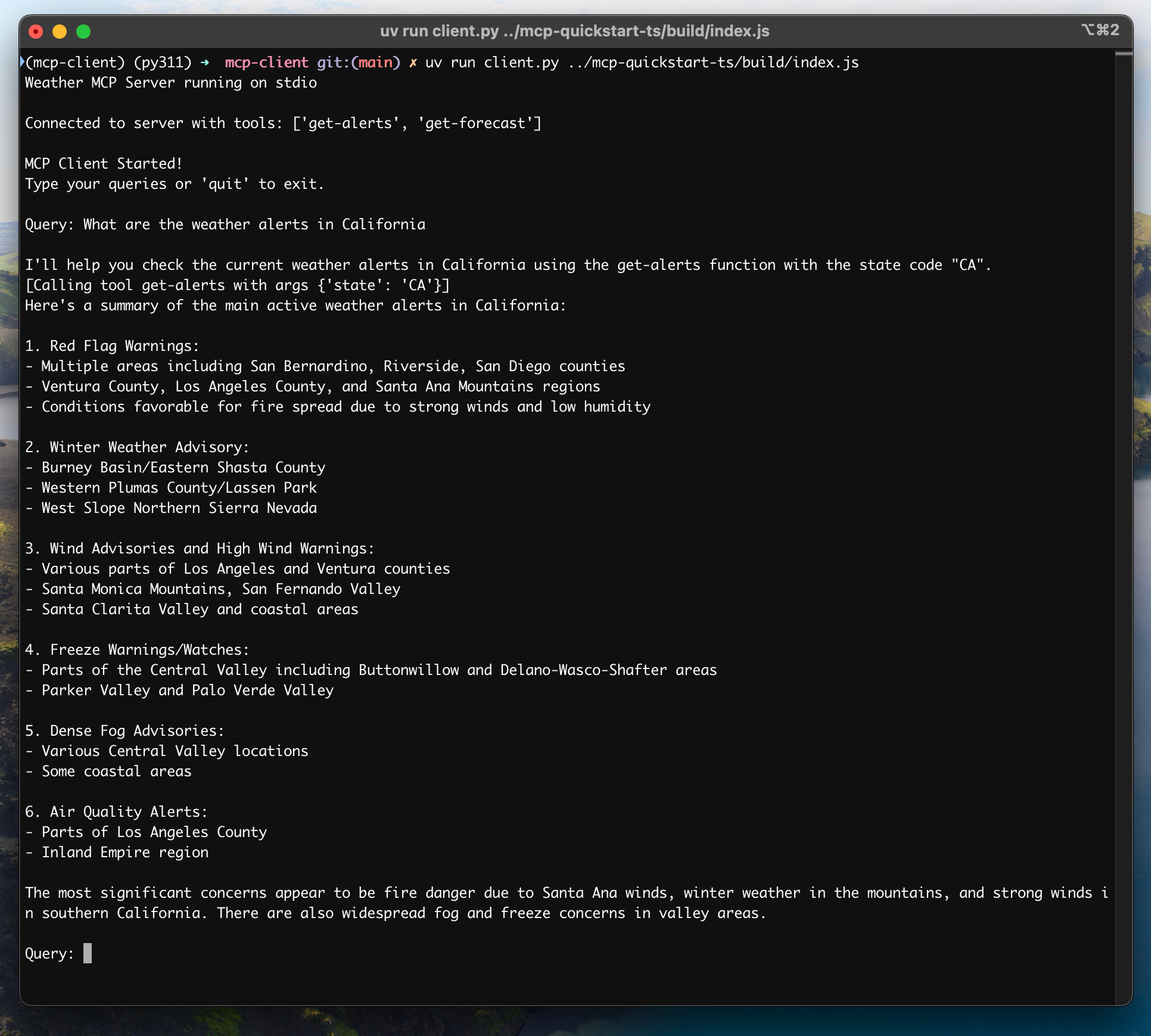 ## How It Works
When you submit a query:
1. The client gets the list of available tools from the server
2. Your query is sent to Claude along with tool descriptions
3. Claude decides which tools (if any) to use
4. The client executes any requested tool calls through the server
5. Results are sent back to Claude
6. Claude provides a natural language response
7. The response is displayed to you
## Best practices
1. **Error Handling**
* Always wrap tool calls in try-catch blocks
* Provide meaningful error messages
* Gracefully handle connection issues
2. **Resource Management**
* Use `AsyncExitStack` for proper cleanup
* Close connections when done
* Handle server disconnections
3. **Security**
* Store API keys securely in `.env`
* Validate server responses
* Be cautious with tool permissions
## Troubleshooting
### Server Path Issues
* Double-check the path to your server script is correct
* Use the absolute path if the relative path isn't working
* For Windows users, make sure to use forward slashes (/) or escaped backslashes (\\) in the path
* Verify the server file has the correct extension (.py for Python or .js for Node.js)
Example of correct path usage:
```bash
# Relative path
uv run client.py ./server/weather.py
# Absolute path
uv run client.py /Users/username/projects/mcp-server/weather.py
# Windows path (either format works)
uv run client.py C:/projects/mcp-server/weather.py
uv run client.py C:\\projects\\mcp-server\\weather.py
```
### Response Timing
* The first response might take up to 30 seconds to return
* This is normal and happens while:
* The server initializes
* Claude processes the query
* Tools are being executed
* Subsequent responses are typically faster
* Don't interrupt the process during this initial waiting period
### Common Error Messages
If you see:
* `FileNotFoundError`: Check your server path
* `Connection refused`: Ensure the server is running and the path is correct
* `Tool execution failed`: Verify the tool's required environment variables are set
* `Timeout error`: Consider increasing the timeout in your client configuration
## How It Works
When you submit a query:
1. The client gets the list of available tools from the server
2. Your query is sent to Claude along with tool descriptions
3. Claude decides which tools (if any) to use
4. The client executes any requested tool calls through the server
5. Results are sent back to Claude
6. Claude provides a natural language response
7. The response is displayed to you
## Best practices
1. **Error Handling**
* Always wrap tool calls in try-catch blocks
* Provide meaningful error messages
* Gracefully handle connection issues
2. **Resource Management**
* Use `AsyncExitStack` for proper cleanup
* Close connections when done
* Handle server disconnections
3. **Security**
* Store API keys securely in `.env`
* Validate server responses
* Be cautious with tool permissions
## Troubleshooting
### Server Path Issues
* Double-check the path to your server script is correct
* Use the absolute path if the relative path isn't working
* For Windows users, make sure to use forward slashes (/) or escaped backslashes (\\) in the path
* Verify the server file has the correct extension (.py for Python or .js for Node.js)
Example of correct path usage:
```bash
# Relative path
uv run client.py ./server/weather.py
# Absolute path
uv run client.py /Users/username/projects/mcp-server/weather.py
# Windows path (either format works)
uv run client.py C:/projects/mcp-server/weather.py
uv run client.py C:\\projects\\mcp-server\\weather.py
```
### Response Timing
* The first response might take up to 30 seconds to return
* This is normal and happens while:
* The server initializes
* Claude processes the query
* Tools are being executed
* Subsequent responses are typically faster
* Don't interrupt the process during this initial waiting period
### Common Error Messages
If you see:
* `FileNotFoundError`: Check your server path
* `Connection refused`: Ensure the server is running and the path is correct
* `Tool execution failed`: Verify the tool's required environment variables are set
* `Timeout error`: Consider increasing the timeout in your client configuration
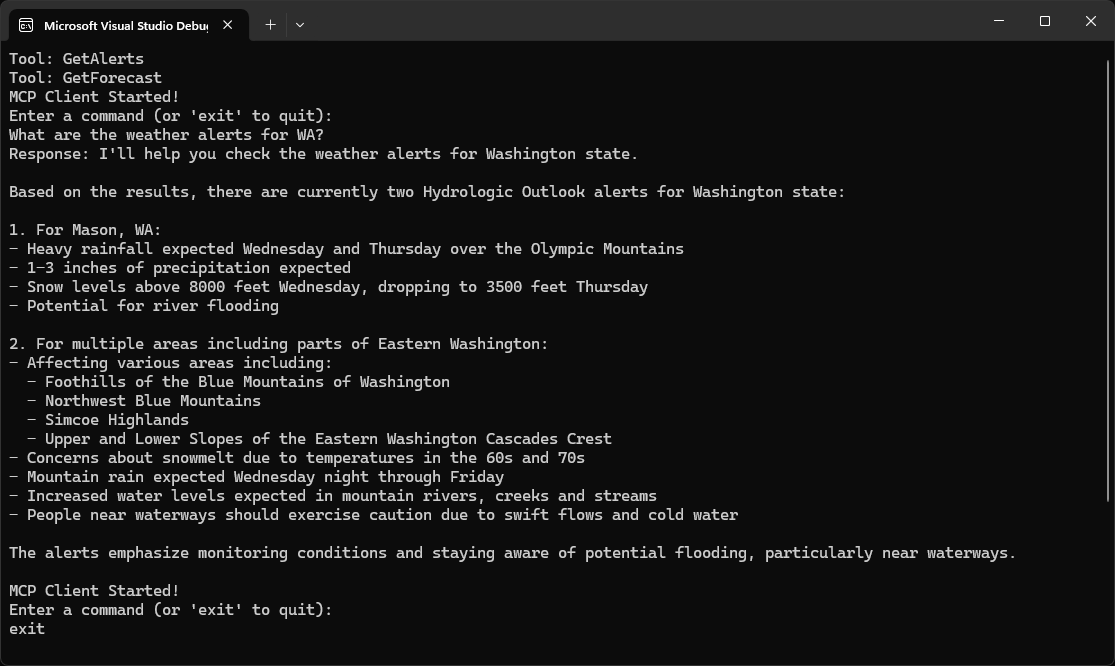
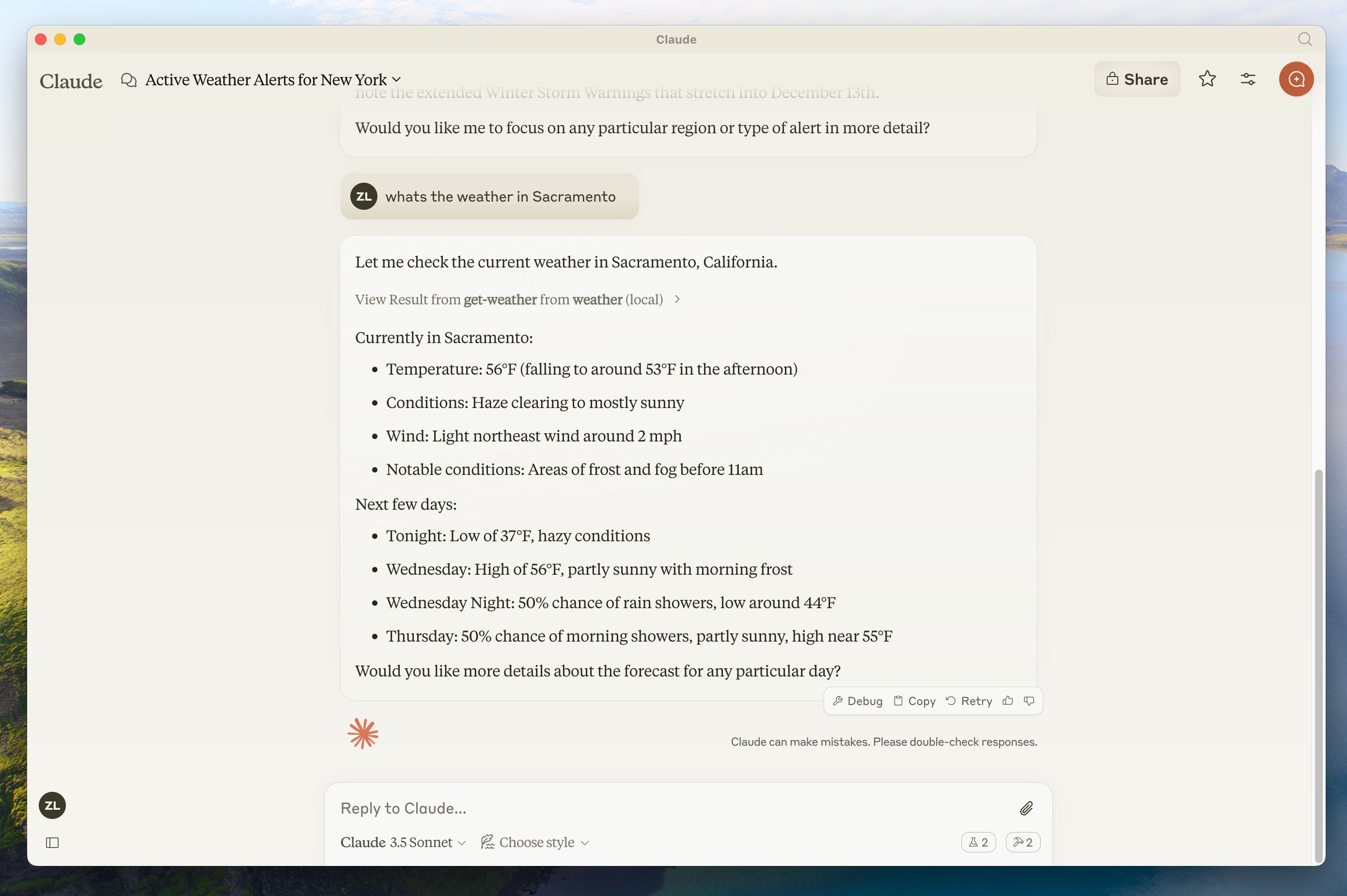
 icon:
icon:
 After clicking on the slider icon, you should see two tools listed:
 If your server isn't being picked up by Claude for Desktop, proceed to the [Troubleshooting](#troubleshooting) section for debugging tips.
If the tool settings icon has shown up, you can now test your server by running the following commands in Claude for Desktop:
* What's the weather in Sacramento?
* What are the active weather alerts in Texas?
If your server isn't being picked up by Claude for Desktop, proceed to the [Troubleshooting](#troubleshooting) section for debugging tips.
If the tool settings icon has shown up, you can now test your server by running the following commands in Claude for Desktop:
* What's the weather in Sacramento?
* What are the active weather alerts in Texas?
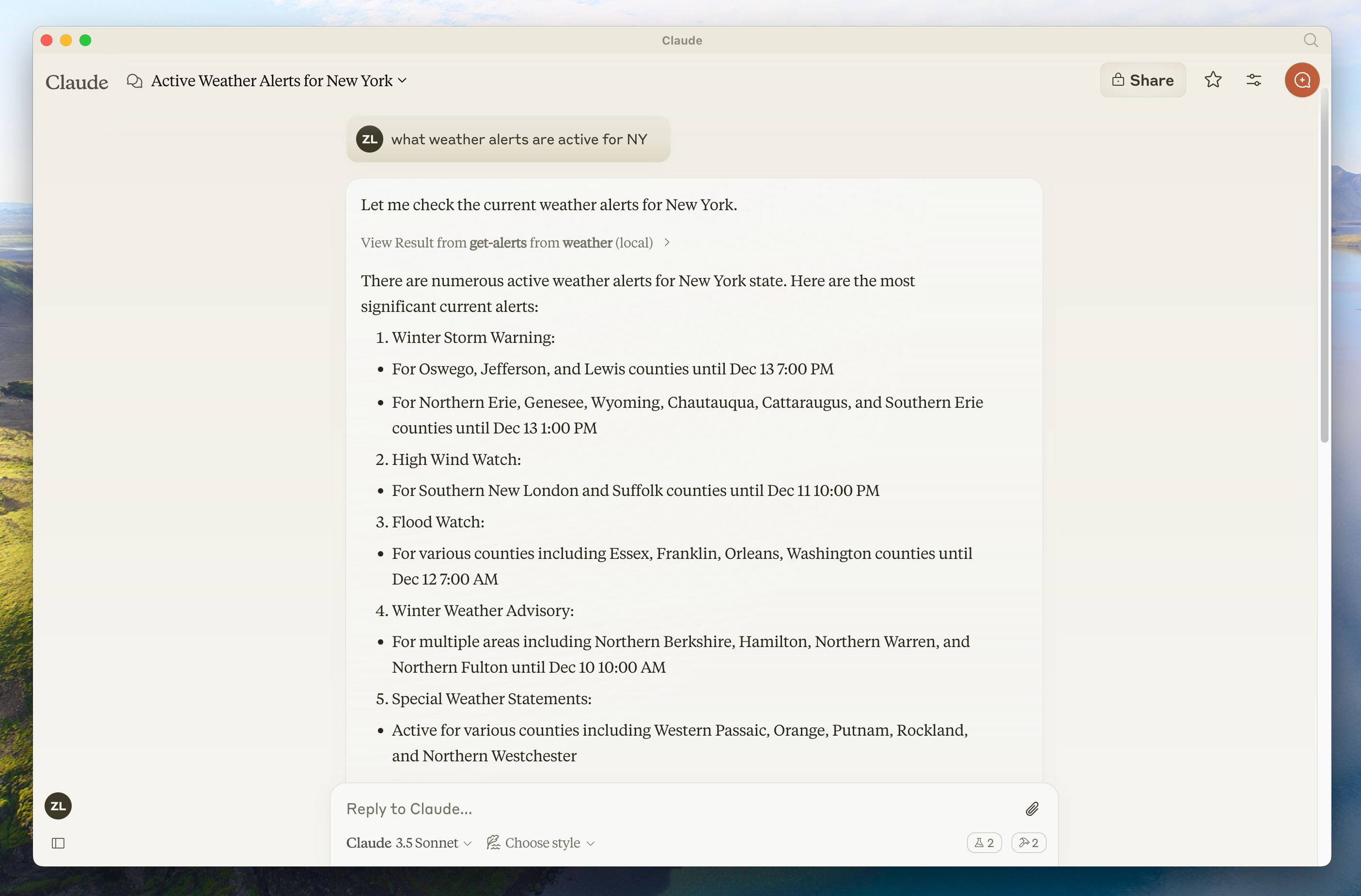
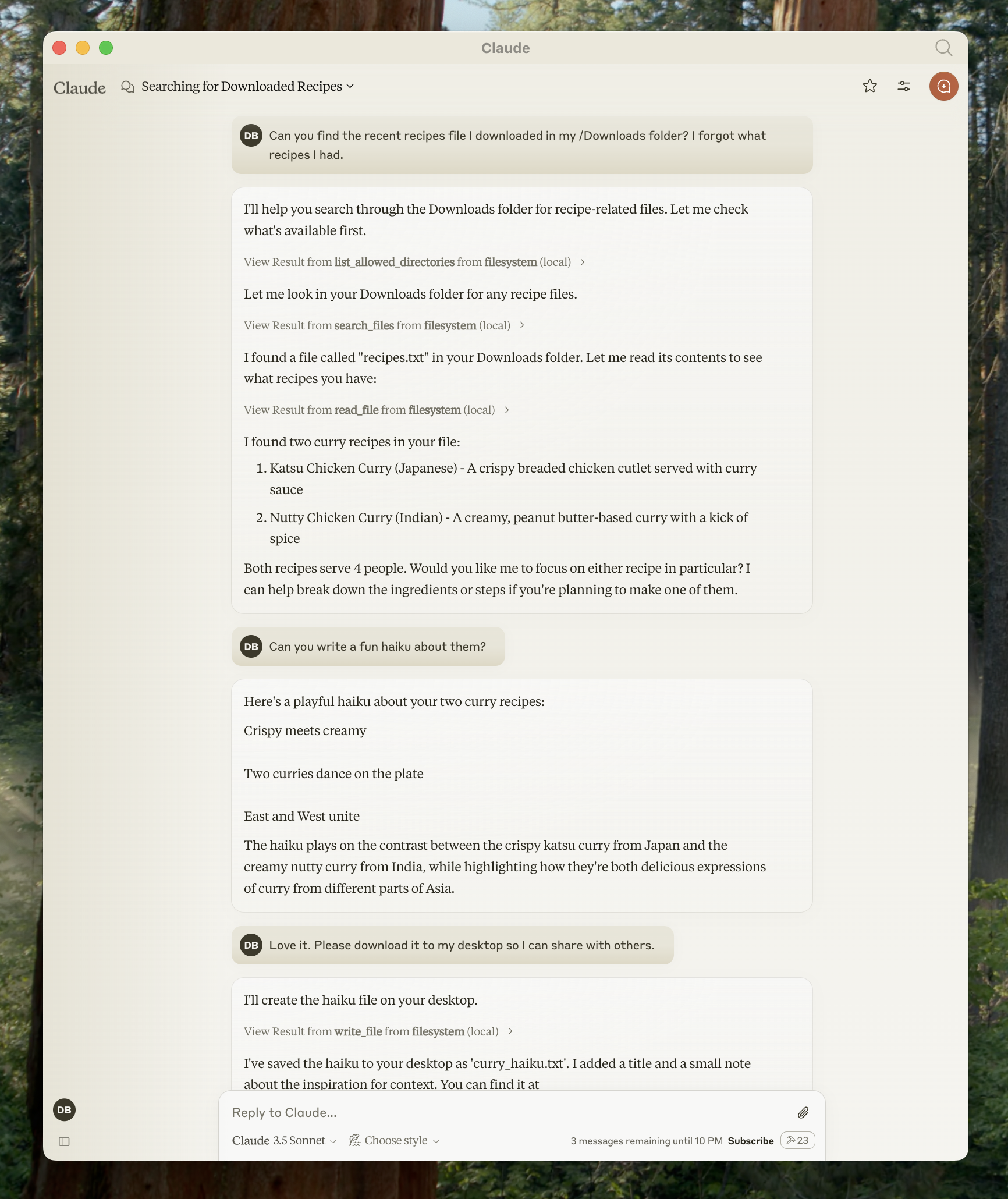 ## Prerequisites
Before starting this tutorial, ensure you have the following installed on your system:
### Claude Desktop
Download and install [Claude Desktop](https://claude.ai/download) for your operating system. Claude Desktop is currently available for macOS and Windows. Linux support is coming soon.
If you already have Claude Desktop installed, verify you're running the latest version by clicking the Claude menu and selecting "Check for Updates..."
### Node.js
The Filesystem Server and many other MCP servers require Node.js to run. Verify your Node.js installation by opening a terminal or command prompt and running:
```bash
node --version
```
If Node.js is not installed, download it from [nodejs.org](https://nodejs.org/). We recommend the LTS (Long Term Support) version for stability.
## Understanding MCP Servers
MCP servers are programs that run on your computer and provide specific capabilities to Claude Desktop through a standardized protocol. Each server exposes tools that Claude can use to perform actions, with your approval. The Filesystem Server we'll install provides tools for:
* Reading file contents and directory structures
* Creating new files and directories
* Moving and renaming files
* Searching for files by name or content
All actions require your explicit approval before execution, ensuring you maintain full control over what Claude can access and modify.
## Installing the Filesystem Server
The process involves configuring Claude Desktop to automatically start the Filesystem Server whenever you launch the application. This configuration is done through a JSON file that tells Claude Desktop which servers to run and how to connect to them.
## Prerequisites
Before starting this tutorial, ensure you have the following installed on your system:
### Claude Desktop
Download and install [Claude Desktop](https://claude.ai/download) for your operating system. Claude Desktop is currently available for macOS and Windows. Linux support is coming soon.
If you already have Claude Desktop installed, verify you're running the latest version by clicking the Claude menu and selecting "Check for Updates..."
### Node.js
The Filesystem Server and many other MCP servers require Node.js to run. Verify your Node.js installation by opening a terminal or command prompt and running:
```bash
node --version
```
If Node.js is not installed, download it from [nodejs.org](https://nodejs.org/). We recommend the LTS (Long Term Support) version for stability.
## Understanding MCP Servers
MCP servers are programs that run on your computer and provide specific capabilities to Claude Desktop through a standardized protocol. Each server exposes tools that Claude can use to perform actions, with your approval. The Filesystem Server we'll install provides tools for:
* Reading file contents and directory structures
* Creating new files and directories
* Moving and renaming files
* Searching for files by name or content
All actions require your explicit approval before execution, ensuring you maintain full control over what Claude can access and modify.
## Installing the Filesystem Server
The process involves configuring Claude Desktop to automatically start the Filesystem Server whenever you launch the application. This configuration is done through a JSON file that tells Claude Desktop which servers to run and how to connect to them.
 This opens the Claude Desktop configuration window, which is separate from your Claude account settings.
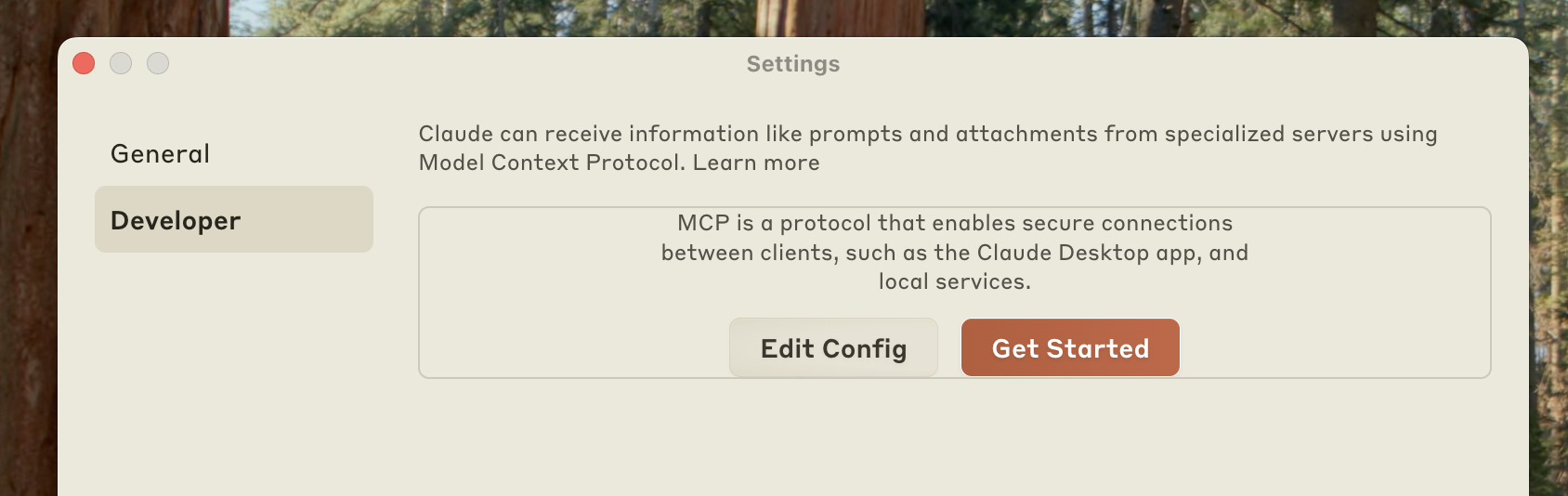 This action creates a new configuration file if one doesn't exist, or opens your existing configuration. The file is located at:
* **macOS**: `~/Library/Application Support/Claude/claude_desktop_config.json`
* **Windows**: `%APPDATA%\Claude\claude_desktop_config.json`
This action creates a new configuration file if one doesn't exist, or opens your existing configuration. The file is located at:
* **macOS**: `~/Library/Application Support/Claude/claude_desktop_config.json`
* **Windows**: `%APPDATA%\Claude\claude_desktop_config.json`
 Click on this indicator to view the available tools provided by the Filesystem Server:
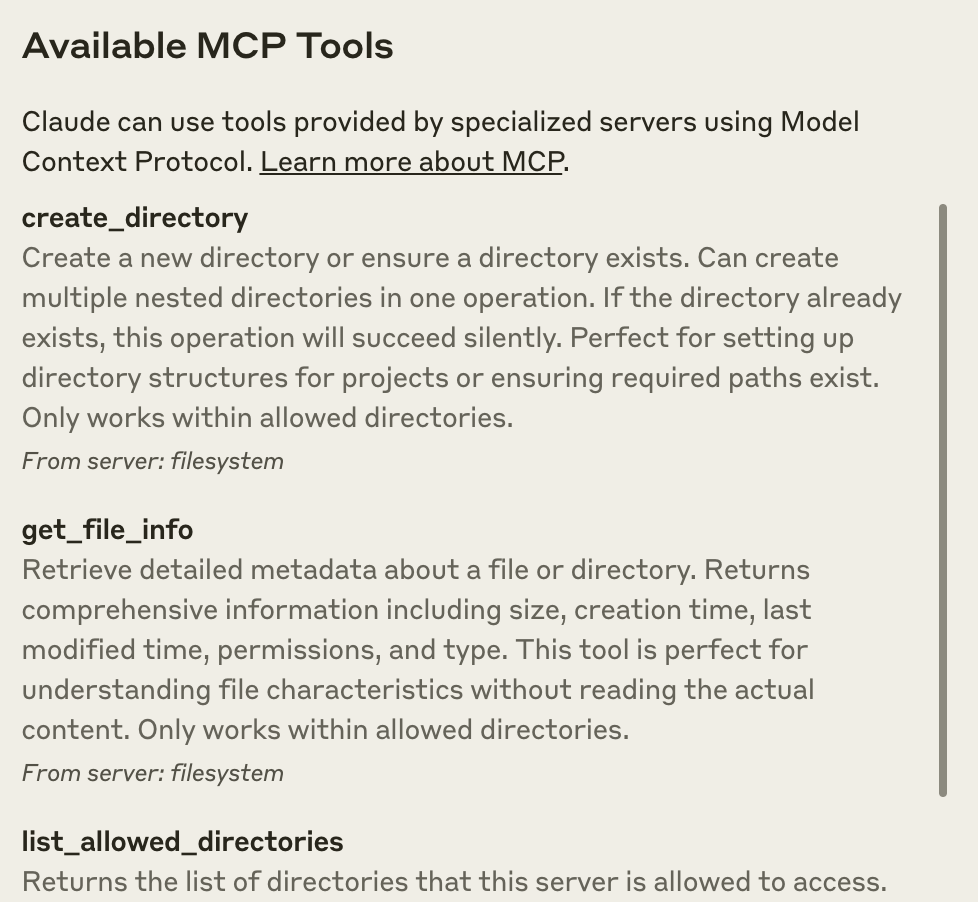 If the server indicator doesn't appear, refer to the [Troubleshooting](#troubleshooting) section for debugging steps.
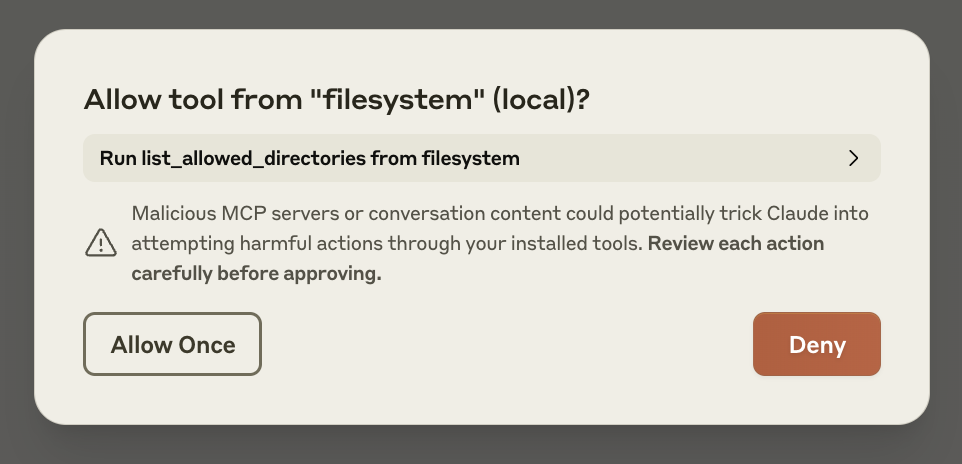 Review each request carefully before approving. You can always deny a request if you're not comfortable with the proposed action.
## Troubleshooting
If you encounter issues setting up or using the Filesystem Server, these solutions address common problems:
Review each request carefully before approving. You can always deny a request if you're not comfortable with the proposed action.
## Troubleshooting
If you encounter issues setting up or using the Filesystem Server, these solutions address common problems:
 A dialog will appear prompting you to enter the remote MCP server URL. This URL should be provided by the server developer or administrator. Enter the complete URL, ensuring it includes the proper protocol (https\://) and any necessary path components.
 After entering the URL, click "Add" to proceed with the connection.
 Follow the authentication prompts provided by the server. This may redirect you to a third-party authentication provider or display a form within Claude. Once authentication is complete, Claude will establish a secure connection to the remote server.
 The menu displays all available resources and prompts from your connected servers. Select the items you want to include in your conversation. These resources provide Claude with context and information from your external tools.
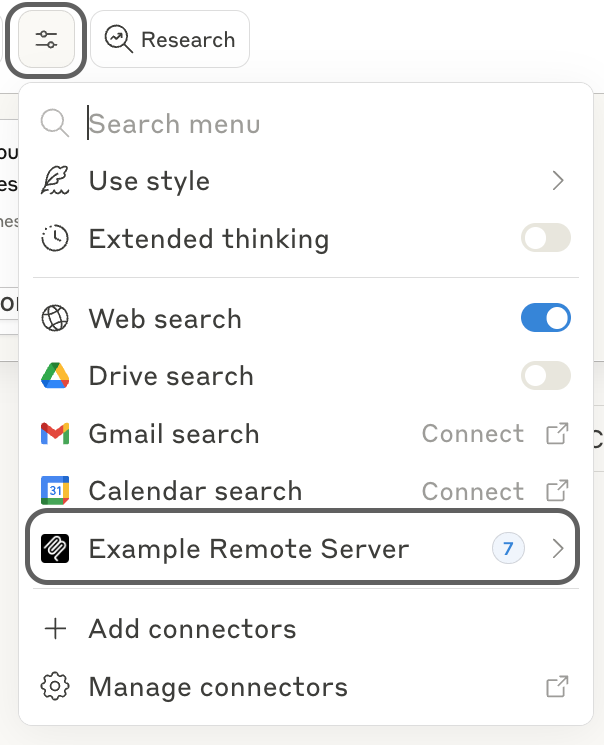 Navigate back to the Connectors settings and click on your connected server. Here you can enable or disable specific tools, set usage limits, and configure other security parameters according to your needs.
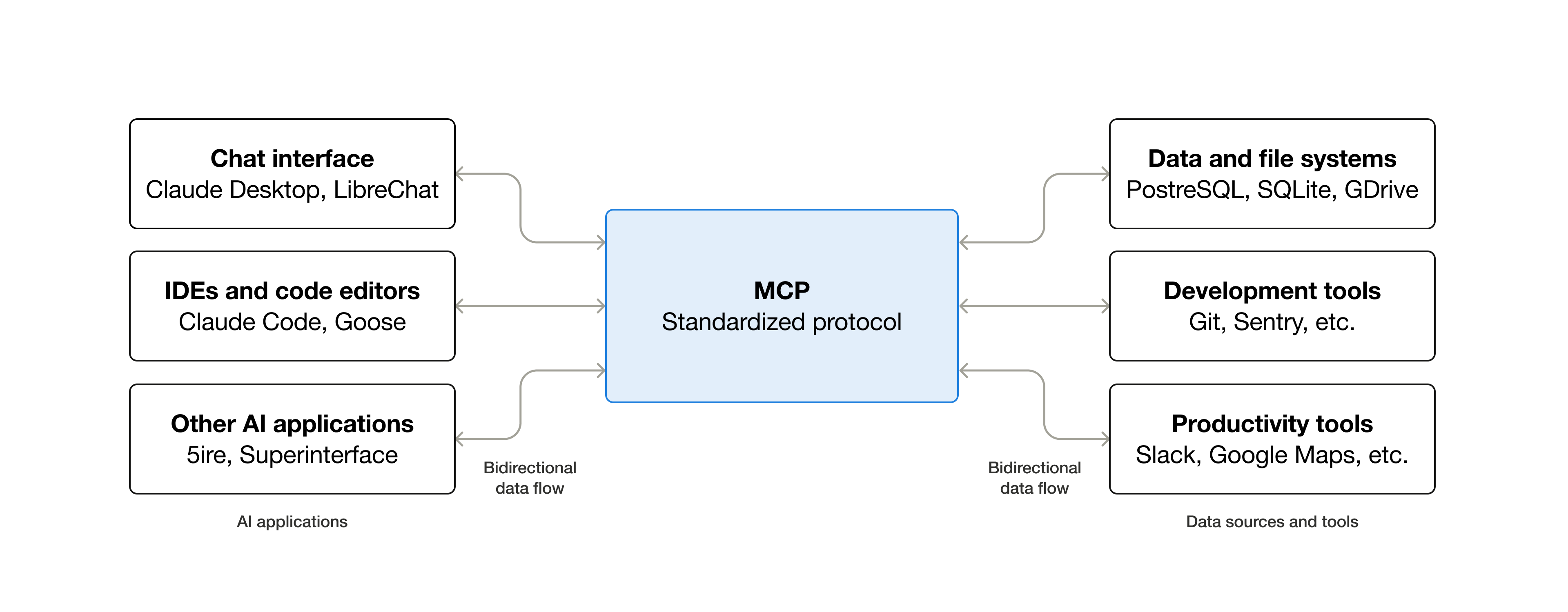 ## What can MCP enable?
* Agents can access your Google Calendar and Notion, acting as a more personalized AI assistant.
* Claude Code can generate an entire web app using a Figma design.
* Enterprise chatbots can connect to multiple databases across an organization, empowering users to analyze data using chat.
* AI models can create 3D designs on Blender and print them out using a 3D printer.
## Why does MCP matter?
Depending on where you sit in the ecosystem, MCP can have a range of benefits.
* **Developers**: MCP reduces development time and complexity when building, or integrating with, an AI application or agent.
* **AI applications or agents**: MCP provides access to an ecosystem of data sources, tools and apps which will enhance capabilities and improve the end-user experience.
* **End-users**: MCP results in more capable AI applications or agents which can access your data and take actions on your behalf when necessary.
## Start Building
## What can MCP enable?
* Agents can access your Google Calendar and Notion, acting as a more personalized AI assistant.
* Claude Code can generate an entire web app using a Figma design.
* Enterprise chatbots can connect to multiple databases across an organization, empowering users to analyze data using chat.
* AI models can create 3D designs on Blender and print them out using a 3D printer.
## Why does MCP matter?
Depending on where you sit in the ecosystem, MCP can have a range of benefits.
* **Developers**: MCP reduces development time and complexity when building, or integrating with, an AI application or agent.
* **AI applications or agents**: MCP provides access to an ecosystem of data sources, tools and apps which will enhance capabilities and improve the end-user experience.
* **End-users**: MCP results in more capable AI applications or agents which can access your data and take actions on your behalf when necessary.
## Start Building
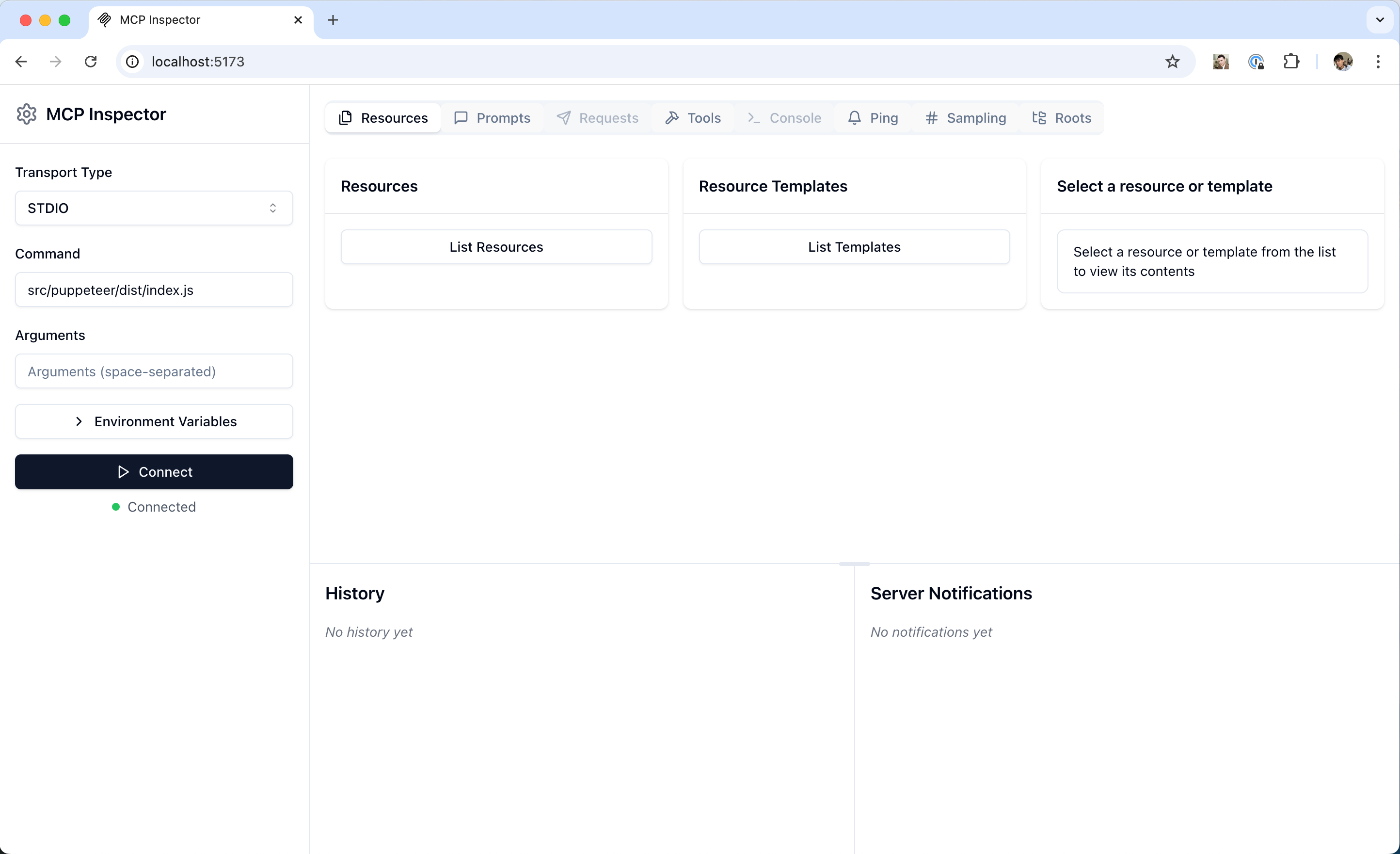 The Inspector provides several features for interacting with your MCP server:
### Server connection pane
* Allows selecting the [transport](/legacy/concepts/transports) for connecting to the server
* For local servers, supports customizing the command-line arguments and environment
### Resources tab
* Lists all available resources
* Shows resource metadata (MIME types, descriptions)
* Allows resource content inspection
* Supports subscription testing
### Prompts tab
* Displays available prompt templates
* Shows prompt arguments and descriptions
* Enables prompt testing with custom arguments
* Previews generated messages
### Tools tab
* Lists available tools
* Shows tool schemas and descriptions
* Enables tool testing with custom inputs
* Displays tool execution results
### Notifications pane
* Presents all logs recorded from the server
* Shows notifications received from the server
## Best practices
### Development workflow
1. Start Development
* Launch Inspector with your server
* Verify basic connectivity
* Check capability negotiation
2. Iterative testing
* Make server changes
* Rebuild the server
* Reconnect the Inspector
* Test affected features
* Monitor messages
3. Test edge cases
* Invalid inputs
* Missing prompt arguments
* Concurrent operations
* Verify error handling and error responses
## Next steps
The Inspector provides several features for interacting with your MCP server:
### Server connection pane
* Allows selecting the [transport](/legacy/concepts/transports) for connecting to the server
* For local servers, supports customizing the command-line arguments and environment
### Resources tab
* Lists all available resources
* Shows resource metadata (MIME types, descriptions)
* Allows resource content inspection
* Supports subscription testing
### Prompts tab
* Displays available prompt templates
* Shows prompt arguments and descriptions
* Enables prompt testing with custom arguments
* Previews generated messages
### Tools tab
* Lists available tools
* Shows tool schemas and descriptions
* Enables tool testing with custom inputs
* Displays tool execution results
### Notifications pane
* Presents all logs recorded from the server
* Shows notifications received from the server
## Best practices
### Development workflow
1. Start Development
* Launch Inspector with your server
* Verify basic connectivity
* Check capability negotiation
2. Iterative testing
* Make server changes
* Rebuild the server
* Reconnect the Inspector
* Test affected features
* Monitor messages
3. Test edge cases
* Invalid inputs
* Missing prompt arguments
* Concurrent operations
* Verify error handling and error responses
## Next steps
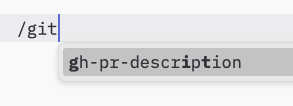 However, implementors are free to expose prompts through any interface pattern that suits
their needs—the protocol itself does not mandate any specific user interaction
model.
## Capabilities
Servers that support prompts **MUST** declare the `prompts` capability during
[initialization](/specification/2025-06-18/basic/lifecycle#initialization):
```json
{
"capabilities": {
"prompts": {
"listChanged": true
}
}
}
```
`listChanged` indicates whether the server will emit notifications when the list of
available prompts changes.
## Protocol Messages
### Listing Prompts
To retrieve available prompts, clients send a `prompts/list` request. This operation
supports [pagination](/specification/2025-06-18/server/utilities/pagination).
**Request:**
```json
{
"jsonrpc": "2.0",
"id": 1,
"method": "prompts/list",
"params": {
"cursor": "optional-cursor-value"
}
}
```
**Response:**
```json
{
"jsonrpc": "2.0",
"id": 1,
"result": {
"prompts": [
{
"name": "code_review",
"title": "Request Code Review",
"description": "Asks the LLM to analyze code quality and suggest improvements",
"arguments": [
{
"name": "code",
"description": "The code to review",
"required": true
}
]
}
],
"nextCursor": "next-page-cursor"
}
}
```
### Getting a Prompt
To retrieve a specific prompt, clients send a `prompts/get` request. Arguments may be
auto-completed through [the completion API](/specification/2025-06-18/server/utilities/completion).
**Request:**
```json
{
"jsonrpc": "2.0",
"id": 2,
"method": "prompts/get",
"params": {
"name": "code_review",
"arguments": {
"code": "def hello():\n print('world')"
}
}
}
```
**Response:**
```json
{
"jsonrpc": "2.0",
"id": 2,
"result": {
"description": "Code review prompt",
"messages": [
{
"role": "user",
"content": {
"type": "text",
"text": "Please review this Python code:\ndef hello():\n print('world')"
}
}
]
}
}
```
### List Changed Notification
When the list of available prompts changes, servers that declared the `listChanged`
capability **SHOULD** send a notification:
```json
{
"jsonrpc": "2.0",
"method": "notifications/prompts/list_changed"
}
```
## Message Flow
```mermaid
sequenceDiagram
participant Client
participant Server
Note over Client,Server: Discovery
Client->>Server: prompts/list
Server-->>Client: List of prompts
Note over Client,Server: Usage
Client->>Server: prompts/get
Server-->>Client: Prompt content
opt listChanged
Note over Client,Server: Changes
Server--)Client: prompts/list_changed
Client->>Server: prompts/list
Server-->>Client: Updated prompts
end
```
## Data Types
### Prompt
A prompt definition includes:
* `name`: Unique identifier for the prompt
* `title`: Optional human-readable name of the prompt for display purposes.
* `description`: Optional human-readable description
* `arguments`: Optional list of arguments for customization
### PromptMessage
Messages in a prompt can contain:
* `role`: Either "user" or "assistant" to indicate the speaker
* `content`: One of the following content types:
However, implementors are free to expose prompts through any interface pattern that suits
their needs—the protocol itself does not mandate any specific user interaction
model.
## Capabilities
Servers that support prompts **MUST** declare the `prompts` capability during
[initialization](/specification/2025-06-18/basic/lifecycle#initialization):
```json
{
"capabilities": {
"prompts": {
"listChanged": true
}
}
}
```
`listChanged` indicates whether the server will emit notifications when the list of
available prompts changes.
## Protocol Messages
### Listing Prompts
To retrieve available prompts, clients send a `prompts/list` request. This operation
supports [pagination](/specification/2025-06-18/server/utilities/pagination).
**Request:**
```json
{
"jsonrpc": "2.0",
"id": 1,
"method": "prompts/list",
"params": {
"cursor": "optional-cursor-value"
}
}
```
**Response:**
```json
{
"jsonrpc": "2.0",
"id": 1,
"result": {
"prompts": [
{
"name": "code_review",
"title": "Request Code Review",
"description": "Asks the LLM to analyze code quality and suggest improvements",
"arguments": [
{
"name": "code",
"description": "The code to review",
"required": true
}
]
}
],
"nextCursor": "next-page-cursor"
}
}
```
### Getting a Prompt
To retrieve a specific prompt, clients send a `prompts/get` request. Arguments may be
auto-completed through [the completion API](/specification/2025-06-18/server/utilities/completion).
**Request:**
```json
{
"jsonrpc": "2.0",
"id": 2,
"method": "prompts/get",
"params": {
"name": "code_review",
"arguments": {
"code": "def hello():\n print('world')"
}
}
}
```
**Response:**
```json
{
"jsonrpc": "2.0",
"id": 2,
"result": {
"description": "Code review prompt",
"messages": [
{
"role": "user",
"content": {
"type": "text",
"text": "Please review this Python code:\ndef hello():\n print('world')"
}
}
]
}
}
```
### List Changed Notification
When the list of available prompts changes, servers that declared the `listChanged`
capability **SHOULD** send a notification:
```json
{
"jsonrpc": "2.0",
"method": "notifications/prompts/list_changed"
}
```
## Message Flow
```mermaid
sequenceDiagram
participant Client
participant Server
Note over Client,Server: Discovery
Client->>Server: prompts/list
Server-->>Client: List of prompts
Note over Client,Server: Usage
Client->>Server: prompts/get
Server-->>Client: Prompt content
opt listChanged
Note over Client,Server: Changes
Server--)Client: prompts/list_changed
Client->>Server: prompts/list
Server-->>Client: Updated prompts
end
```
## Data Types
### Prompt
A prompt definition includes:
* `name`: Unique identifier for the prompt
* `title`: Optional human-readable name of the prompt for display purposes.
* `description`: Optional human-readable description
* `arguments`: Optional list of arguments for customization
### PromptMessage
Messages in a prompt can contain:
* `role`: Either "user" or "assistant" to indicate the speaker
* `content`: One of the following content types:
 However, implementations are free to expose resources through any interface pattern that
suits their needs—the protocol itself does not mandate any specific user
interaction model.
## Capabilities
Servers that support resources **MUST** declare the `resources` capability:
```json
{
"capabilities": {
"resources": {
"subscribe": true,
"listChanged": true
}
}
}
```
The capability supports two optional features:
* `subscribe`: whether the client can subscribe to be notified of changes to individual
resources.
* `listChanged`: whether the server will emit notifications when the list of available
resources changes.
Both `subscribe` and `listChanged` are optional—servers can support neither,
either, or both:
```json
{
"capabilities": {
"resources": {} // Neither feature supported
}
}
```
```json
{
"capabilities": {
"resources": {
"subscribe": true // Only subscriptions supported
}
}
}
```
```json
{
"capabilities": {
"resources": {
"listChanged": true // Only list change notifications supported
}
}
}
```
## Protocol Messages
### Listing Resources
To discover available resources, clients send a `resources/list` request. This operation
supports [pagination](/specification/2025-06-18/server/utilities/pagination).
**Request:**
```json
{
"jsonrpc": "2.0",
"id": 1,
"method": "resources/list",
"params": {
"cursor": "optional-cursor-value"
}
}
```
**Response:**
```json
{
"jsonrpc": "2.0",
"id": 1,
"result": {
"resources": [
{
"uri": "file:///project/src/main.rs",
"name": "main.rs",
"title": "Rust Software Application Main File",
"description": "Primary application entry point",
"mimeType": "text/x-rust"
}
],
"nextCursor": "next-page-cursor"
}
}
```
### Reading Resources
To retrieve resource contents, clients send a `resources/read` request:
**Request:**
```json
{
"jsonrpc": "2.0",
"id": 2,
"method": "resources/read",
"params": {
"uri": "file:///project/src/main.rs"
}
}
```
**Response:**
```json
{
"jsonrpc": "2.0",
"id": 2,
"result": {
"contents": [
{
"uri": "file:///project/src/main.rs",
"name": "main.rs",
"title": "Rust Software Application Main File",
"mimeType": "text/x-rust",
"text": "fn main() {\n println!(\"Hello world!\");\n}"
}
]
}
}
```
### Resource Templates
Resource templates allow servers to expose parameterized resources using
[URI templates](https://datatracker.ietf.org/doc/html/rfc6570). Arguments may be
auto-completed through [the completion API](/specification/2025-06-18/server/utilities/completion).
**Request:**
```json
{
"jsonrpc": "2.0",
"id": 3,
"method": "resources/templates/list"
}
```
**Response:**
```json
{
"jsonrpc": "2.0",
"id": 3,
"result": {
"resourceTemplates": [
{
"uriTemplate": "file:///{path}",
"name": "Project Files",
"title": "📁 Project Files",
"description": "Access files in the project directory",
"mimeType": "application/octet-stream"
}
]
}
}
```
### List Changed Notification
When the list of available resources changes, servers that declared the `listChanged`
capability **SHOULD** send a notification:
```json
{
"jsonrpc": "2.0",
"method": "notifications/resources/list_changed"
}
```
### Subscriptions
The protocol supports optional subscriptions to resource changes. Clients can subscribe
to specific resources and receive notifications when they change:
**Subscribe Request:**
```json
{
"jsonrpc": "2.0",
"id": 4,
"method": "resources/subscribe",
"params": {
"uri": "file:///project/src/main.rs"
}
}
```
**Update Notification:**
```json
{
"jsonrpc": "2.0",
"method": "notifications/resources/updated",
"params": {
"uri": "file:///project/src/main.rs",
"title": "Rust Software Application Main File"
}
}
```
## Message Flow
```mermaid
sequenceDiagram
participant Client
participant Server
Note over Client,Server: Resource Discovery
Client->>Server: resources/list
Server-->>Client: List of resources
Note over Client,Server: Resource Access
Client->>Server: resources/read
Server-->>Client: Resource contents
Note over Client,Server: Subscriptions
Client->>Server: resources/subscribe
Server-->>Client: Subscription confirmed
Note over Client,Server: Updates
Server--)Client: notifications/resources/updated
Client->>Server: resources/read
Server-->>Client: Updated contents
```
## Data Types
### Resource
A resource definition includes:
* `uri`: Unique identifier for the resource
* `name`: The name of the resource.
* `title`: Optional human-readable name of the resource for display purposes.
* `description`: Optional description
* `mimeType`: Optional MIME type
* `size`: Optional size in bytes
### Resource Contents
Resources can contain either text or binary data:
#### Text Content
```json
{
"uri": "file:///example.txt",
"name": "example.txt",
"title": "Example Text File",
"mimeType": "text/plain",
"text": "Resource content"
}
```
#### Binary Content
```json
{
"uri": "file:///example.png",
"name": "example.png",
"title": "Example Image",
"mimeType": "image/png",
"blob": "base64-encoded-data"
}
```
### Annotations
Resources, resource templates and content blocks support optional annotations that provide hints to clients about how to use or display the resource:
* **`audience`**: An array indicating the intended audience(s) for this resource. Valid values are `"user"` and `"assistant"`. For example, `["user", "assistant"]` indicates content useful for both.
* **`priority`**: A number from 0.0 to 1.0 indicating the importance of this resource. A value of 1 means "most important" (effectively required), while 0 means "least important" (entirely optional).
* **`lastModified`**: An ISO 8601 formatted timestamp indicating when the resource was last modified (e.g., `"2025-01-12T15:00:58Z"`).
Example resource with annotations:
```json
{
"uri": "file:///project/README.md",
"name": "README.md",
"title": "Project Documentation",
"mimeType": "text/markdown",
"annotations": {
"audience": ["user"],
"priority": 0.8,
"lastModified": "2025-01-12T15:00:58Z"
}
}
```
Clients can use these annotations to:
* Filter resources based on their intended audience
* Prioritize which resources to include in context
* Display modification times or sort by recency
## Common URI Schemes
The protocol defines several standard URI schemes. This list not
exhaustive—implementations are always free to use additional, custom URI schemes.
### https\://
Used to represent a resource available on the web.
Servers **SHOULD** use this scheme only when the client is able to fetch and load the
resource directly from the web on its own—that is, it doesn’t need to read the resource
via the MCP server.
For other use cases, servers **SHOULD** prefer to use another URI scheme, or define a
custom one, even if the server will itself be downloading resource contents over the
internet.
### file://
Used to identify resources that behave like a filesystem. However, the resources do not
need to map to an actual physical filesystem.
MCP servers **MAY** identify file:// resources with an
[XDG MIME type](https://specifications.freedesktop.org/shared-mime-info-spec/0.14/ar01s02.html#id-1.3.14),
like `inode/directory`, to represent non-regular files (such as directories) that don’t
otherwise have a standard MIME type.
### git://
Git version control integration.
### Custom URI Schemes
Custom URI schemes **MUST** be in accordance with [RFC3986](https://datatracker.ietf.org/doc/html/rfc3986),
taking the above guidance in to account.
## Error Handling
Servers **SHOULD** return standard JSON-RPC errors for common failure cases:
* Resource not found: `-32002`
* Internal errors: `-32603`
Example error:
```json
{
"jsonrpc": "2.0",
"id": 5,
"error": {
"code": -32002,
"message": "Resource not found",
"data": {
"uri": "file:///nonexistent.txt"
}
}
}
```
## Security Considerations
1. Servers **MUST** validate all resource URIs
2. Access controls **SHOULD** be implemented for sensitive resources
3. Binary data **MUST** be properly encoded
4. Resource permissions **SHOULD** be checked before operations
# Tools
Source: https://modelcontextprotocol.io/specification/2025-06-18/server/tools
However, implementations are free to expose resources through any interface pattern that
suits their needs—the protocol itself does not mandate any specific user
interaction model.
## Capabilities
Servers that support resources **MUST** declare the `resources` capability:
```json
{
"capabilities": {
"resources": {
"subscribe": true,
"listChanged": true
}
}
}
```
The capability supports two optional features:
* `subscribe`: whether the client can subscribe to be notified of changes to individual
resources.
* `listChanged`: whether the server will emit notifications when the list of available
resources changes.
Both `subscribe` and `listChanged` are optional—servers can support neither,
either, or both:
```json
{
"capabilities": {
"resources": {} // Neither feature supported
}
}
```
```json
{
"capabilities": {
"resources": {
"subscribe": true // Only subscriptions supported
}
}
}
```
```json
{
"capabilities": {
"resources": {
"listChanged": true // Only list change notifications supported
}
}
}
```
## Protocol Messages
### Listing Resources
To discover available resources, clients send a `resources/list` request. This operation
supports [pagination](/specification/2025-06-18/server/utilities/pagination).
**Request:**
```json
{
"jsonrpc": "2.0",
"id": 1,
"method": "resources/list",
"params": {
"cursor": "optional-cursor-value"
}
}
```
**Response:**
```json
{
"jsonrpc": "2.0",
"id": 1,
"result": {
"resources": [
{
"uri": "file:///project/src/main.rs",
"name": "main.rs",
"title": "Rust Software Application Main File",
"description": "Primary application entry point",
"mimeType": "text/x-rust"
}
],
"nextCursor": "next-page-cursor"
}
}
```
### Reading Resources
To retrieve resource contents, clients send a `resources/read` request:
**Request:**
```json
{
"jsonrpc": "2.0",
"id": 2,
"method": "resources/read",
"params": {
"uri": "file:///project/src/main.rs"
}
}
```
**Response:**
```json
{
"jsonrpc": "2.0",
"id": 2,
"result": {
"contents": [
{
"uri": "file:///project/src/main.rs",
"name": "main.rs",
"title": "Rust Software Application Main File",
"mimeType": "text/x-rust",
"text": "fn main() {\n println!(\"Hello world!\");\n}"
}
]
}
}
```
### Resource Templates
Resource templates allow servers to expose parameterized resources using
[URI templates](https://datatracker.ietf.org/doc/html/rfc6570). Arguments may be
auto-completed through [the completion API](/specification/2025-06-18/server/utilities/completion).
**Request:**
```json
{
"jsonrpc": "2.0",
"id": 3,
"method": "resources/templates/list"
}
```
**Response:**
```json
{
"jsonrpc": "2.0",
"id": 3,
"result": {
"resourceTemplates": [
{
"uriTemplate": "file:///{path}",
"name": "Project Files",
"title": "📁 Project Files",
"description": "Access files in the project directory",
"mimeType": "application/octet-stream"
}
]
}
}
```
### List Changed Notification
When the list of available resources changes, servers that declared the `listChanged`
capability **SHOULD** send a notification:
```json
{
"jsonrpc": "2.0",
"method": "notifications/resources/list_changed"
}
```
### Subscriptions
The protocol supports optional subscriptions to resource changes. Clients can subscribe
to specific resources and receive notifications when they change:
**Subscribe Request:**
```json
{
"jsonrpc": "2.0",
"id": 4,
"method": "resources/subscribe",
"params": {
"uri": "file:///project/src/main.rs"
}
}
```
**Update Notification:**
```json
{
"jsonrpc": "2.0",
"method": "notifications/resources/updated",
"params": {
"uri": "file:///project/src/main.rs",
"title": "Rust Software Application Main File"
}
}
```
## Message Flow
```mermaid
sequenceDiagram
participant Client
participant Server
Note over Client,Server: Resource Discovery
Client->>Server: resources/list
Server-->>Client: List of resources
Note over Client,Server: Resource Access
Client->>Server: resources/read
Server-->>Client: Resource contents
Note over Client,Server: Subscriptions
Client->>Server: resources/subscribe
Server-->>Client: Subscription confirmed
Note over Client,Server: Updates
Server--)Client: notifications/resources/updated
Client->>Server: resources/read
Server-->>Client: Updated contents
```
## Data Types
### Resource
A resource definition includes:
* `uri`: Unique identifier for the resource
* `name`: The name of the resource.
* `title`: Optional human-readable name of the resource for display purposes.
* `description`: Optional description
* `mimeType`: Optional MIME type
* `size`: Optional size in bytes
### Resource Contents
Resources can contain either text or binary data:
#### Text Content
```json
{
"uri": "file:///example.txt",
"name": "example.txt",
"title": "Example Text File",
"mimeType": "text/plain",
"text": "Resource content"
}
```
#### Binary Content
```json
{
"uri": "file:///example.png",
"name": "example.png",
"title": "Example Image",
"mimeType": "image/png",
"blob": "base64-encoded-data"
}
```
### Annotations
Resources, resource templates and content blocks support optional annotations that provide hints to clients about how to use or display the resource:
* **`audience`**: An array indicating the intended audience(s) for this resource. Valid values are `"user"` and `"assistant"`. For example, `["user", "assistant"]` indicates content useful for both.
* **`priority`**: A number from 0.0 to 1.0 indicating the importance of this resource. A value of 1 means "most important" (effectively required), while 0 means "least important" (entirely optional).
* **`lastModified`**: An ISO 8601 formatted timestamp indicating when the resource was last modified (e.g., `"2025-01-12T15:00:58Z"`).
Example resource with annotations:
```json
{
"uri": "file:///project/README.md",
"name": "README.md",
"title": "Project Documentation",
"mimeType": "text/markdown",
"annotations": {
"audience": ["user"],
"priority": 0.8,
"lastModified": "2025-01-12T15:00:58Z"
}
}
```
Clients can use these annotations to:
* Filter resources based on their intended audience
* Prioritize which resources to include in context
* Display modification times or sort by recency
## Common URI Schemes
The protocol defines several standard URI schemes. This list not
exhaustive—implementations are always free to use additional, custom URI schemes.
### https\://
Used to represent a resource available on the web.
Servers **SHOULD** use this scheme only when the client is able to fetch and load the
resource directly from the web on its own—that is, it doesn’t need to read the resource
via the MCP server.
For other use cases, servers **SHOULD** prefer to use another URI scheme, or define a
custom one, even if the server will itself be downloading resource contents over the
internet.
### file://
Used to identify resources that behave like a filesystem. However, the resources do not
need to map to an actual physical filesystem.
MCP servers **MAY** identify file:// resources with an
[XDG MIME type](https://specifications.freedesktop.org/shared-mime-info-spec/0.14/ar01s02.html#id-1.3.14),
like `inode/directory`, to represent non-regular files (such as directories) that don’t
otherwise have a standard MIME type.
### git://
Git version control integration.
### Custom URI Schemes
Custom URI schemes **MUST** be in accordance with [RFC3986](https://datatracker.ietf.org/doc/html/rfc3986),
taking the above guidance in to account.
## Error Handling
Servers **SHOULD** return standard JSON-RPC errors for common failure cases:
* Resource not found: `-32002`
* Internal errors: `-32603`
Example error:
```json
{
"jsonrpc": "2.0",
"id": 5,
"error": {
"code": -32002,
"message": "Resource not found",
"data": {
"uri": "file:///nonexistent.txt"
}
}
}
```
## Security Considerations
1. Servers **MUST** validate all resource URIs
2. Access controls **SHOULD** be implemented for sensitive resources
3. Binary data **MUST** be properly encoded
4. Resource permissions **SHOULD** be checked before operations
# Tools
Source: https://modelcontextprotocol.io/specification/2025-06-18/server/tools
Optional annotations for the client. The client can use annotations to inform how objects are used or displayed